Order Ahead App for Tea and Coffee Shops: What Real Ordering Data Shows About Repeat Customers

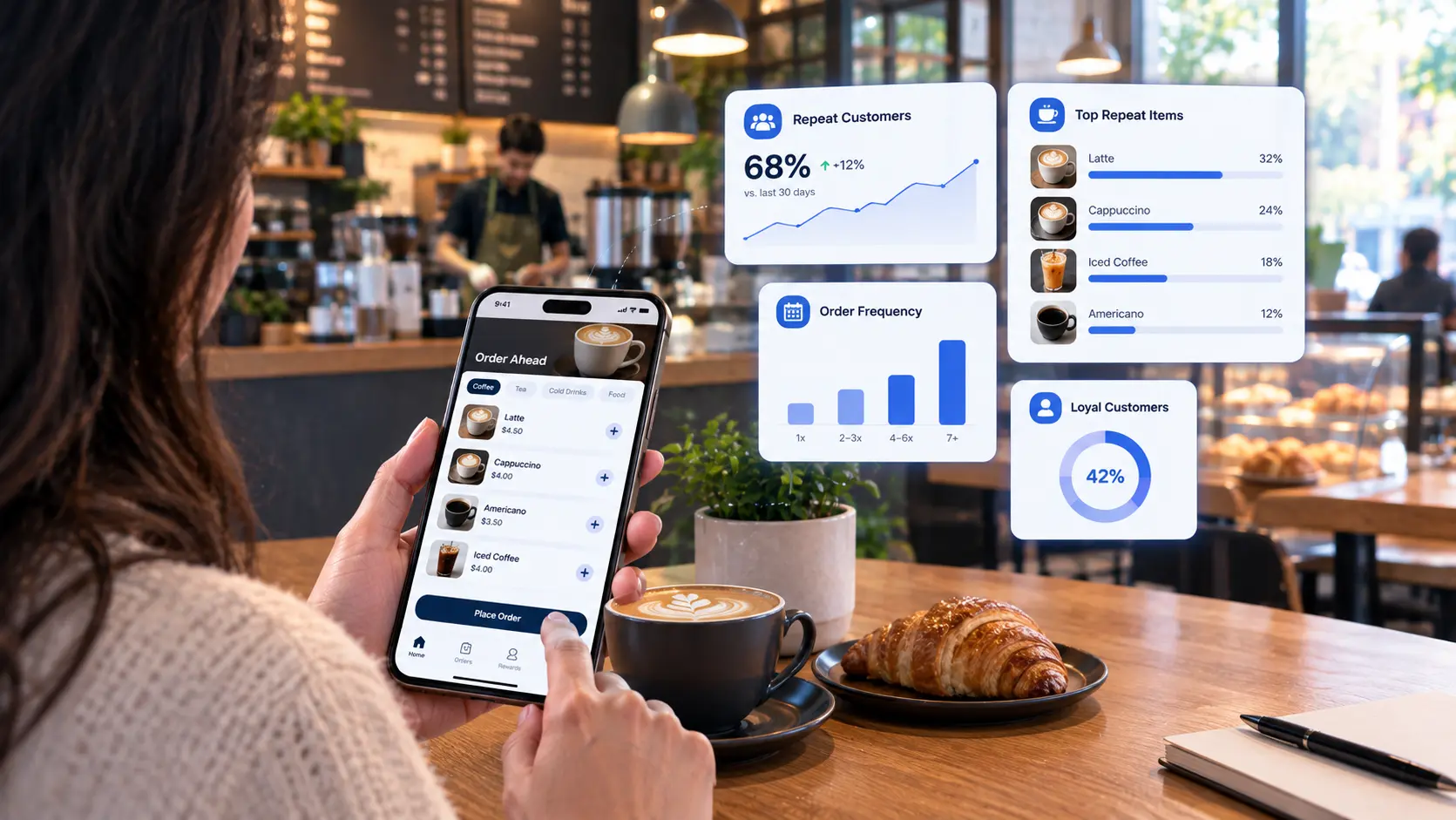
Discover how order-ahead apps help tea and coffee shops understand repeat customer behavior, track ordering patterns, improve retention, and turn real ordering data into smarter decisions.
Here is a hypothetical example. A busy tea shop has a line out the door every weekday at noon. Some customers wait ten minutes for a drink. Others look at the line, check the time, and walk to the café next door. The owner knows the lunch rush is the best hour of the day, yet the counter can only move as fast as one person taking orders.
An order ahead app fixes that bottleneck. Customers browse the menu, pay on their phone, and pick up a ready drink without joining the line. This guide covers what a strong app needs, how loyalty fits in, and what real ordering data from a specialty tea retailer reveals about repeat customers.
Why the Counter Line Limits Growth
A physical counter creates three problems that no amount of staff training fully solves:
• Throughput has a ceiling. Counter ordering caps sales at however fast a single line can move, which matters most at peak hours.
• Walk-aways are invisible. A customer who leaves the line never shows up in any report, so lost sales go unmeasured.
• Regulars get no recognition. Without a digital touchpoint, a returning customer has no built-in reason to choose the same shop over the one next door.
A mobile ordering app for coffee shops and tea shops removes the line from the equation and turns each order into data the business can use.
What an Order Ahead App Should Include
The best apps keep the path from opening the app to paying as short as possible. Six features matter most.
1. A Full, Easy-to-Browse Menu
The menu should cover every category, from classic drinks to specialty items, food, and merchandise. Clear photos, customization options, and saved favorites speed up repeat orders.
2. Mobile Order and Pay
Mobile order and pay lets customers add items to a cart, pay inside the app, and arrive to a ready order. Payment inside the app is the step that removes the wait at the counter.
3. Fast, Secure Sign-In
Face ID or fingerprint sign-in removes the password step for returning customers. Every second saved at sign-in makes reordering feel effortless.
4. A Digital Loyalty Card
A digital loyalty card carries each customer's status and rewards across every order. It replaces paper punch cards that get lost and gives the business a clear record of who comes back.
5. Seasonal and Promotional Items
Holiday drinks, limited flavors, and themed specials give regulars a reason to open the app again. Featuring them at the top of the menu turns curiosity into orders.
6. A Recurring Monthly Option
A recurring monthly option, such as a monthly tea order, built into the same ordering flow turns frequent buyers into predictable revenue.
Building these features well takes careful product design. Teams experienced in café app development plan the ordering flow, payment, and loyalty as one connected experience rather than three separate tools.
How Loyalty and Ordering Work Together
Loyalty programs struggle when they sit outside the ordering experience. A customer has to remember a separate card, a separate app, or a phone number at the counter. When loyalty lives inside the order ahead app, every purchase counts automatically.
Generic points schemes also fall short when every shop offers the same thing. The reasons are covered in more depth in this look at why mobile loyalty apps built on generic points programs struggle. The stronger approach rewards real habits, such as a regular lunch order, rather than treating every visit the same.
A Real Example From the Field
Enorness built a native mobile ordering app for SalTea Sloth, a specialty tea and beverage retailer operating physical locations. Before the app, the stores lacked modern digital touchpoints, counter ordering limited throughput, and returning customers had no built-in reason to come back.
The SalTea Sloth mobile ordering and loyalty app handles the full customer journey. It offers a full ordering menu across teas, specialty drinks, shakes, smoothies, and merchandise, along with seasonal and holiday features. Customers browse, add to cart, and pay inside the app before arriving. Returning customers sign in with Face ID or fingerprint, and a digital loyalty card carries their status and rewards across every order. A recurring monthly tea option is built into the same ordering flow.
The ordering data since launch tells a clear story:
• 2,629 total orders placed through the app
• 1,582 registered customers, with 381 placing at least one order
• 59.8% of ordering customers placed a second order, roughly 6 in 10
• 5.1 days median time to a second order
• 6.9 orders on average per ordering customer
• 97% of registered users enrolled in loyalty
• 30x more orders at lunch than at store opening
• 223 orders across two years from the top customer, about one every 3 to 4 days
What the Data Says About Repeat Customers
Three lessons stand out for any tea shop app or coffee shop app.
The first order is the hardest step. Once a customer orders, roughly 6 in 10 come back, and the median gap is about five days. That makes the repeat customer rate the clearest sign that the product works.
Peak hours drive the value. Lunch produced 30 times more orders than store opening. An order ahead app earns its keep in exactly the hours when the line is longest.
In this case, growth depended on outreach more than new features. Order volume and new customer acquisition slowed through the first half of 2026, alongside a drop in outbound activity. Only 63 push notifications were sent across the full engagement. The case study names the open opportunity as reactivation and reach: bringing more of the 1,582 registered customers into a first order, rather than further product changes.
Turning Registered Users Into Regular Customers
Customer reactivation is where most of the remaining value sits. A practical plan uses the channels the app already supports:
• Push notifications: A welcome offer for registered users who have never ordered, and a reminder for regulars who skip their usual lunch order
• In-store promotion: Signs and staff mentions at the counter that point waiting customers to the app
• Loyalty offers: A bonus reward on the second order, since the first repeat is the step that builds the habit
• Seasonal launches: A notification when a new seasonal drink goes live
Automated reactivation campaigns send these messages based on behavior, such as five days without an order, so outreach keeps running without daily manual effort.
Measuring What Matters
An order ahead app produces rich data, but only a few numbers guide decisions. Registered-to-ordering conversion, repeat customer rate, time to second order, orders per customer, and orders by hour show where to focus. Ordering data dashboards bring these numbers into one view, so owners see the effect of each campaign within days.
Getting found matters too. Clear store listings, strong screenshots, and the right keywords from app store optimization bring new customers to the app beyond the people who already visit the shop.
Common Mistakes to Avoid
• Launching the app without telling in-store customers it exists
• Keeping loyalty in a separate card or app instead of inside the ordering flow
• Sending almost no push notifications, which leaves registered users inactive
• Burying seasonal items deep in the menu
• Measuring downloads instead of first orders and repeat orders
How Enorness Builds Order Ahead Apps
Enorness is an AI-native software and digital product partner based in Sheridan, Wyoming. Every ordering app project starts by mapping the store's peak hours, menu, and loyalty goals, and diagnosing where customers drop off today.
The team then builds ordering, payment, loyalty, and reporting as one connected app, and helps plan the outreach that turns downloads into regular customers. For any tea shop, coffee shop, or beverage retailer ready to move past the counter line, the next step is simple: Book a strategy call.
Frequently Asked Questions
Q1: What is an order ahead app?
A: An order ahead app lets customers browse a menu, pay on their phone, and pick up a ready order without waiting in line at the counter.
Q2: What features should a tea shop app include?
A: A full menu, mobile order and pay, Face ID or fingerprint sign-in, a digital loyalty card, seasonal items, and a recurring monthly option.
Q3: How does a digital loyalty card help a coffee shop?
A: It tracks status and rewards automatically on every order, replaces lost paper cards, and gives the shop a clear record of who returns.
Q4: What repeat customer rate can an order ahead app reach?
A: In the SalTea Sloth app, 59.8% of ordering customers placed a second order, with a median of 5.1 days between the first and second order.
Q5: When does mobile order and pay deliver the most value?
A: During peak hours. In the SalTea Sloth data, lunch produced 30 times more orders than store opening, when counter lines are longest.
Q6: How can a shop increase orders from registered app users?
A: Through customer reactivation: welcome offers for users who have not ordered yet, behavior-based push notifications, in-store promotion, and loyalty rewards on the second order.
Final Thoughts
An order ahead app removes the counter line, rewards regulars, and turns every purchase into useful data. Real ordering data shows that once customers place a first order, most come back within days. The biggest gains then come from steady outreach that brings more registered users to that first order.

Written by
Mark Louis




Let's Build Something Extraordinary
Turn ideas into intelligent products that drive real business results.