App Store Optimization (ASO): Enorness Complete Guide

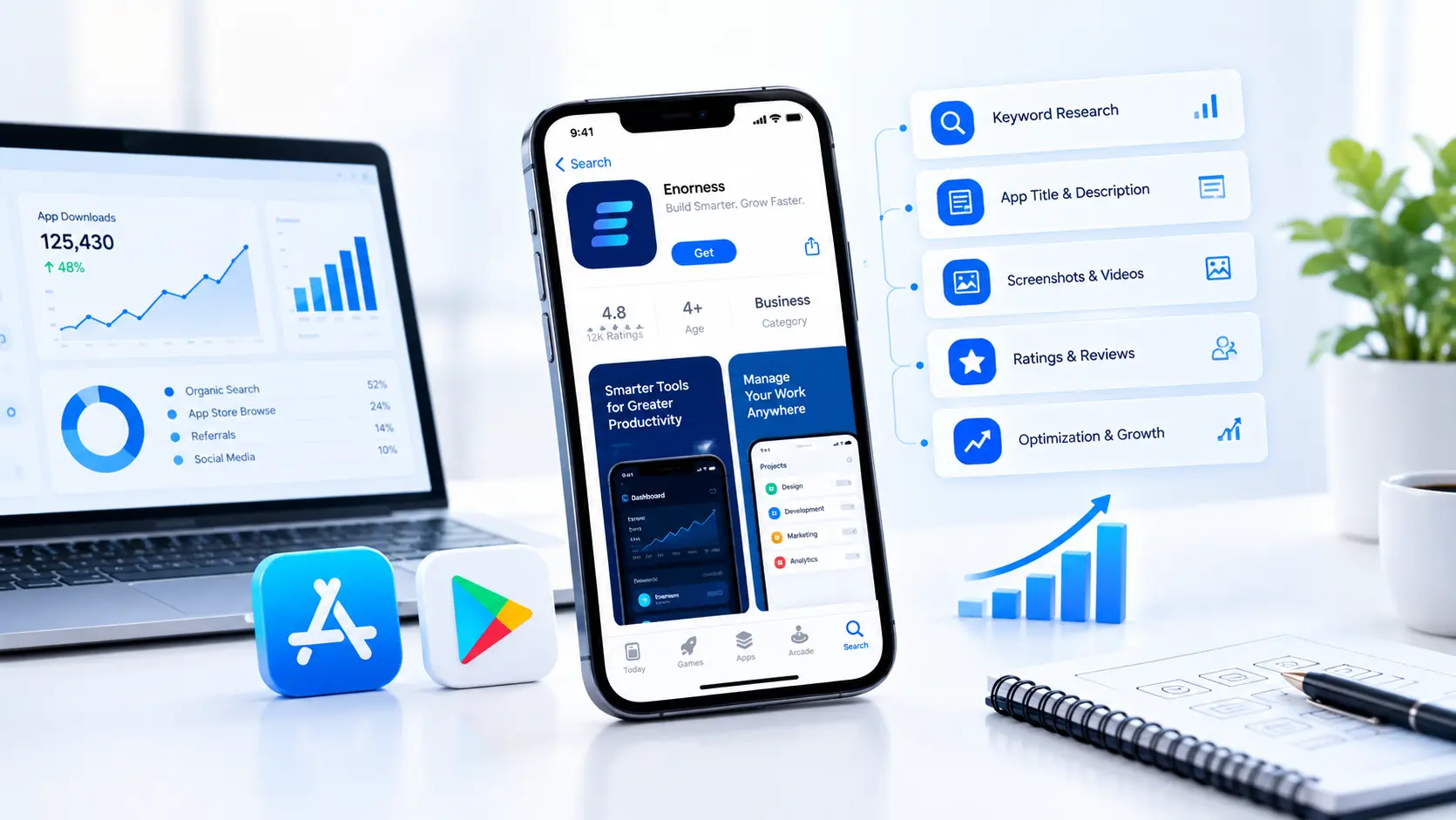
Picture two budgeting apps. Same features, same price, similar design. One pulls 3,000 organic installs a month.
Picture two budgeting apps. Same features, same price, similar design. One pulls 3,000 organic installs a month. The other barely clears 200. The difference usually isn't the product. It's the listing: the words in the title, the first screenshot, the rating, and whether the store understands who the app is for.
That gap is what app store optimization fixes. Apple says roughly 65% of App Store downloads start with a search, which makes the store search bar the cheapest growth channel most app teams have. Here's how ASO works in 2026, field by field.
What Is App Store Optimization?
App store optimization (ASO) is the work of improving where your app ranks in App Store and Google Play search, and how many people install it after they see the listing. People sometimes call it app store SEO, and the comparison holds, with one twist. A web page only needs the click. An app listing has to win the search and then close the sale, usually in under five seconds.
So every ASO strategy has two halves: visibility (keywords and ranking signals) and conversion (icon, screenshots, ratings). Ignore either and the other stops paying off.
iOS vs Google Play: Why One ASO Strategy Doesn't Fit Both
The two stores read different fields, so copying your iOS metadata into the Google Play Console leaves rankings on the table.
Factor | Apple App Store | Google Play |
Title | 30 characters | 30 characters |
Second field | Subtitle, 30 characters | Short description, 80 characters |
Hidden keyword field | Yes, 100 characters | No |
Long description ranks? | No | Yes, up to 4,000 characters |
Changing metadata | Needs a new app version (promotional text is the exception) | Update anytime, no new build |
Built-in testing | Product Page Optimization | Store Listing Experiments |
Heavy quality signal | Conversion rate and retention | Android vitals and uninstall rate |
Both stores now lean hard on engagement. If people install and delete within a day, no keyword tweak will cover for it.
ASO Keywords: How to Find Terms People Actually Type
The best ASO keywords come from your users' vocabulary, not your pitch deck. A meal-planning startup might describe itself as "personalized nutrition," while real people type "meal planner," "grocery list," or "high protein recipes." Here's a research process that holds up:
Mine your own reviews and support tickets. The phrases customers use to describe their problem are often your best long-tail keywords.
Pull volume and difficulty data from AppTweak, Appfigures, or MobileAction, and use search popularity scores from Apple Ads (formerly Apple Search Ads).
Pick winnable terms first. A new app rarely ranks for "budget." It can rank for "budget planner for couples" within weeks.
Assign every keyword a home so no field repeats another.
Google Play's Guided Search now groups apps by user goals, so descriptions that spell out outcomes, like "split rent with roommates," beat feature lists.
iOS App Store Optimization: Title, Subtitle, and Keyword Field
Apple mixes words across your title, subtitle, and keyword field to match searches. Repeating a word doesn't make it stronger. It just burns characters. A few rules that make a visible difference:
Lead the title with your brand plus your single most valuable keyword, for example "Mealsy: Meal Planner & Recipes."
Use the subtitle for a second keyword wrapped in a real benefit, such as "Healthy Grocery Lists in Minutes."
Write the keyword field as comma-separated single words with no spaces: grocery,macro,diet,prep,family,budget,vegan,keto. Skip plurals, skip "app," and skip anything already in the title.
Treat screenshot captions as searchable copy. Several ASO platforms report that Apple now reads text inside screenshots.
Use promotional text for time-sensitive offers, since it updates without an app review.
iOS 26 also added App Tags, generated partly from your metadata. One more reason to describe your app accurately.
Google Play Store Optimization: Write for Humans, Index for Search
Google Play ranks your full description, so it deserves real effort. Put your primary keyword in the first sentence, use secondary terms naturally after that, and keep sections short. Stuffing a phrase 20 times breaks Google Play's metadata policy. Your 80-character short description should read like an ad headline, because on many screens it's the only text people see.
Screenshots, Icon, and Video: Where Installs Are Won
Most visitors decide from the icon and first two or three screenshots. Those are your real headline.
Icon: one bold shape, strong contrast, readable at thumbnail size. Put it next to your top five competitors before approving it.
First screenshot: show the result, not the login screen. "Plan a week of dinners in 2 minutes" beats "Welcome to Mealsy."
Preview video: get to the core action in the first three seconds, and assume the sound is off.
Proof: a rating badge or user count caption builds trust quickly, if it's true.
Screenshots can only show the interface you actually built, which is why UI/UX design and ASO work best when planned together. Test one change at a time with Apple's Product Page Optimization, which runs up to three variants against your original, or Google Play's Store Listing Experiments.
Custom Product Pages Now Rank in Organic Search
This is the biggest change to iOS app store optimization in years. Since July 30, 2025, you can assign keywords to Custom Product Pages in App Store Connect, and those pages can replace your default listing in organic search. Apple allows up to 70 of them, each with its own screenshots, preview video, and promotional text.
The catch: each keyword combination belongs to only one page, and it must already sit in your keyword field. A fitness app could show yoga screenshots to people searching "yoga" and dumbbell workouts to people searching "home workout." On Android, custom store listings give similar control by country and by Google Ads campaign.
Ratings, Reviews, and the Technical Side of ASO
AppTweak's 2026 benchmarks found that 95% of apps featured on the App Store have a rating of 4.0 or higher. You don't get there by begging for reviews on first launch. Ask right after a win, like a completed order or a finished workout, using Apple's SKStoreReviewController or Google's In-App Review API. Apple shows its prompt at most three times per user per year, so pick those moments carefully. Reply to one-star reviews quickly and specifically. A fixed bug plus a polite reply often turns a 1 into a 4.
Then there's the part most ASO guides skip entirely: code quality. Google Play reduces visibility for apps that cross its Android vitals thresholds for crashes and "app not responding" errors. Bloated downloads, slow cold starts, and battery drain raise uninstalls on both stores. Firebase Crashlytics shows where users drop off, but the fix lives in the codebase. A well-structured build from an experienced React Native app development team usually does more for rankings than another round of keyword edits.
App Store SEO for AI Search
More people now ask ChatGPT, Gemini, or Google's AI Overviews which app to download, and those answers come from the open web. To show up:
Publish a proper app landing page on your website with SoftwareApplication schema, ratings, pricing, and store links.
Use the same app name, category, and one-line description everywhere: your site, both stores, and review platforms.
Get mentioned in "best apps for" roundups and comparison articles, which AI tools cite often.
Answer your category's common questions in help articles.
Local ASO for US Businesses
For ordering, delivery, and service apps, a city name is a keyword. "Houston pizza delivery" has clearer intent than "pizza." Add location terms where they fit and build Custom Product Pages for your biggest metros. The US App Store also indexes Spanish (Mexico) metadata, a second 100-character keyword field. For an ecommerce mobile app or multi-location restaurant app, that's free reach.
How to Measure ASO and Increase App Downloads
Check these every month in App Store Connect and the Google Play Console: rankings for your top 20 to 30 keywords, search impressions, product page views, conversion rate from page view to install, installs by source (search, browse, referral), and day 1, day 7, and day 30 retention.
Judge tests on revenue or retention, not installs alone. Real mobile app growth comes from the users who stay.
A Practical 90-Day ASO Plan
Month 1: audit both listings, research keywords, rewrite titles, subtitles, keyword field, and Play descriptions.
Month 2: redesign the icon and first three screenshots, start A/B tests, and launch three to five Custom Product Pages.
Month 3: tune review prompts, add Spanish (Mexico) metadata, fix the top crash issues, and publish your app landing page.
Still pre-launch? Start now. An app launch with optimized metadata and early reviews sends good signals from day one.
Frequently Asked Questions
What is app store optimization in simple terms?
It's improving your app's store listing so it ranks higher in App Store and Google Play search and convinces more visitors to install. It covers keywords, visuals, ratings, and app quality.
How long does ASO take to work?
Keyword changes usually move rankings in one to four weeks. Steady organic growth shows up over three to six months.
Does Apple use the app description for ranking?
No. Apple ranks the title, subtitle, and keyword field. Google Play does index the full description, so write it with keywords in mind.
Do Custom Product Pages help organic rankings?
Not directly, but since July 2025 they can appear in organic search, and a more relevant page usually converts better.
How often should I update my ASO?
Check rankings monthly, refresh metadata every one to three months, and update screenshots with major releases.
Does app performance affect ASO?
Yes. High crash rates, app-not-responding errors, and quick uninstalls hurt visibility, especially on Google Play, where Android vitals affect how apps are surfaced.
Grow Your App with Enorness
ASO sits between marketing and engineering. Enorness builds and optimizes mobile apps for US businesses, from keyword maps and screenshot design to crash fixes and performance tuning. Need a full build or a dedicated app development team for an existing app? Book a free ASO consultation and we'll show you where your listing is losing installs.


Let's Build Something Extraordinary
Turn ideas into intelligent products that drive real business results.