Agentic AI vs RPA: What's the Real Difference and Which Fits a Given Business

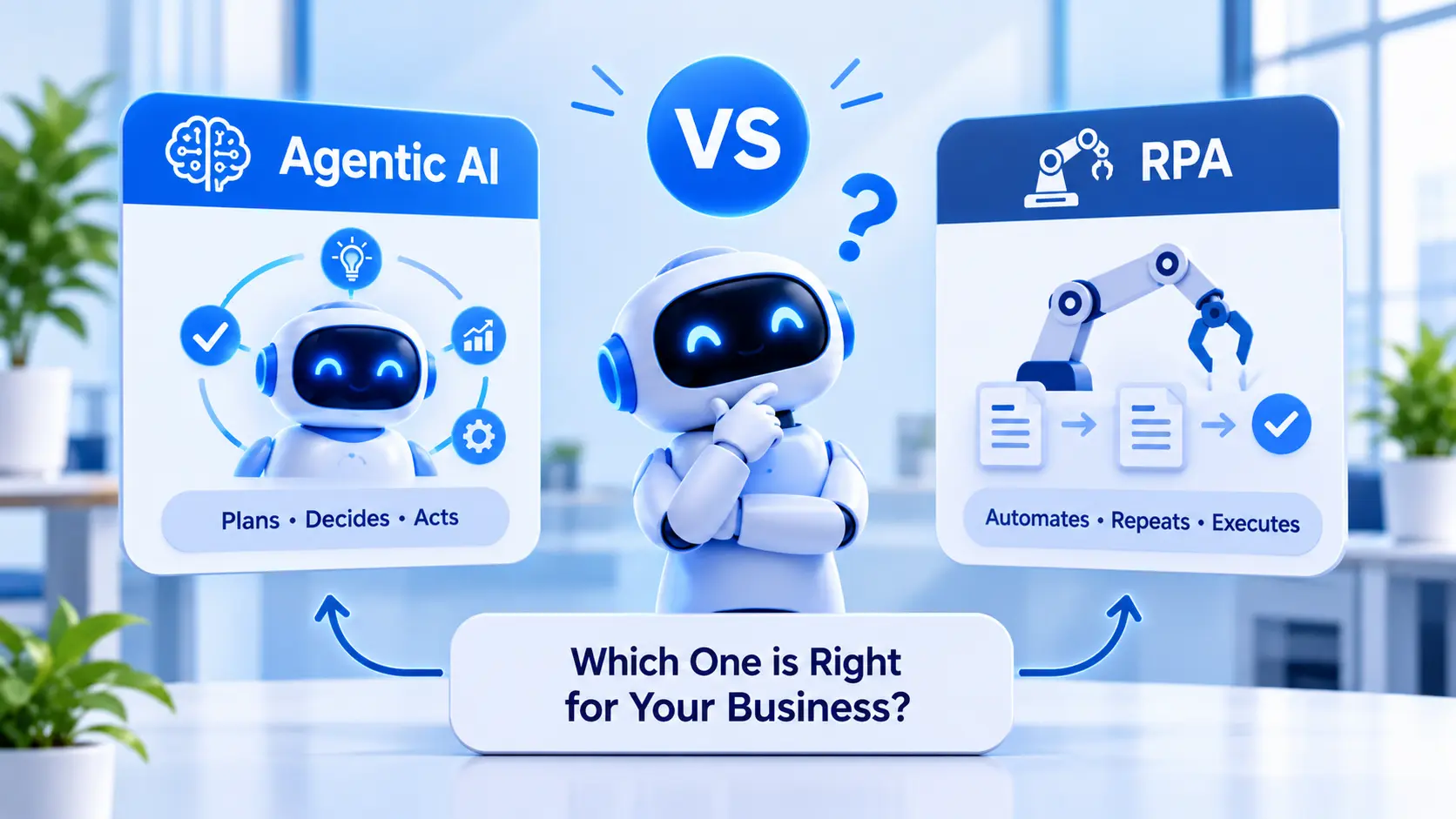
RPA follows a fixed script. Agentic AI reasons through input that changes. Here is the real difference between the two, when each one is the right call, and how one gym client used an agent instead of a bot.
Agentic AI vs RPA has become a common comparison as automation vendors rebrand older products with newer language. The actual difference is not about which tool is more modern. It is about what each one can do when the input is not identical every time.
Enorness builds AI solutions and agents as well as rule-based automation, which makes the distinction a practical one rather than a marketing exercise. This covers what robotic process automation actually does, what agentic AI adds on top of it, and how to tell which one a given process needs.
What RPA Actually Does
Robotic process automation follows a fixed script against a fixed input format. It reads a specific field, in a specific location, on a specific screen or document, and performs the same sequence of actions every time. When the input matches what the bot was built to expect, RPA runs reliably and fast.
The limitation shows up the moment the input varies. A field in a different position, a document in a slightly different layout, or a message that does not match any of the bot's expected phrases will stop an RPA workflow or send it down the wrong path. RPA has no mechanism for interpreting something it was not explicitly told to expect.
What Agentic AI Adds
Agentic AI, the subject of AI agent development generally, adds a reasoning layer on top of the same kind of action-taking logic RPA uses. Instead of matching an input against a fixed pattern, an agent interprets what the input means, then decides which action fits, even when the input does not look exactly like anything it has seen before.
This does not make agentic AI a replacement for RPA in every case. It makes it the right tool specifically for the layer where input is unstructured or variable, which is a layer RPA was never built to handle.
The Core Technical Difference
Rules versus reasoning
RPA executes rules: if the input matches condition A, perform action A. Agentic automation works differently: it classifies the input first, then selects an action from a range of possibilities based on that classification, including actions the system was not explicitly scripted to expect in that exact form.
Fixed input versus variable input
An invoice with the total always in the same cell is a fixed-input problem, well suited to RPA. An inbound message that could be a pricing question, a complaint, or a booking request in any phrasing is a variable-input problem, which is where AI agents vs RPA bots stops being a fair comparison. The bot was never built for that layer.
Failure behavior
When RPA hits an input it does not recognize, it typically stops or errors out, and someone has to intervene. When an agent encounters an input it has lower confidence about, it can flag it rather than guess, but it does not stop the whole process the way a broken RPA step does.
When to Use RPA
RPA remains the right choice for the structured, predictable layer of a process, which is the territory covered in business process automation generally: data entry between systems that do not natively integrate, moving a fixed field from one form to another, or running the same multi-step sequence against a document that always has the same layout.
RPA is also usually cheaper and faster to build for this layer. There is no reasoning model to tune and no classification logic to test against edge cases, because there are no edge cases in a genuinely fixed-input process.
When to Use Agentic AI
Agentic automation is the right call once a process involves input that cannot be fully specified in advance: a message that could arrive in any phrasing, a document that could be formatted differently depending on who sent it, or a request that needs to be classified before any rule can apply to it.
Train Gym is a case in point. Membership inquiries arrived across Instagram and Facebook in whatever phrasing a prospective member happened to use, which is the kind of input a fixed-rule bot handles poorly. Between May 1 and July 15, an AI agent built for that variable input processed 260 messages, qualified 69 leads, and converted 6 to booked appointments, an 8.7 percent conversion rate from qualified lead to booking.
How Enorness Decides Which One a Process Needs
The starting question is always about the input, not the goal. Two processes can have the same business objective and need entirely different tools, depending on whether the input that triggers each one is fixed or variable.
Most real deployments use both. A single workflow might use RPA to move data between systems once an AI lead generation agent has already classified and qualified the inbound message. Each tool handles the layer it was actually built for.
Businesses unsure which layer of their own process needs an agent and which needs a bot can get in touch with Enorness to map the process before any build starts.
Frequently Asked Questions
What is the difference between agentic AI and RPA?
RPA executes a fixed set of rules against a fixed input format. Agentic AI adds a reasoning layer that interprets variable input first, then decides which action fits, including input that does not match a predefined pattern.
Can RPA and agentic AI work together?
Yes, and in most real deployments they do. An agent typically handles the variable-input layer, classifying and qualifying what arrives, and RPA handles the structured layer that follows, such as moving the result into a CRM or booking system.
Is agentic AI just a rebrand of RPA?
No. Some vendors use the term loosely, but the technical difference is real. RPA has no mechanism for interpreting an input it was not explicitly scripted to expect. Agentic AI is built specifically to classify and reason about input that varies.
When should a business choose RPA over an AI agent?
When the input is genuinely fixed and predictable, such as a field that always appears in the same place on the same document. RPA is faster and cheaper to build for that layer, and there is no reasoning problem to solve.
How long does it take to add agentic AI to an existing RPA setup?
A focused agent handling one variable-input layer is a smaller scope than a deployment spanning multiple layers, which takes longer to design and test before it runs reliably.
What happens when an AI agent is not confident about an input?
A well-designed agent can flag cases it is unsure about for a person to review instead of guessing. The specific path depends on how the agent is configured for the process.

Written by
Mark Louis




Let's Build Something Extraordinary
Turn ideas into intelligent products that drive real business results.