Business Process Automation: How Growing Companies Remove Manual Work and Move Faster

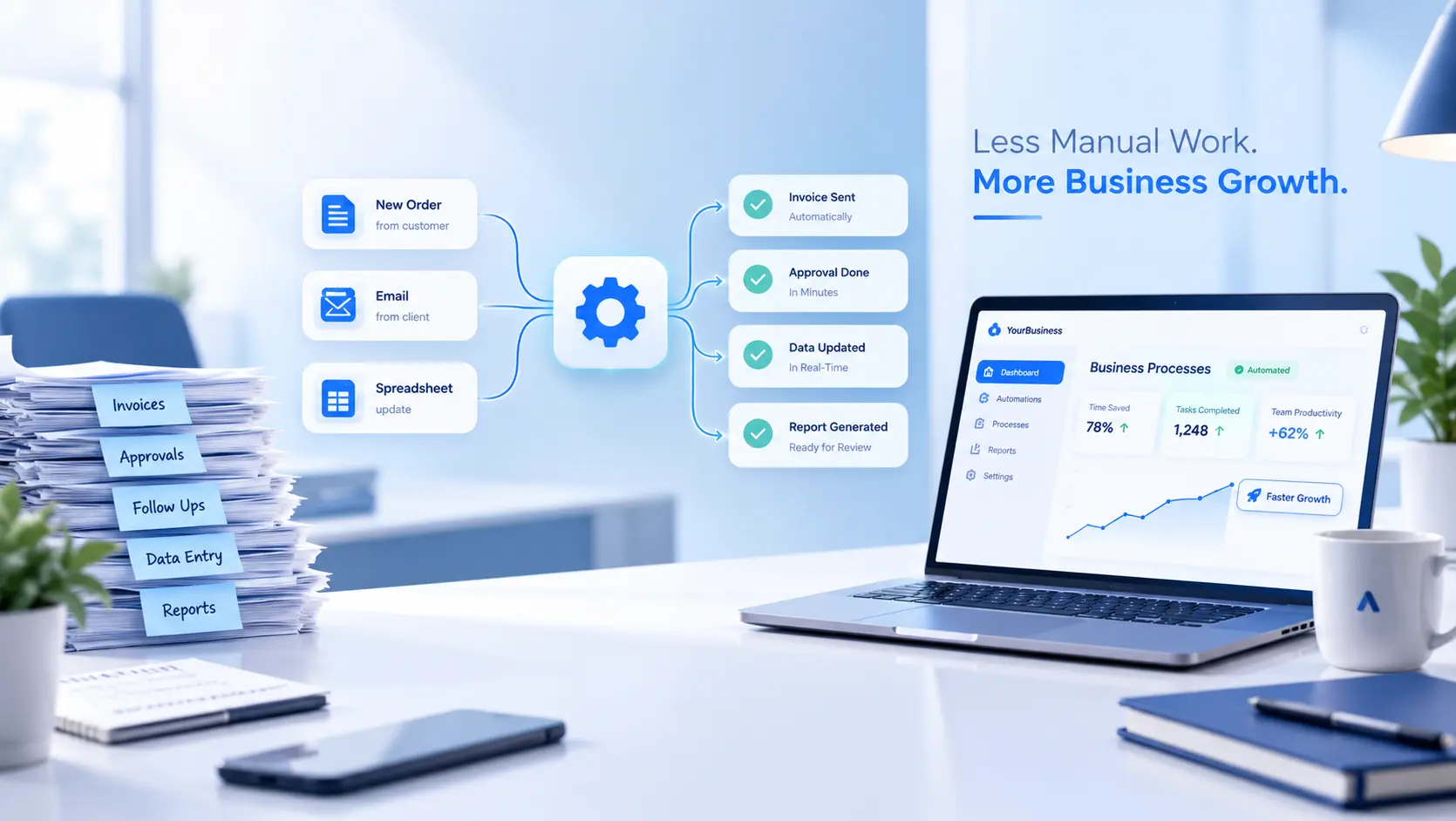
Business process automation helps growing companies reduce repetitive manual work, minimize errors, and improve operational efficiency. Learn how automated workflows can streamline everyday processes, save time, and help teams focus on higher-value business tasks.
Most growing companies do not have a productivity problem. They have a repetition problem. The same lead message gets read, sorted, and routed. The same report gets pulled from the same dashboard every Monday. The same onboarding checklist runs through the same steps for every new client. Business process automation addresses the repetition problem directly by replacing rule-based human decisions with logic that runs on its own.
This is not an enterprise-only practice. Enorness builds business process automation for companies at the growth stage, where every manual hour carries a cost in speed, accuracy, and time a team member does not spend on work that requires real judgment.
What Business Process Automation Actually Means
Business process automation is the practice of identifying a task that runs on a repeatable decision tree and replacing the human in that loop with software logic. The task does not disappear; the person handling it does.
Before automation can run, business process management defines what the process actually is: what triggers it, what decisions branch off it, and where the output goes. Skipping this step produces automation that runs the wrong thing faster.
A process qualifies for automation when it is triggered by a predictable event, governed by a clear rule, and produces a result that does not require judgment on every instance. Lead response, appointment scheduling, data entry, status reporting, and client onboarding steps all qualify. Strategy reviews and relationship decisions do not.
The distinction matters because the goal is not to automate everything. It is to automate the layer of work that runs beneath the decisions a team member actually needs to make.
Where Manual Work Costs Growing Companies the Most
Four categories account for the majority of repeatable manual work in most growing businesses.
Lead response and qualification
A new inquiry arrives and someone reads it, decides whether it matches a service, and sends a reply. When inquiry volume is low, this takes minutes. When messages come from multiple channels across different time zones, the gap between message and response is where leads go cold. Speed here is not a nice-to-have; it is often the deciding factor between a booked call and a lost contact.
Appointment and scheduling management
Booking a service slot involves confirmation steps, reminder messages, and rescheduling loops. Each step is a rule-based task that runs without meaningful variation from one booking to the next.
Reporting and data aggregation
A weekly performance report pulls the same metrics from the same sources every time. An account status update checks the same fields in the same system. These tasks carry no analytical weight on their own; they are setup work for the analysis that follows.
Client onboarding
A new client requires the same setup sequence: account creation, permissions, branding configuration, welcome communication. As Enorness covered in its work on multi-tenant SaaS architecture, a new client should be able to go live without a new application build for every onboarding. The same principle applies to any business that brings clients on at volume.
How AI Agents Handle Repetitive Business Processes
Traditional workflow automation software handles structured tasks well: if a form is submitted, send an email. Most process automation tools handle the trigger layer without difficulty. The problem appears when inputs stop being uniform.
AI agents for business handle a different class of task: one where the input is variable. A message from a lead does not arrive in a standard format. It might ask three questions at once, reference an offer by the wrong name, or need to be routed to one of several options based on what it contains. Standard workflow logic cannot handle this. AI agents can.
Enorness builds AI agents that sit inside a business's existing communication channels, read incoming messages, apply routing logic, and respond or escalate based on rules the business sets. The agent does not replace the team. It removes the sorting layer so the team handles only conversations that have already been qualified.
The reliability of this layer depends on the data infrastructure underneath it. An agent connected to a properly structured data source gives consistent answers and routes accurately. One running on ad hoc inputs degrades quickly as volume increases.
A Real Example: Lead Qualification at Train Gym
Train Gym was handling inquiries across Instagram and Facebook about memberships, free trials, and class schedules. Every message landed on a staff member before it could be sorted or answered.
Enorness built an AI booking agent that handled this layer automatically. Between May 1 and July 15, the agent processed 260 messages, qualified 69 leads, and converted 6 to booked appointments, an 8.7 percent conversion rate from qualified lead to booking. Staff handled only the conversations the agent had already sorted and prepared.
The decision to automate business processes in this case was not about replacing staff. It was about redirecting attention from sorting to closing. Staff time shifted from reading and routing to the conversations that had already been pre-qualified.
The results: 260 messages processed, 69 qualified leads, 6 booked appointments, and an 8.7 percent conversion rate from qualified lead to booking.
Workflow Automation Software vs. Custom Process Automation
Off-the-shelf workflow automation software works well for generic tasks: form submission triggers, email sequences, calendar invites. Many companies reach the edge of what these tools can handle. The rules become too specific. The routing too layered. The data sources too varied for the template a vendor provides.
Custom process automation starts from the actual workflow: what triggers it, what decisions branch off it, what the output needs to look like, and where it connects to the systems already in use. Enorness designs business automation solutions around the specific logic a business runs, rather than adapting the business to a vendor's template.
The difference shows most clearly at the integration layer. A custom-built automation connects to the exact systems a business already uses: its CRM, its booking tool, its communication platform. An off-the-shelf tool connects to what its vendor has prioritized. When those lists do not overlap, the process breaks or requires manual bridging that defeats the purpose of automating it.
What to Automate First
Three criteria identify the highest-value automation targets in any growing operation.
Frequency: a task that runs ten times a day returns more from automation than one that runs once a week. The investment in building the automation amortizes faster against high-frequency tasks.
Rule-clarity: a task with a clear decision tree automates cleanly. A task that requires judgment on most instances should wait until the rules governing it can be defined precisely enough to encode.
Cost of delay: a task where a slow response has a direct business cost, such as lead response or support acknowledgment, should be prioritized over internal reporting where timing has no customer-facing consequence.
Starting with the intersection of all three, high frequency, clear rules, and time-sensitive output, produces the fastest measurable return from any automation investment and gives the team a reference point for what automation actually delivers before expanding further.
How Enorness Approaches Business Process Automation
Enorness builds automation at the workflow level, not the tool level. The starting point is the process: what happens, in what order, under what conditions, and where the work goes next. Technology selection follows from that design rather than driving it.
For AI agent work, Enorness's AI solutions and agents practice handles design, build, and integration. For automation that requires clean pipelines before logic can run reliably, data engineering runs alongside the automation build. For automation that needs to live inside a larger custom platform, enterprise software provides the infrastructure those processes run on.
Companies ready to remove manual layers from their operations can get in touch with Enorness to identify the highest-impact starting point.
Frequently Asked Questions
What is business process automation?
Business process automation is the replacement of a repeatable, rule-based human task with software logic that executes the same decision without manual input on each instance.
How do AI agents fit into business process automation?
AI agents handle the variable-input layer of automation, such as reading a message, identifying what it is about, and routing or responding according to business rules, where traditional workflow automation would require a fixed input format to function.
What business processes can be automated?
Lead response and qualification, appointment scheduling, client onboarding sequences, status reporting, and data aggregation are the most common starting points. Each involves high-frequency, rule-based decisions with low judgment requirements on individual instances.
What is the difference between workflow automation software and custom process automation?
Workflow automation platforms handle generic trigger-and-action sequences. Custom process automation is built around the specific decision logic, data sources, and system integrations a business already uses, without requiring the business to reshape its process around a vendor's template.
How does automating business processes reduce costs?
Automation removes the time cost of repeatable decisions from a team member's day. The same task runs without the hourly cost attached to a human completing it, and without the speed constraint of working hours or staffing levels.
How long does it take to implement business process automation?
A build targeting one high-frequency process is a smaller scope than a broader automation architecture, which needs a longer design phase before implementation begins.

Written by
Abdullah Siddiqui



Let's Build Something Extraordinary
Turn ideas into intelligent products that drive real business results.