AI Lead Generation: How AI Agents Qualify Inbound Leads Before Sales Gets Involved

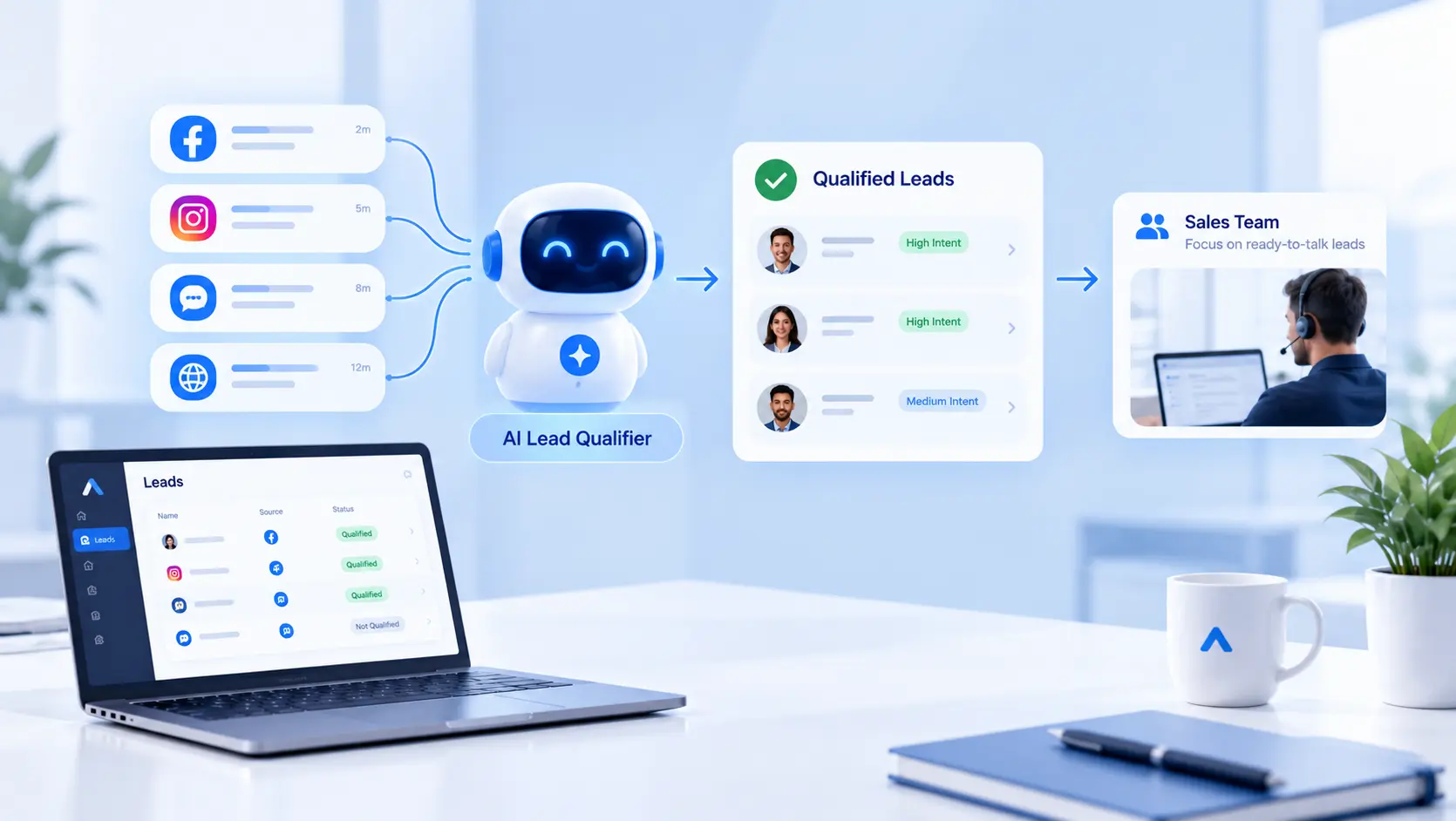
AI lead generation helps businesses qualify inbound leads automatically, identify high-intent prospects, and help sales teams focus on better opportunities.
Most lead generation effort goes into getting attention: ads, content, outreach. Far less goes into what happens after someone responds. AI lead generation addresses that second half, the messages that arrive after an ad is clicked, a form is submitted, or a social post gets a comment, and the sorting work required before a sales conversation can start.
Companies that generate inbound interest often lose leads in the gap between first contact and qualified follow-up.
Enorness builds AI agents for sales teams to close that gap. This covers what automated lead qualification actually does, how it differs from lead scoring and demand generation, and what it delivered for one fitness client.
What AI Lead Generation Actually Means
AI lead generation is not a paid traffic strategy or an ad targeting method. It describes the layer that handles incoming interest once it exists: reading each inbound message, determining what it indicates about intent, and either qualifying it against defined criteria or routing it to a sales conversation.
This differs from demand generation, which creates interest, and from lead scoring, which ranks leads already captured in a CRM. AI lead generation operates earlier, at the point a message first arrives, before any data has been entered into a system.
For a step-by-step setup walkthrough, the AI lead qualification guide covers configuring qualification criteria and routing rules in detail. This piece takes a different angle: where lead generation automation sits relative to lead scoring and demand generation, and what changed for one gym client once it was in place.
Where Manual Lead Generation Breaks Down
Volume outpaces staff capacity
Inbound interest does not arrive in a steady, staff-sized stream. A single promotion, event, or piece of social content can generate a spike in messages that takes a staff member hours to read and sort, by which point the earliest messages have gone cold.
Response delay costs qualified leads
A lead that waits hours for a reply behaves differently than one answered immediately. When the sorting step depends on staff availability, response time becomes inconsistent across the day and across channels, and the inconsistency itself costs leads that were otherwise qualified.
Qualification criteria vary by person
Without a consistent framework applied to every message, two staff members screening the same type of inquiry can reach different conclusions about whether it is worth escalating. Leads are lost not to poor service, but to inconsistent triage.
How an AI Lead Generation Agent Works
The architecture behind an AI lead generation agent follows the same layered structure used in AI agent development generally: a perception layer that connects to the channels where messages arrive, a reasoning layer that classifies intent, and an action layer that routes the result. What differs is the specific logic applied at each layer.
Reading the message
The agent connects directly to the channel where inbound interest already arrives, most commonly social messaging. No lead is qualified from a spreadsheet export or a delayed sync; the agent reads the message where it lands.
Classifying intent
Not every inbound message is a lead. Some are pricing questions, some are support issues, some are spam. The reasoning layer classifies each message against the business's own criteria before anything is logged as a qualified lead.
Routing the result
A message classified as qualified is routed toward the next step in the sales pipeline, a booking link or a scheduling flow. A message that does not meet the criteria is not escalated further.
A Real Example: Train Gym's Lead Pipeline
Train Gym handled membership inquiries manually across Instagram and Facebook. Every message landed on a staff member before it could be sorted or answered, the same qualification bottleneck common to service businesses with active social channels.
Enorness built an AI booking agent that qualified leads directly within that message flow. Between May 1 and July 15, the agent processed 260 messages, qualified 69 of them as leads, and converted 6 to booked appointments, an 8.7 percent conversion rate from qualified lead to booking. Qualification happened without a staff member opening the thread first.
The agent did not generate the inbound interest. It removed the sorting step that sat between that interest and a booked appointment, which is the specific job AI lead generation is built to do.
AI Lead Generation vs Traditional Lead Generation
Traditional lead generation optimizes the top of the funnel: more traffic, more form fills, more ad impressions. AI lead generation optimizes the step immediately after, deciding which of those responses deserve a sales conversation and routing them there without delay.
The two are complementary rather than competing. More traffic without a qualification layer produces more unsorted messages, not more revenue. An AI sales pipeline that starts with a reliable qualification step gets more value out of the traffic already being generated, before any additional ad spend or content investment is added.
How Enorness Approaches AI Lead Generation
Enorness starts by mapping where inbound interest already arrives, most often social messaging. The agent is built around that existing channel rather than requiring a new one the business has to promote separately.
From there, data engineering work ensures the agent receives consistent, structured input rather than fragments pulled from inconsistent systems, which supports accurate qualification.
Once qualification works reliably, the handoff into scheduling or CRM entry is handled through business process automation, so a qualified lead does not get re-entered manually at the next step.
Companies ready to find out where their own lead flow loses qualified leads can get in touch with Enorness to scope the first agent.
Frequently Asked Questions
What is AI lead generation?
AI lead generation is the use of an AI agent to read inbound messages or form submissions, determine intent, and qualify or route them before a human is involved. It automates the sorting step that typically happens between first contact and a sales conversation.
How is AI lead generation different from lead scoring?
Lead scoring ranks leads already entered into a CRM, usually based on fields like company size or email engagement. AI lead generation operates earlier, at the point a message first arrives, before any data has been entered into a system.
Can AI lead generation work alongside an existing CRM?
Yes. An AI lead generation agent typically qualifies a message first, then passes the result into the CRM or booking system already in use rather than replacing it.
How long does it take to deploy an AI lead generation agent?
A focused agent handling one channel is a smaller scope than a deployment spanning multiple channels, which takes longer to design and test before it runs reliably.
What results has Enorness delivered with AI lead generation?
In the Train Gym deployment, the agent processed 260 messages, qualified 69 leads, and converted 6 to booked appointments, an 8.7 percent conversion rate from qualified lead to booking.
Does AI lead generation replace a sales team?
No. It replaces the manual sorting step that happens before a sales conversation, not the conversation itself. The sales or membership team still handles the relationship and the close.

Written by
Mark Louis


Let's Build Something Extraordinary
Turn ideas into intelligent products that drive real business results.