AI Agent Development: How Businesses Build Agents That Actually Work

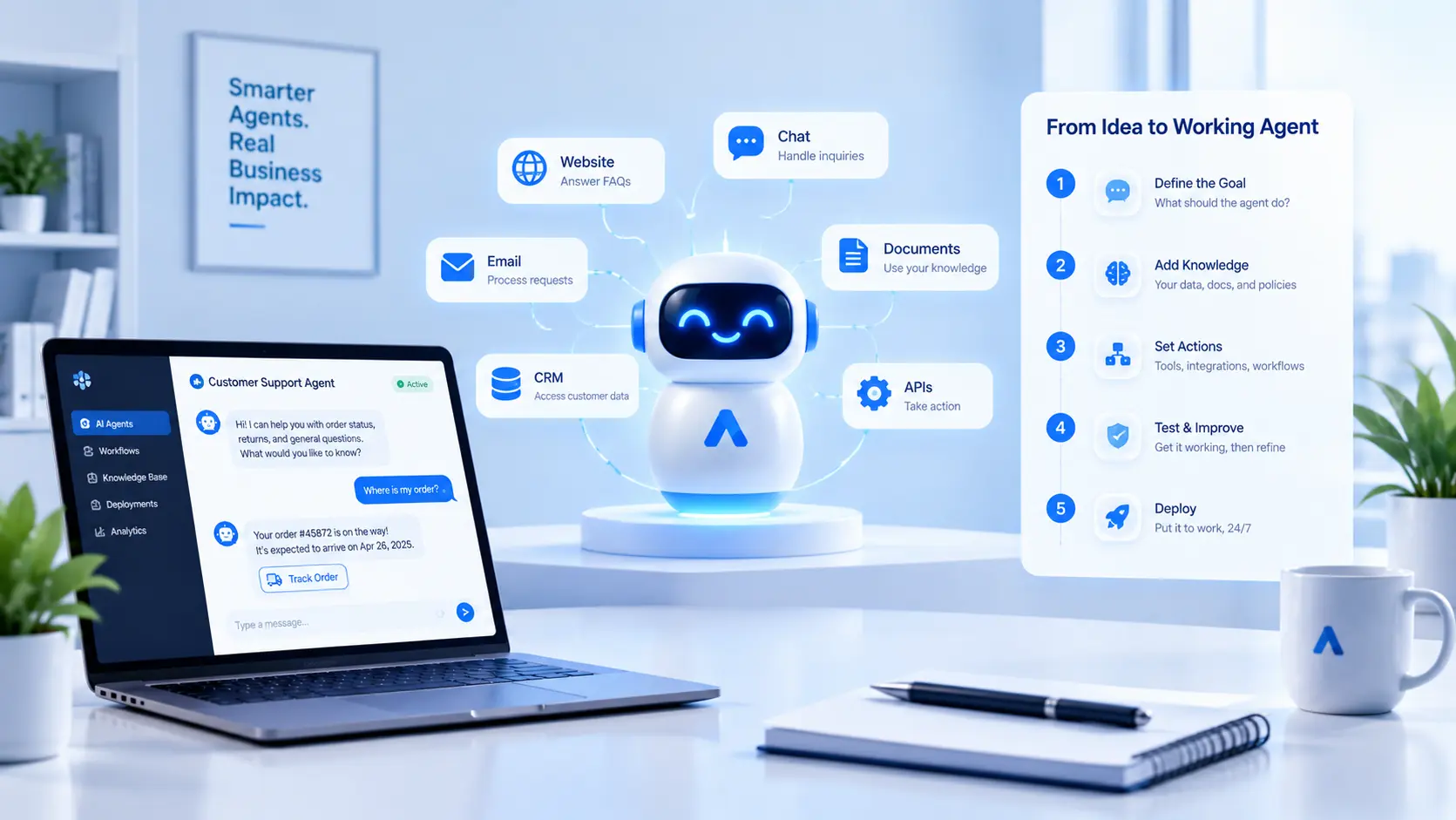
Build powerful AI agents that automate business tasks, streamline workflows, and deliver measurable results.
Most software solves a fixed problem with a predictable input. AI agent development addresses a different class of problem: one where the input varies, the context matters, and the response needs to change accordingly. An AI agent does not execute a script. It reads what arrives, interprets it, and decides what to do next based on the logic it has been given.
Enorness builds AI solutions and agents for growing companies that have hit the limit of what rule-based automation can handle. This covers the architecture decisions, integration layer, and testing requirements that determine whether a custom AI agent delivers consistent results or fails quietly in production.
What AI Agent Development Is
An AI agent is software that receives variable input, processes it through a reasoning layer, and takes a defined action or sequence of actions in response. The definition separates agents from simpler automation. A workflow automation tool executes a trigger-action pair. An AI agent reads the trigger, interprets its content, and decides which action to take.
AI agents for business handle a different class of task than standard automation: one where the input does not arrive in a fixed format and interpretation is required before any rule can apply. Business process automation addresses the layer where rules are clear and inputs are predictable. AI agent development addresses the layer that sits above it. The two often run together: an agent handles intake, and structured automation handles what follows.
The most common use cases include lead qualification across messaging channels, customer inquiry routing, scheduling coordination, and internal data handling. In each case, the value comes from removing the human step required to read, interpret, and route an incoming request.
Where AI Agents Deliver the Clearest Business Value
Three categories of business work return the most from AI agent investment.
Inbound communication handling
Every business receives unstructured inbound messages. Someone asks about pricing. Someone asks to reschedule. A third message asks a question already answered on the website. Reading and routing each of these manually is low-value work that blocks higher-value work. An AI automation agent trained on a company's offers, policies, and routing rules handles this layer without a human touch on every instance.
Lead qualification
The AI booking agent Enorness built for a fitness client qualified leads across Instagram and Facebook before any staff interaction occurred. The agent read each message, determined intent, and routed it to the relevant offer.
Internal process routing
Finance teams, operations teams, and support teams all receive requests that need to be sorted before they can be acted on. An agent reading a support inbox and tagging tickets by category, urgency, and department applies the same architecture as external lead qualification. The input is different; the logic pattern is the same.
The Architecture Behind a Working AI Agent
Building AI agents for production use requires four layers working together.
Perception layer. The agent needs a consistent way to receive input. For a messaging agent, this is a connection to the channels where messages arrive. For a data agent, this is a connection to the data source it reads from. Without a clean input layer, the agent processes inconsistent data and produces inconsistent output.
Reasoning layer. This is where the language model, classification logic, or rule-based decision tree sits. Most business AI agents use a combination of structured rules and a language model. The rules handle predictable cases; the model handles edge cases within a defined confidence threshold.
Memory and context. An agent that reads one message at a time without retaining context gives inconsistent responses across a conversation. Effective AI agent development includes a context layer giving the agent access to relevant prior information: prior messages in a thread, an existing CRM record, or status data from a connected system. For agents that depend on clean, structured data, data engineering runs alongside the agent build to ensure reliable inputs throughout.
Action layer. The agent needs to do something with its output: send a message, update a record, trigger a workflow, or escalate to a human. The reliability of this layer depends entirely on the quality of the integrations underneath it.
How AI Agent Development Differs from Standard Software
Standard software is deterministic. The same input produces the same output every time. An AI agent is probabilistic. The same input can produce different outputs depending on the model, the context window, and the confidence threshold the developer sets.
This changes how development and testing work. A standard software build is tested against expected outputs. An AI agent build is tested against acceptable output ranges, edge cases, failure modes, and escalation paths. The build includes not just the agent logic but the rules that govern what the agent does when its confidence falls below a threshold.
Enterprise AI agents add a further layer: they need to operate reliably across higher message volumes, connect to more complex system environments, and maintain consistent behavior as the underlying model updates. The overlap with business process automation is deliberate. Many operations combine deterministic automation for the structured layer and AI agents for the variable-input layer. Designing these two together, rather than connecting them after the fact, produces more reliable systems and simpler maintenance cycles.
A Real Example: Lead Qualification at Train Gym
Train Gym handled membership inquiries manually across Instagram and Facebook. Every message landed on a staff member before it could be sorted or answered.
Enorness built an AI booking agent that handled the intake layer automatically. Between May 1 and July 15, the agent processed 260 messages, qualified 69 leads, and converted 6 to booked appointments, an 8.7 percent conversion rate from qualified lead to booking. Staff handled only the conversations the agent had already sorted and prepared.
The agent did not replace the sales conversation. It removed the sorting step that preceded it. That is the pattern most effective AI agent deployments follow: the agent handles reading and routing; the human handles relationship and judgment.
How Enorness Approaches AI Agent Development
The starting point is the process, not the model. Enorness maps the workflow the agent needs to handle before selecting the architecture that fits it. A lead qualification agent for a service business requires different architecture than an internal data routing agent for an operations team.
For companies with existing systems, the AI agent builder practice at Enorness integrates with what is already in use: CRMs, booking tools, communication platforms, and data pipelines. The agent connects to the real environment rather than replacing it.
Companies ready to move from evaluation to build can get in touch with Enorness to identify the process where AI agent development returns the most value first.
Frequently Asked Questions
What is AI agent development?
AI agent development is the process of designing, building, and integrating software that receives variable input, applies reasoning logic, and takes a defined action in response, without requiring a human to interpret each incoming request.
How is an AI agent different from a chatbot?
A chatbot follows a predefined script and responds to specific keywords or menu selections. An AI agent interprets the meaning of an input, applies business rules or model reasoning, and can take actions across connected systems based on what it reads.
What systems can an AI agent integrate with?
AI agents integrate with whatever systems the business already uses: CRMs, messaging platforms, booking tools, email, databases, and internal operations software. The integration layer is built as part of the development process.
How long does AI agent development take?
A focused agent handling one process is a smaller scope than a deployment covering multiple channels or workflows, which takes longer to design and test before it runs reliably.
What does AI agent development cost?
Cost depends on the scope of the agent, the number of integrations required, and the complexity of the reasoning layer. A focused single-process agent costs significantly less than a multi-channel deployment with custom reasoning logic.
What industries benefit most from AI agents?
Service businesses with high inbound message volume are strong candidates, such as fitness studios, as in the Train Gym case. Any operation that receives frequent, variable-format requests that need sorting is a good fit.

Written by
Mark Louis


Let's Build Something Extraordinary
Turn ideas into intelligent products that drive real business results.