Subscription Billing Software: Build vs Buy for Growing SaaS Companies

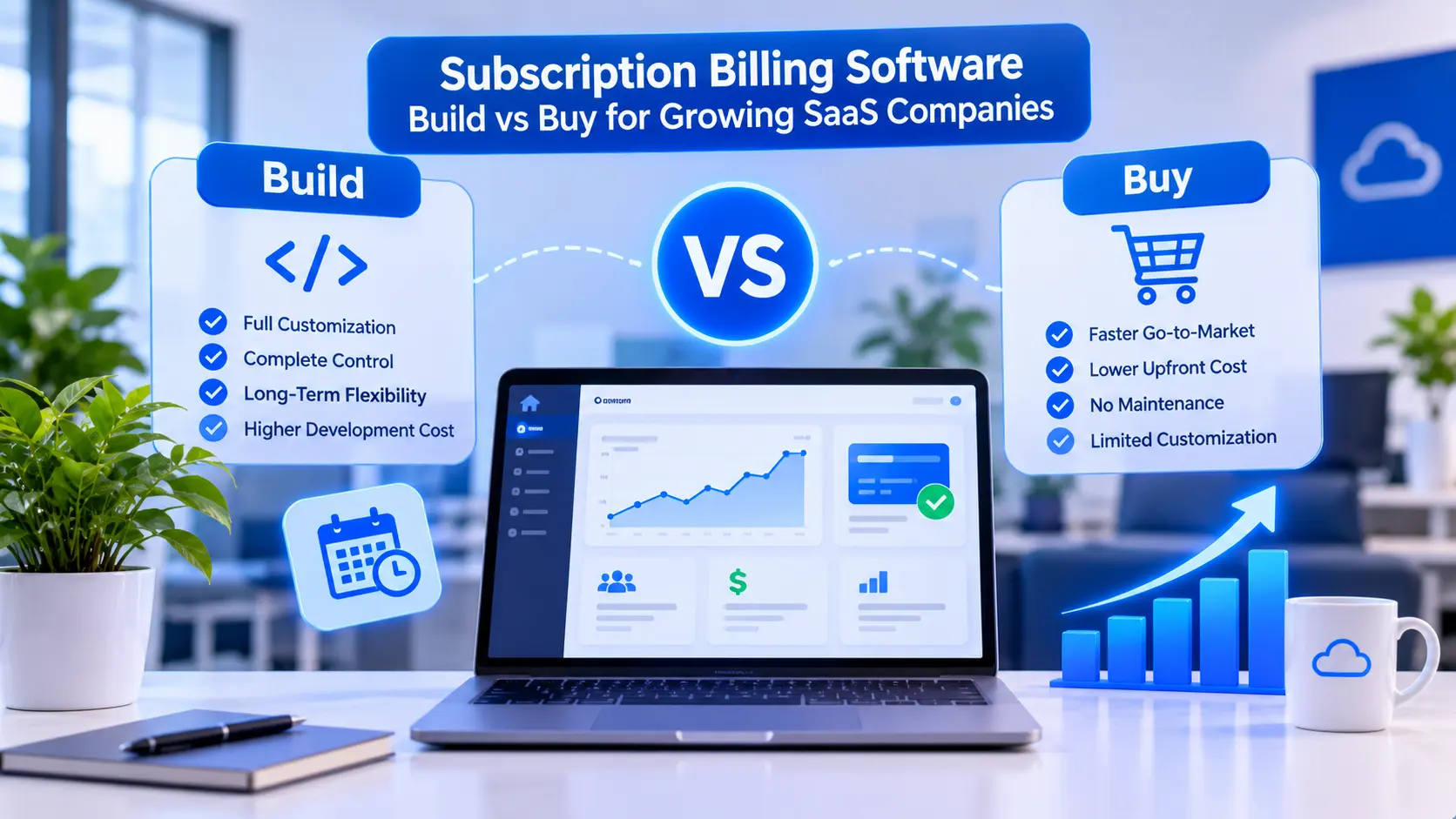
Subscription billing software sits at the center of every recurring-revenue business. Here's what building it costs versus buying it, and how a growing SaaS company can tell which path actually fits.
Subscription billing software is the system that turns a pricing plan into actual recurring charges: it tracks what each customer owes, when, handles upgrades and downgrades mid-cycle, and reconciles payments against invoices. The subscription billing software build vs buy decision is really a question about how much of that logic a company's own pricing model needs to control directly.
Many teams start with a buy decision by default, because a recurring billing platform is faster to launch with. The harder question comes later, when the pricing model outgrows what an off-the-shelf system was built to handle, and moving past that point has a real cost.
What a Billing System Actually Has to Handle
Beyond charging a card on a schedule, a billing system has to handle proration when a customer changes plans mid-cycle, retries and dunning when a card fails, tax calculation across jurisdictions, and invoice generation that matches what finance and the customer both expect to see. None of these are hard individually. What makes billing infrastructure genuinely difficult is the number of edge cases that accumulate once real customers start hitting all of them at once.
Where an Off-the-Shelf SaaS Billing System Fits Well
Standard subscription tiers with predictable pricing
A handful of fixed plans, monthly or annual billing, straightforward upgrades, is exactly what most commercial billing platforms were designed around, and they tend to handle it well out of the box.
Small teams without dedicated billing engineering capacity
Maintaining tax compliance, payment method updates, and card network changes is ongoing work. A bought platform absorbs that maintenance, which matters most for a team that doesn't have engineers to spare for it.
Speed to launch matters more than full customization
Getting a subscription product live quickly is often worth more early on than having complete control over every billing edge case.
Where Building a Custom Billing Platform Starts to Make Sense
Usage-based or hybrid pricing
Pricing that combines a flat fee with metered usage, or changes based on a customer's own product activity, often needs logic that sits closer to the product itself than a general billing platform is built to accommodate.
Billing logic tied to internal systems
When invoicing needs to reflect data from internal systems, usage logs, account-tier changes, custom contract terms, that connective logic usually ends up custom regardless of which billing platform sits underneath it.
Billing as a competitive differentiator
A company whose pricing model is itself part of the product's appeal, flexible packaging, negotiated enterprise terms at scale, may find that the constraints of an off-the-shelf platform start showing up as product limitations, not just billing limitations.
A Hypothetical Example: A Usage-Based SaaS Outgrowing Its Billing Platform
A hypothetical example: a SaaS company launches with simple monthly tiers on a commercial billing platform and later introduces usage-based pricing on top of those tiers. The platform can track usage, but combining it with existing flat-fee logic, mid-cycle tier changes, and custom enterprise contracts starts requiring workarounds stacked on workarounds. At that point, many companies build a thin custom billing layer that owns the pricing logic while still using the platform underneath for payment processing and compliance, rather than replacing it outright.
Build vs Buy: The Actual Trade-Offs
Buying a recurring billing platform trades long-term flexibility for a faster launch and someone else handling compliance and maintenance. Building custom billing software trades a longer, costlier build for full control over pricing logic, which only pays off if that logic is genuinely complex enough to need it. That same timeline-versus-control trade-off shows up across the same phases any enterprise software build goes through, not just in billing: the two paths rarely compete on cost at a single point in time, they compete on which set of trade-offs a specific pricing model can live with over several years.
The billing platform itself is a separate choice from the payment processor underneath it, which is its own decision with its own trade-offs; see Stripe vs Adyen for how that specific comparison plays out for US businesses.
Frequently Asked Questions
Is it ever simpler to just use Stripe Billing or Chargebee as-is?
For many companies, yes, at least at first. A ready-made recurring billing platform covers standard subscription models well. The build question usually comes up later, once pricing gets more complex than the platform's defaults comfortably handle.
What makes a pricing model too complex for an off-the-shelf billing system?
Usage-based tiers that combine with flat fees, mid-cycle plan changes with prorated credits, multi-entity billing across regions, or billing logic tied tightly to a product's own usage data are the usual triggers. Each one is possible on most platforms, but each added layer of custom logic narrows how well the platform's defaults still fit.
Does buying mean giving up control over the billing experience?
Not entirely. Most billing platforms expose APIs and webhooks that let a company customize the checkout flow, invoices, and dunning emails around the platform's core engine. Full control over the underlying billing logic itself, however, is the part that usually requires building.
How much does custom billing software typically cost to build and maintain?
It varies widely with pricing-model complexity and how many systems it needs to connect to, so there's no single reliable figure. What tends to be true is that the ongoing cost, tax rules changing, payment method updates, edge cases in proration, can add up to a large share of the initial build cost over the first few years.
Can a company switch from buy to build later, or is that a one-way decision?
It's possible but rarely simple. Migrating active subscriptions, historical invoices, and payment methods to a new system carries real risk of billing errors mid-migration, so most companies that make the switch plan for a careful, gradual cutover rather than a single flip.
Is there a middle ground between fully building and fully buying?
Yes. Some companies build a thin custom layer on top of a billing platform's core engine, using the platform for payment processing and compliance while handling their own pricing logic. This can capture some of build's flexibility without taking on the full maintenance burden.
Working Out Which Path Fits
The fastest way to tell is listing every pricing rule the product actually needs and checking how many of them a commercial billing platform handles natively versus how many would need custom workarounds. Enorness can be reached to talk through whether a specific pricing model is better served by a bought platform, a custom build, or a hybrid of the two.

Written by
Mark Louis




Let's Build Something Extraordinary
Turn ideas into intelligent products that drive real business results.