Stripe vs Adyen for US Businesses: 2026 Decision Guide

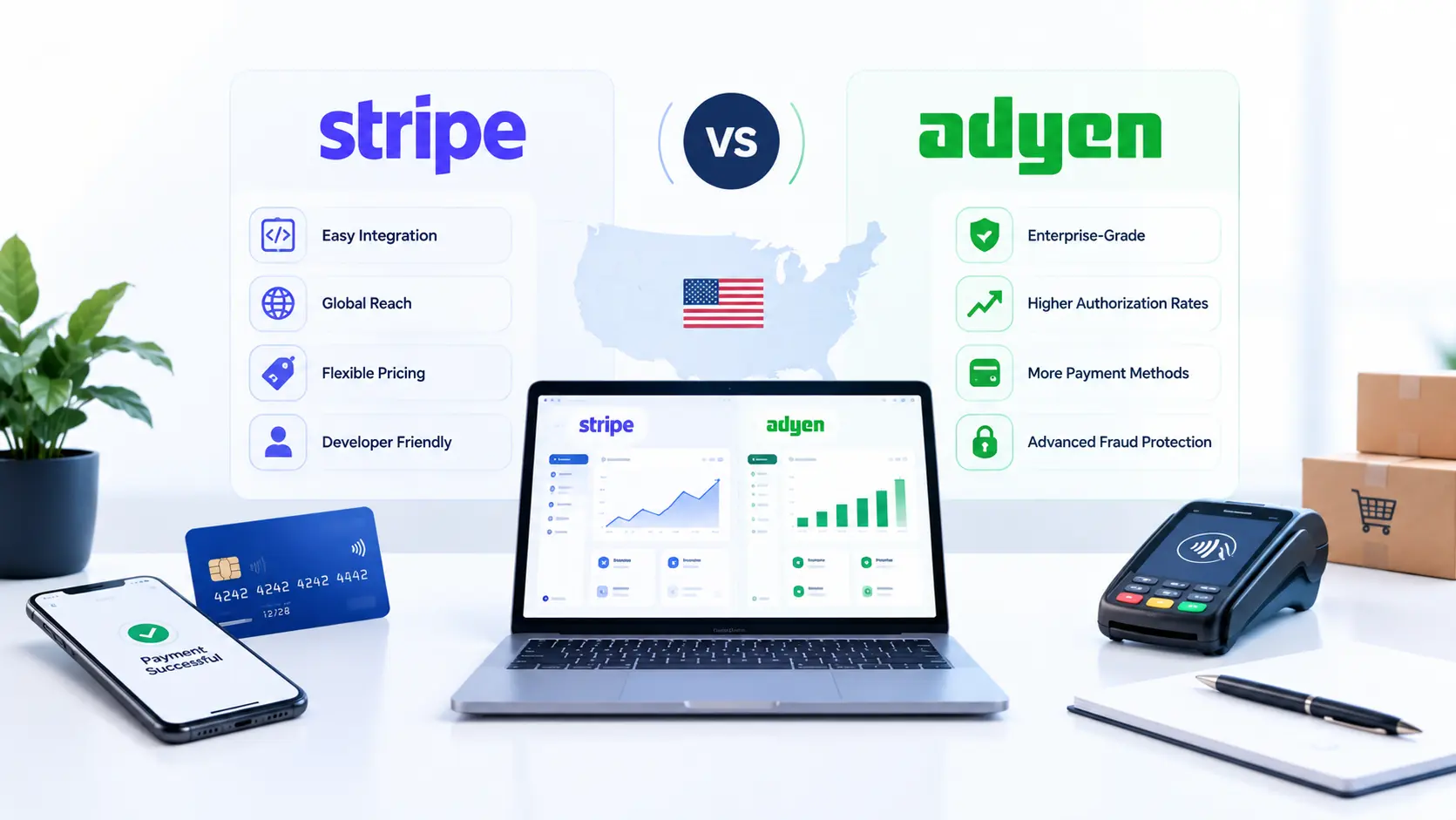
Most Stripe vs Adyen comparisons end with the same advice: Stripe for startups, Adyen for enterprises.
Most Stripe vs Adyen comparisons end with the same advice: Stripe for startups, Adyen for enterprises. That is directionally true, but it hides the question that actually decides your bill. It is not only how much you process. It is which cards your customers pay with. This guide uses published 2026 US pricing, works through real per-transaction math, and covers the costs, lock-in risks, and AI commerce features that most comparisons skip.
Stripe vs Adyen at a Glance
Factor | Stripe | Adyen |
US online card price | 2.9% + 30¢ flat | $0.13 + 0.60% + interchange and scheme fees |
American Express | 2.9% + 30¢ | $0.13 + 3.3% + $0.10 |
ACH direct debit | 0.8%, capped at $5 | $0.13 + $0.27 |
In-person cards | 2.7% + 5¢ | Interchange++ with terminal pricing |
Monthly minimum | None | Minimum invoice set by industry |
Onboarding | Self-serve, same day | Sales-led review |
Dispute fee | $15 received, $15 to counter | Set by contract |
Negotiated IC+ pricing | Yes, for large volume | Default model |
Prices come from each provider's published US pricing at the time of writing. Always confirm current rates before signing.
Why Card Mix Matters More Than Volume
Stripe charges every domestic card the same flat rate. Adyen passes through the real interchange fee set by the card network, then adds its own markup. That means your payment processing fees on Adyen swing widely depending on the card in your customer's hand.
Here is an illustrative $100 online sale, using approximate US interchange rates and Adyen's published list markup:
Card type | Stripe | Adyen (list price) | Winner |
Regulated debit | $3.20 | About $1.10 | Adyen |
Standard consumer credit | $3.20 | About $2.75 | Adyen |
Premium rewards credit | $3.20 | About $3.35 | Stripe |
American Express | $3.20 | About $3.53 | Stripe |
The pattern is clear. Adyen wins big on debit because US regulated debit interchange is capped under the Durbin Amendment at 21 cents plus 0.05%, with a 1 cent fraud adjustment. Stripe wins on premium rewards cards and Amex, where Adyen's pass-through costs exceed the flat rate.
Now scale it. Take a US brand doing $500K a month at a $100 average order, with 40% debit, 35% standard credit, 15% rewards, and 10% Amex. At list prices, Stripe costs about $16,000 a month. Adyen lands near $11,300, a gap of roughly $56,000 a year. A luxury brand whose buyers mostly swipe rewards cards and Amex would see that gap shrink to almost nothing.
The lesson: pull a card-type report from your current processor before trusting any "break-even volume" rule of thumb.
Interchange Plus Pricing Is Not Adyen-Only
Many comparisons frame this as flat rate versus interchange plus pricing, as if Stripe only offers one model. It does not. Stripe's custom pricing includes IC+ structures, volume discounts, and multi-product discounts for businesses with large payment volume. If you process several hundred thousand dollars a month, ask Stripe for an IC+ quote before assuming a migration is your only path to savings. Sometimes the cheapest move is a phone call, not a re-platform.
Hidden Costs Most Comparisons Skip
The headline rate is only part of the bill. Watch these line items:
Minimum invoice: Adyen confirms it charges a minimum monthly invoice that depends on industry and business model. If your fees fall short, you pay the difference.
Reserves: Adyen can hold a rolling deposit against potential liabilities, which reduces the cash that reaches your bank each settlement.
Refunds: Stripe does not charge a refund fee on standard card pricing, but it does not return the original processing fee either. Interchange is also not returned on Adyen refunds.
Disputes: Stripe charges $15 when a dispute arrives and another $15 if you counter it manually, refunded only when you win.
Buy now, pay later: Klarna through Stripe costs 5.99% + 30¢, nearly double a card payment. Offer it where it lifts average order value, not everywhere.
Instant payouts: Stripe charges 1.5% for instant access to funds. Standard payouts are free.
For B2B sellers, ACH is the sleeper issue. A $10,000 invoice paid by ACH costs $5 on Stripe because of the cap, and about 40 cents on Adyen at list price. Both are far cheaper than taking that invoice by card.
Which Provider Fits Your Industry?
SaaS and subscriptions: Stripe. Billing, usage metering, smart retries, and revenue recognition live in one stack.
Marketplaces and platforms: Stripe Connect is faster to launch, with onboarding, payouts, and tax form tooling built in. Adyen for Platforms suits larger operators who want tighter control.
Restaurants and food ordering: Stripe Terminal plus online ordering covers most operators. Multi-location groups with high debit share should price Adyen, especially when POS Integration spans dozens of stores.
Omnichannel retail: Adyen. Its unified commerce model ties in-store and online customer data, fraud rules, and reconciliation into a single view.
Small businesses and new stores: Stripe. No minimums, no sales call, and live payments in a day make it the most practical payment gateway for small business owners.
Fraud, Taxes, and Cash Flow
Both providers include machine learning fraud screening. Stripe Radar is trained on data from millions of businesses and works with zero setup, while advanced rules for dedicated fraud teams are priced separately. Adyen's risk tools draw on both online and in-store signals, which helps omnichannel retailers spot the same bad actor across channels.
Sales tax is a quieter US difference. Stripe Tax can calculate, collect, and file sales tax across states, which saves small teams real hours each month. With Adyen, most businesses plug in a separate tax engine.
Finally, check settlement timing and payout options against your cash flow. A restaurant group or retailer with tight margins feels a few extra days of held funds far more than a SaaS business with annual contracts.
Agentic Commerce: The 2026 Factor Nobody Is Pricing In
AI shopping agents are starting to buy on behalf of customers, and your processor decides whether you can sell through them. Stripe co-developed the Agentic Commerce Protocol with OpenAI, which lets businesses accept purchases from AI platforms like ChatGPT with minimal changes. Stripe prices its Shared Payment Tokens, the credential agents use to pay, at 15 cents each. Adyen offers an official Model Context Protocol server for AI-agent integrations and its Uplift suite for AI-driven authorization and fraud optimization.
If AI-driven discovery is part of your growth plan, ask both providers exactly which agent platforms they support today and which are on their roadmap.
Avoid Lock-In Before You Sign
Switching processors is painful mainly because of stored cards. If your customers' card data lives only inside one provider's vault, migrating subscriptions means asking thousands of people to re-enter payment details. Before signing, confirm in writing that you can export card data to another PCI DSS compliant processor.
Also look at orchestration options. Stripe's Vault and Forward API lets you store cards with Stripe while routing some payments to another processor. That makes a hybrid setup possible, for example Stripe for subscriptions and Adyen for high-volume debit traffic. A well-built payment gateway integration keeps the processor behind an internal abstraction layer, so changing providers later is a configuration change rather than a rebuild.
A 5-Step Checklist to Decide
Export 90 days of transactions broken down by card type, debit versus credit, domestic versus international, and average order value.
Model both providers using the per-card math above, not a single blended rate.
Request a Stripe IC+ quote and an Adyen quote, including minimum invoice, reserves, dispute fees, and settlement timing.
Price the engineering and finance effort, including checkout, webhooks, reconciliation, and staff time to read itemized statements.
Confirm data portability and termination terms before committing.
Frequently Asked Questions
Is Adyen cheaper than Stripe for US businesses?
Often, but not always. At list prices, Adyen is much cheaper on debit and standard credit cards, while Stripe can be cheaper on premium rewards cards and American Express. Your card mix decides the winner.
Can small businesses use Adyen?
Usually not directly. Adyen is sales-led, reviews businesses before onboarding, and applies a minimum monthly invoice. Small businesses typically start on Stripe or use Adyen through a platform that has already integrated it.
Does Stripe offer interchange plus pricing?
Yes. Stripe offers IC+ structures and volume discounts through custom pricing for businesses with large payment volume. Standard accounts pay the flat 2.9% + 30¢ rate.
How long does it take to integrate Stripe or Adyen?
A standard Stripe checkout can go live in days. Adyen online integrations usually take several weeks, and full in-store plus online rollouts can take months.
Can I use Stripe and Adyen at the same time?
Yes. Many larger businesses route different payment types or regions to different processors. Stripe's Vault and Forward API and third-party orchestration tools make hybrid setups practical.
Which is better for accepting AI agent purchases?
Both are investing heavily. Stripe supports the Agentic Commerce Protocol used by ChatGPT, while Adyen offers an MCP server for agent integrations. Check current platform support before deciding.
Get Your Payments Stack Built Right with Enorness
Choosing a processor is a finance decision. Implementing it well is an engineering one. Enorness builds ecommerce payment solutions for US businesses, from Stripe checkout and subscription billing to Adyen terminal rollouts and multi-processor routing. Our team models your real card mix, integrates the provider that fits, and structures your code so you are never locked in. Book a free payments consultation and get a clear recommendation backed by your own numbers.


Let's Build Something Extraordinary
Turn ideas into intelligent products that drive real business results.