SOC 2 Compliance for SaaS Startups: What It Actually Takes to Get Enterprise-Ready

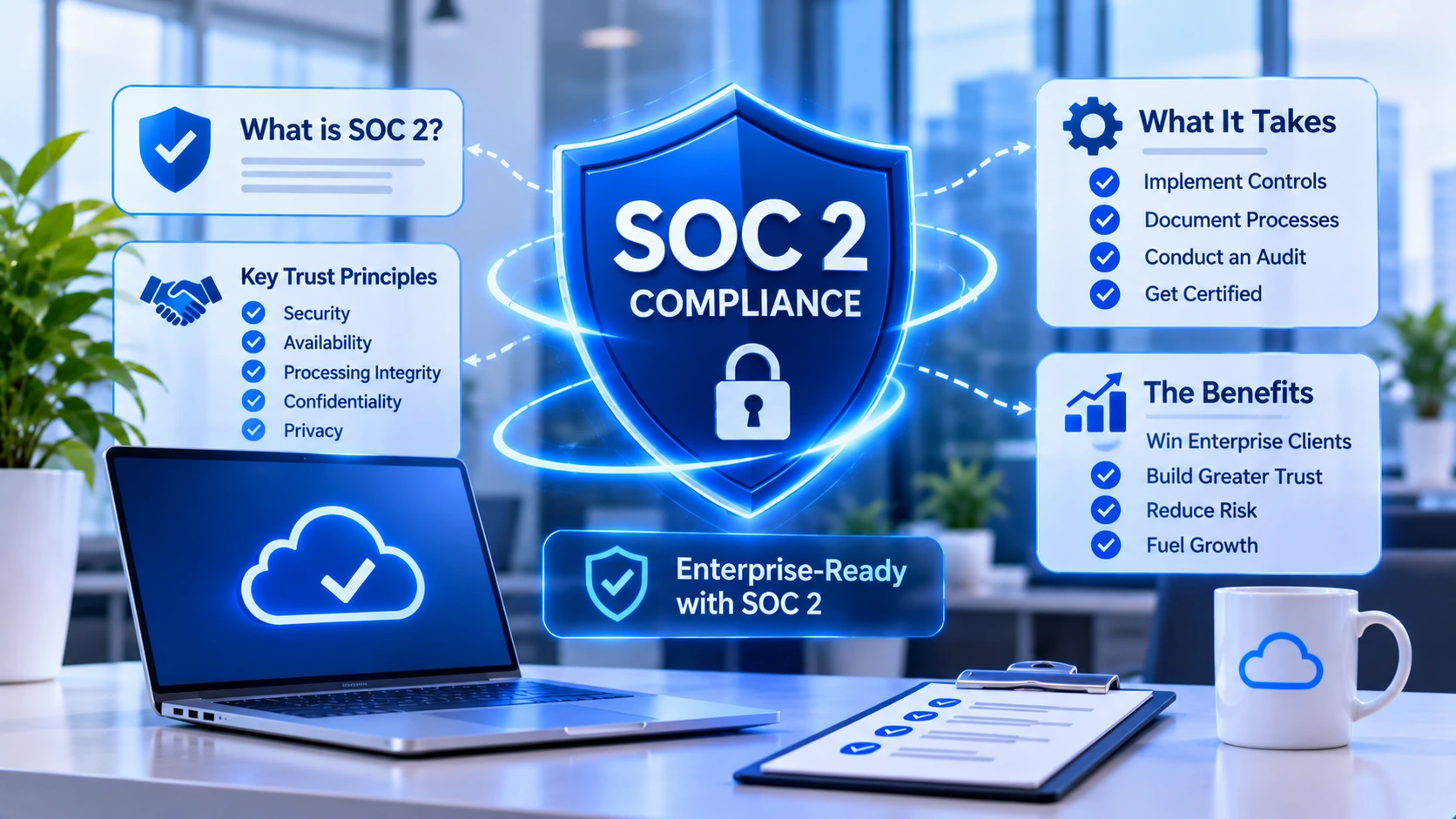
SOC 2 compliance for SaaS startups comes down to whether real controls can be proven with evidence, not just described in a policy document. Here's what the audit actually checks and where readiness usually breaks down.
SOC 2 is an audit report, not a piece of software: a licensed CPA firm examines a company's actual controls, access management, logging, encryption, incident response, against a set of Trust Services Criteria and states whether those controls are operating as described. SOC 2 compliance for SaaS startups usually becomes urgent the moment a mid-market or enterprise customer asks for the report before signing.
The part that often catches teams off guard is not the audit itself. It is that the audit only checks what a company can already show evidence of, so a startup that waits until the audit is scheduled to start logging access changes or reviewing permissions usually finds months of missing evidence, not a quick fix.
What SOC 2 Actually Certifies
SOC 2 evaluates a company against one or more of five Trust Services Criteria: security, availability, processing integrity, confidentiality, and privacy. Many SaaS companies pursuing it start with security alone, since that is a criterion customers commonly ask about. The audit itself is performed by an independent, licensed CPA firm; no software vendor can issue or guarantee a SOC 2 report, including Enorness.
The access controls, logging, and system design already in place long before an auditor is engaged generally affect how smooth that process is far more than any single tool choice. That underlying system design is the same decision covered in how to pick the right web application architecture: the structural choices made early tend to decide how much retrofitting an audit later requires.
Where Startups Get Stuck Before an Audit
The SOC 2 certification process tends to expose gaps that go unnoticed until an auditor starts asking specific questions.
Access control sprawl
Years of ad hoc access grants, a contractor added to production, an old employee's account never revoked, show up immediately once an auditor starts asking who can access what and why. Untangling that after the fact can take longer than building role-based access from the start.
Missing audit logs
An auditor needs evidence that access changes, deployments, and data exports are actually being logged, not just that a policy document says they should be. Many startups discover gaps in this logging only when they try to produce months of history for the audit.
Manual evidence collection
Screenshotting admin panels and exporting spreadsheets to prove a control exists can work for a one-time check, but a Type 2 audit asks for evidence over a period of months, which makes manual collection unsustainable at any real pace.
SOC 2 Type 1 vs Type 2
A Type 1 report checks whether the right controls exist at a single point in time, essentially a snapshot. A Type 2 report checks whether those same controls actually operated correctly over a period of months. Many enterprise customers eventually ask for Type 2, since a Type 1 only confirms a control was designed, not that it held up in practice. Many startups start with Type 1 to get a report in hand sooner, then move to Type 2 once the underlying systems have a track record to show.
How Software and Infrastructure Choices Affect Readiness
Security compliance for SaaS companies gets meaningfully easier or harder based on decisions made well before an audit is ever scheduled.
Centralized access and single sign-on
Tying access to a central identity provider, rather than separate logins per tool, makes it possible to show who had access to what at any point, and to revoke it everywhere at once when someone leaves. For a company serving multiple customers on shared infrastructure, this same boundary is what keeps one customer's data separated from another's; see multi-tenant SaaS architecture for how that isolation is typically structured.
Logging and monitoring built in from the start
Systems designed to log access, changes, and data exports by default produce the evidence an audit needs automatically, instead of requiring someone to reconstruct it after the fact.
Encryption and backup practices documented as they're built
Encrypting data at rest and in transit, and documenting backup and recovery procedures as part of the build rather than as an afterthought, turns what would be a scramble into something the team can already describe accurately. Companies moving off aging on-premise infrastructure tend to hit this question directly; what to check before that kind of move covers the backup and recovery decisions that carry over into audit evidence later.
A Hypothetical Example: A Startup Preparing for Its First SOC 2 Audit
A hypothetical example: a startup lands its first enterprise prospect, who asks for a SOC 2 Type 2 report before signing. The company has role-based access in place but no centralized log of who changed what in its production systems. Building that logging layer and centralizing identity management before the audit period starts, rather than during it, is what lets the company produce clean evidence when the audit eventually happens, instead of restarting the clock partway through.
Starting With the Controls That Actually Get Checked
SOC 2 for startups rarely means ripping out existing systems and starting over; more often it means tightening controls that are already close to what is needed. The clearest starting point is listing the specific controls a target customer's security questionnaire asks about and checking which of them the current systems can already produce evidence for. Access controls, logging, and system architecture are generally part of the broader enterprise software engineering work a growing company already needs; it just happens that an auditor eventually reviews some of the same ground.
Frequently Asked Questions
Can Enorness get a company SOC 2 certified?
No, and no software or development partner can. The report is issued by an independent, licensed CPA firm after reviewing the company's actual controls. What a partner can do is build the access controls, logging, and system architecture the audit will examine.
How long does SOC 2 compliance typically take?
It varies with how mature the existing systems and access controls already are. A Type 1 report can sometimes be reached faster since it only checks a point in time, while Type 2 requires the controls to run correctly over an observation period of months before the audit can even start.
Does a startup need Type 1 or Type 2?
It depends mainly on what the customers asking for the report actually require. Many startups start with Type 1 to have something in hand sooner, then move to Type 2 once there's a track record of the controls operating over time.
What's usually the biggest cost in getting ready for SOC 2?
It varies by company, but the engineering time to build or retrofit access controls and logging can be a significant cost alongside the audit fee, especially for a company that didn't design those systems with an audit in mind from the start.
Can a small startup realistically pass a SOC 2 audit?
Yes, in many cases. Auditors scope the review to the criteria selected and the systems in scope, so a small startup is not necessarily held to the same control set as a large enterprise. What matters most is that the controls in place are genuinely followed, not how many there are.
What happens if an audit finds a gap in a control?
It depends on the auditor and the nature of the gap; some become a noted exception in the final report rather than a failure of the whole audit. Addressing a gap before the audit period starts is generally more straightforward than explaining it afterward.
Working Out Where Readiness Actually Stands
The fastest way to tell is mapping the controls a target customer's questionnaire asks about against what current systems can already prove, rather than against a generic checklist. Enorness can be reached to talk through the engineering side of that question, where a product's current access controls, logging, and architecture stand relative to what a specific customer is asking for.

Written by
Mark Louis




Let's Build Something Extraordinary
Turn ideas into intelligent products that drive real business results.