Meditation App Development Guide 2026: Costs, Features & Legal Compliance

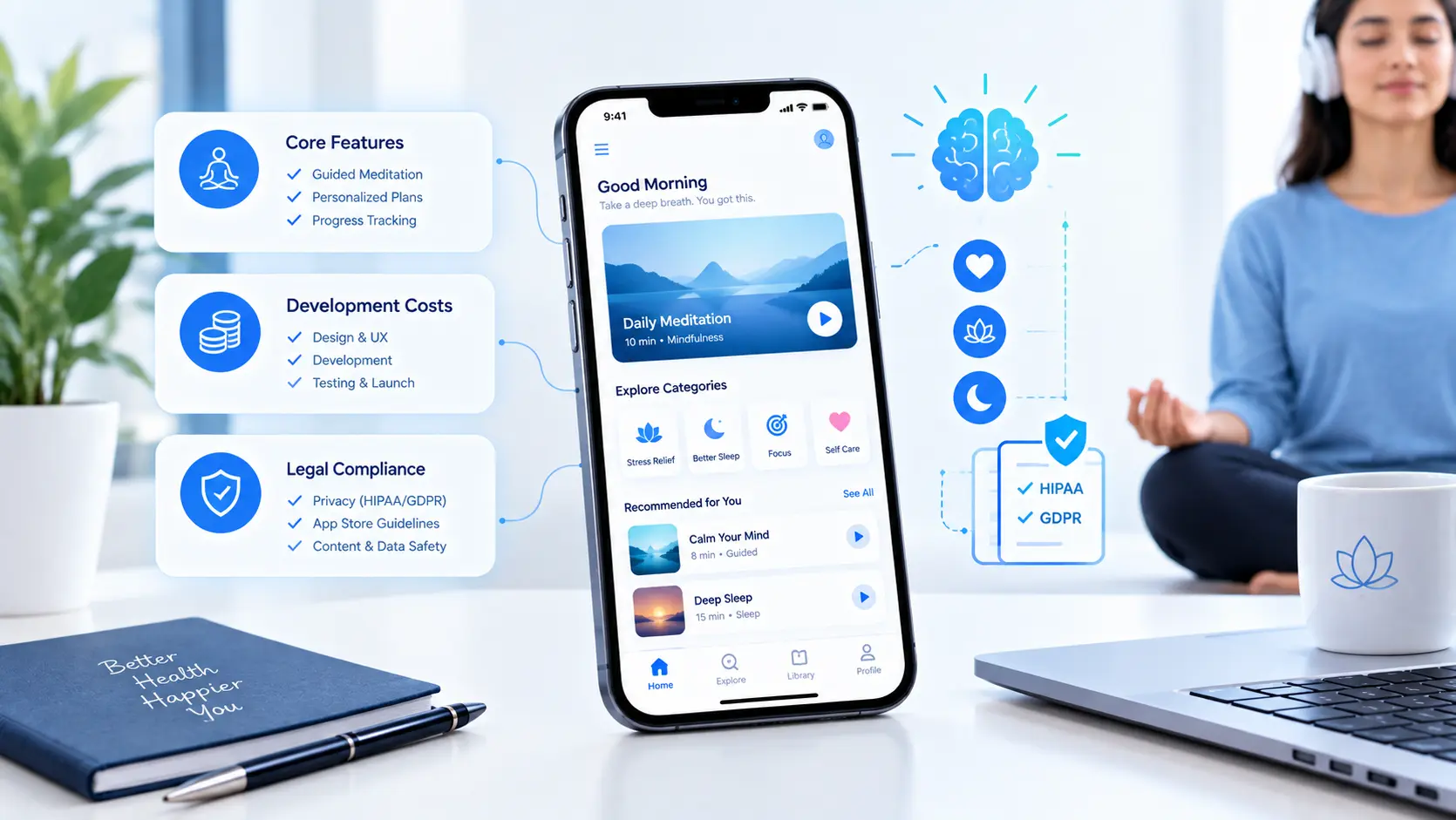
Most founders budget for the app and forget the rest. Then the invoices arrive: voice talent for 200 sessions.
Quick Answer: Building a meditation app in 2026 typically costs $30,000 to $60,000 for an MVP, $60,000 to $120,000 for a mid-tier app, and $120,000 to $250,000 or more for an AI-powered platform. Core features include guided audio, offline downloads, progress tracking, and subscriptions. In the US, you also need to plan for the FTC Health Breach Notification Rule, state health data laws, COPPA, and auto-renewal rules.
Most founders budget for the app and forget the rest. Then the invoices arrive: voice talent for 200 sessions, music licenses, audio streaming bills, and a privacy lawyer asking whether mood logs count as health data. (They usually do.)
This guide covers meditation app development in 2026 end to end: realistic costs, features that drive retention, the tech stack, and the US legal rules most guides skip.
Why Invest in Mindfulness App Development in 2026?
Calm and Headspace proved people will pay for mindfulness, but general-purpose apps struggle to serve specific audiences: nurses on night shifts, first responders, athletes, students, or faith-based users. Niche apps with focused content can win loyal subscribers without fighting the giants head-on.
B2B is the other opening. Employers and health plans buy mindfulness programs, which means steadier revenue than consumer subscriptions.
Must-Have Meditation App Features
Your MVP should do a few things extremely well.
Onboarding quiz: three or four questions about goals (sleep, stress, focus) that shape the first week of content.
Guided audio library: sessions sorted by goal and length, with 3, 5, 10, and 20-minute options.
Reliable audio playback: background playback, lock-screen controls, and no cutoffs when a notification arrives. This matters more than any visual feature.
Offline downloads: people meditate on planes, in basements, and in bed with Wi-Fi off.
Timer and unguided sessions: customizable bells and ambient sounds for experienced users.
Progress tracking: streaks, minutes, and gentle reminders that don't guilt people.
Subscriptions and free trial: handled cleanly on both iOS and Android.
Account and data controls: easy login, data export, and in-app account deletion, which Apple requires.
Advanced Features That Improve Retention
Once the core works, these lift retention and pricing:
AI-powered personalization: recommend sessions based on time of day, mood check-ins, and completion history. Thoughtful AI personalization can also generate short custom sessions, but review every AI script for safety.
Wearable integration: read heart rate and sleep data, and write mindful minutes, through Apple HealthKit and Android Health Connect. Apple Watch breathing sessions are a strong upsell.
Sleep content: sleep stories and soundscapes are often the most-used feature.
Programs and courses: 7 to 30-day structured journeys give users a reason to return.
Corporate dashboards: anonymized, aggregate engagement reports for B2B buyers.
Meditation App Development Cost Breakdown
Wellness app development costs depend on features, platforms, and content volume. Typical US-market ranges:
App tier | What's included | Typical cost | Timeline |
MVP | Audio library, player, offline mode, streaks, subscriptions | $30,000 to $60,000 | 3 to 4 months |
Mid-tier | Programs, personalization rules, HealthKit and Health Connect, admin CMS | $60,000 to $120,000 | 4 to 7 months |
Advanced | AI recommendations, live sessions, community, B2B dashboards | $120,000 to $250,000+ | 7 to 12 months |
A cross-platform build is the biggest cost saver. React Native app development or Flutter lets one codebase serve iOS and Android, often cutting build cost by 30 to 40% versus two native apps, though audio sometimes needs native modules.
Costs Most Guides Leave Out
Content production: professional voice recording, editing, and scripting for a launch library of 50 to 100 sessions can rival the development budget.
Music licensing: commercial tracks need synchronization and streaming rights. Many apps commission original music or use royalty-free libraries with app-use licenses.
Audio delivery: streaming high-quality audio through a CDN like Amazon CloudFront grows with every active user.
Store fees: Apple and Google take 15 to 30% of in-app subscription revenue.
Legal review: privacy policy, terms, and a health data review typically run a few thousand to tens of thousands of dollars.
Maintenance: plan on 15 to 20% of the original build cost each year for OS updates, bug fixes, and new content.
Recommended Tech Stack
Layer | Common choices |
Mobile app | React Native or Flutter, native Swift and Kotlin audio modules where needed |
Audio playback | AVFoundation on iOS, Media3 ExoPlayer on Android |
Backend | Node.js or Python with PostgreSQL, or Firebase for faster MVPs |
Content management | Headless CMS for sessions, programs, and metadata |
Subscriptions | StoreKit 2, Google Play Billing, RevenueCat to unify both |
Analytics | Privacy-conscious tools with health events kept out of ad platforms |
Design matters as much as code. A calm, uncluttered interface with large tap targets and dark mode is the product. Invest in UI/UX design early and test with real users who are tired or stressed, because that's when they'll open your app.
Legal Compliance for Meditation Apps in the US
This is where most meditation app guides fall short. Many say "make sure you're HIPAA compliant" and move on. In reality, most direct-to-consumer meditation apps aren't covered by HIPAA at all, but that doesn't mean health privacy rules don't apply.
When HIPAA Applies (and When It Doesn't)
HIPAA covers health plans, healthcare providers, and their business associates. A consumer app sold directly on the App Store usually isn't covered. HIPAA applies when you build the app for, or on behalf of, a covered entity, for example a hospital's patient mindfulness program or a health plan's member benefit. In that case you'll need a business associate agreement, HIPAA-eligible hosting, access controls, and audit logs.
FTC Health Breach Notification Rule
For non-HIPAA apps, the FTC is the key regulator. Its amended Health Breach Notification Rule, effective July 29, 2024, explicitly covers health and wellness apps that aren't subject to HIPAA. It requires you to notify users and the FTC within 60 days of discovering a breach. Importantly, the FTC treats unauthorized sharing, such as sending mood or sleep data to advertising platforms without consent, as a breach, not just hacking. Enforcement actions against Flo Health and BetterHelp show how seriously the FTC takes this.
State Health Data and Privacy Laws
Several states now treat wellness data as sensitive. Washington's My Health My Data Act applies broadly to consumer health data, requires separate consent to collect and share it, and allows private lawsuits. Nevada and Connecticut have similar protections, and broader privacy laws like California's CCPA classify health information as sensitive personal information. Practical takeaways: get explicit opt-in consent before collecting mood, sleep, or biometric data; publish a separate consumer health data privacy policy; and never share health-related events with ad pixels.
Children's Privacy (COPPA)
If your app targets kids or knowingly collects data from children under 13, COPPA applies, including verifiable parental consent. The FTC's amended COPPA Rule added stricter requirements, including separate parental consent for sharing data with third parties for advertising. Mindfulness apps for schools or families should be designed around this from day one.
Subscription and Auto-Renewal Rules
Free trials that convert to paid plans are heavily regulated. State automatic renewal laws, including California's, require clear terms before purchase, affirmative consent, reminders, and easy online cancellation. The FTC also targets confusing "dark pattern" cancellation flows.
Health Claims, FDA, and App Store Rules
Keep marketing claims in wellness territory. "Helps you relax" is general wellness. Claiming the app treats anxiety, depression, or insomnia can trigger FDA medical device rules and FTC scrutiny.
Apple's App Store Review Guidelines add their own requirements: in-app account deletion, restrictions on using HealthKit data for advertising, and accurate privacy nutrition labels. If your app touches mental health topics, include crisis resources such as the 988 Suicide and Crisis Lifeline, and keep any AI chat features within clear safety limits.
Accessibility
Follow WCAG 2.2: screen reader labels, adjustable text, transcripts for audio, and strong color contrast. It reduces ADA risk and widens your audience.
Monetization Models That Work
Freemium subscription: a free starter library with premium content behind monthly or annual plans. Annual plans with a 7-day trial are the most common setup, handled through reliable payment integration and store billing.
Lifetime access: a one-time premium option that appeals to subscription-weary users.
B2B licensing: per-employee pricing for employers, schools, and health plans.
Teacher courses: premium programs from well-known teachers with revenue sharing.
Skip ads. They break the calm and add privacy risk.
Launch and Growth Tips
Launch with 30 to 50 polished sessions rather than 300 average ones, then add content based on completion data. Track day 1, 7, and 30 retention and trial-to-paid conversion. Store visibility drives early growth, so plan app store optimization around specific searches like "sleep meditation" or "anxiety relief breathing" before launch.
Frequently Asked Questions
Q1: How much does it cost to build a meditation app like Calm?
A: An MVP typically costs $30,000 to $60,000. A Calm-like platform with sleep stories, personalization, wearables, and large content libraries can reach $150,000 to $250,000 or more, plus ongoing content and maintenance costs.
Q2: How long does meditation app development take?
A: An MVP takes three to four months. Mid-tier apps take four to seven, and advanced platforms can take a year.
Q3: Does a meditation app need to be HIPAA compliant?
A: Only if you build it for or on behalf of a HIPAA covered entity, such as a hospital or health plan. Most consumer meditation apps instead fall under the FTC Health Breach Notification Rule and state health data laws.
Q4: What features should a meditation app MVP include?
A: Onboarding, a guided audio library, reliable background playback, offline downloads, progress tracking, subscriptions, and in-app account deletion.
Q5: Can I use popular music in my meditation app?
A: Not without licenses covering in-app streaming. Most apps commission original music or use royalty-free libraries that permit app use.
Q6: How do meditation apps make money?
A: Most use freemium subscriptions with a free trial. Lifetime purchases, B2B licensing to employers and health plans, and teacher courses add revenue.
Build Your Meditation App with Enorness
Enorness handles meditation app development end to end for US founders and wellness brands: product strategy, calming UI/UX, cross-platform builds, audio engineering, subscriptions, and privacy-by-design architecture that holds up to legal review. Need to extend your in-house team instead? Our dedicated development team model plugs right in. Book a free consultation to get a feature plan and cost estimate for your app.

Written by
Mark Louis

Let's Build Something Extraordinary
Turn ideas into intelligent products that drive real business results.