HIPAA Compliant Software Development: 2026 Guide for Healthcare Apps & AI

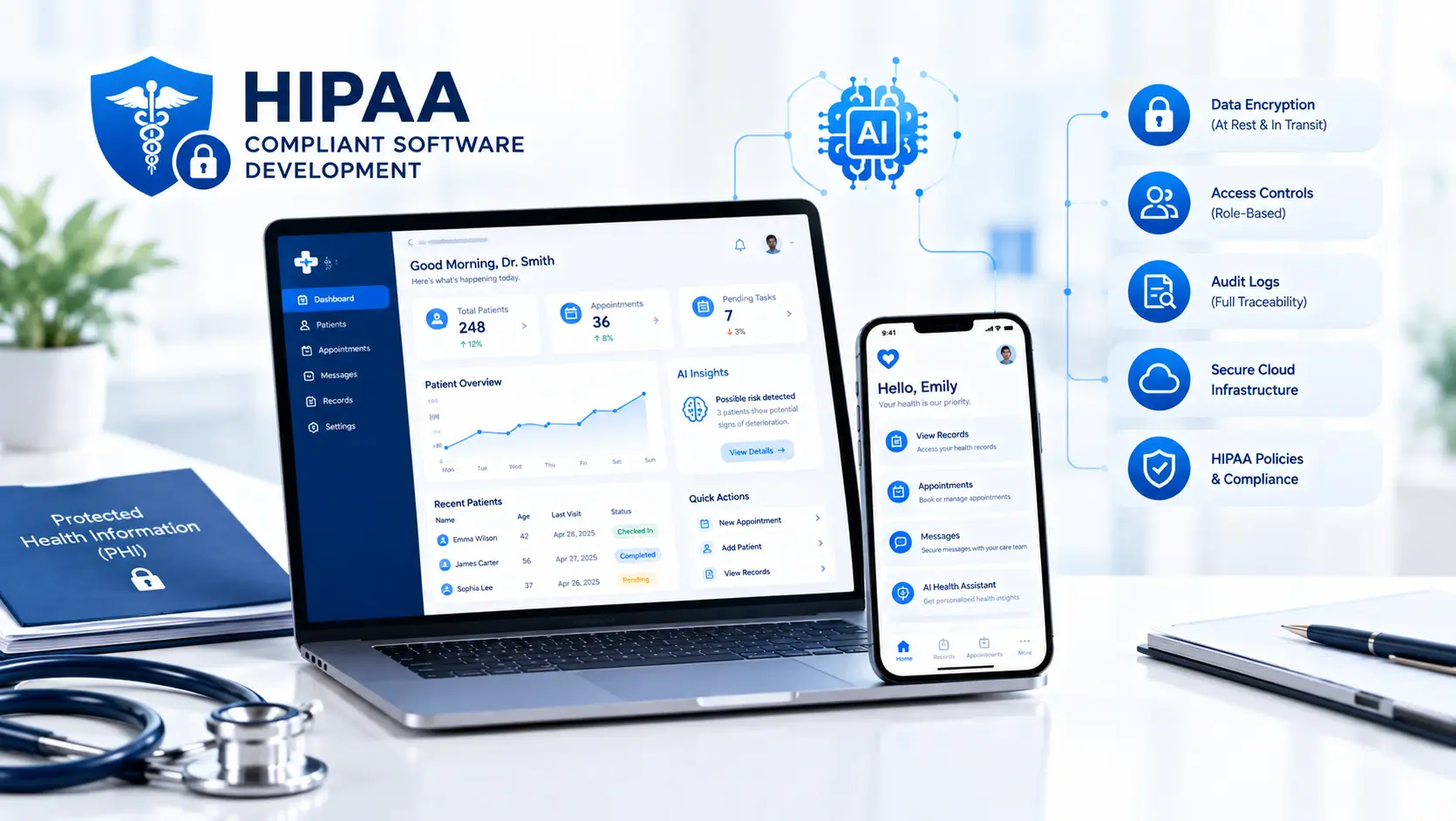
A telehealth startup ships its MVP. Clean design, fast video calls, happy pilot clinic. Three months later, their security review turns up a problem.
Quick Answer: HIPAA compliant software development means building apps that protect electronic protected health information (ePHI) under the HIPAA Privacy, Security, and Breach Notification Rules. In practice, that requires a risk analysis, encryption at rest and in transit, MFA, role-based access, audit logs, signed business associate agreements (BAAs) with every vendor that touches PHI, and a tested breach response plan. There is no official HIPAA certification for software.
A telehealth startup ships its MVP. Clean design, fast video calls, happy pilot clinic. Three months later, their security review turns up a problem: appointment reminders were sending the reason for the visit in push notifications, and the crash reporting tool was capturing patient names from error screens. Neither vendor had signed a BAA. Nothing was hacked, but both were potential HIPAA violations.
That's the reality of building healthcare software. Compliance rarely fails in the obvious places. It fails in notifications, logs, analytics SDKs, and AI prompts. This guide covers what HIPAA requires from developers in 2026, what has and hasn't changed, and how to approach HIPAA compliant app development and AI features that pass a real audit.
What Makes Software HIPAA Compliant?
No government body certifies software as "HIPAA compliant." Compliance belongs to organizations, and software either supports it or undermines it. When vendors call a product HIPAA compliant, they mean it has the safeguards a covered entity or business associate needs, and that they'll sign a BAA.
HIPAA applies to covered entities (healthcare providers, health plans, and clearinghouses) and their business associates, the vendors that create, receive, store, or transmit PHI on their behalf. If you build software for a clinic, hospital, or insurer, you're almost certainly a business associate. Three rules shape your build:
Privacy Rule: who can use and disclose PHI, and the minimum necessary standard.
Security Rule: administrative, physical, and technical safeguards for ePHI.
Breach Notification Rule: notifying affected individuals within 60 days of discovering a breach, plus HHS and, for breaches affecting 500 or more people in a state, the media.
Does Your App Actually Need HIPAA?
This question decides your architecture and budget, so answer it early.
Scenario | HIPAA applies? | What applies instead or as well |
Patient portal for a clinic | Yes | HIPAA plus state privacy laws |
Telehealth platform used by providers | Yes | HIPAA plus state telehealth rules |
Insurer's member app | Yes | HIPAA |
Consumer fitness or meditation app sold directly | Usually no | FTC Health Breach Notification Rule and state health data laws |
Employer wellness app not tied to a health plan | Often no | FTC rules and state laws |
Direct-to-consumer apps aren't off the hook. The FTC and states like Washington regulate consumer health data aggressively, as we cover in our guide to wellness app compliance.
2026 Status Check: What's Final and What's Only Proposed
A lot of content online presents the new HIPAA Security Rule as if it's already law. It isn't. HHS published the proposed overhaul in January 2025, and as of September 2026 no final rule has been issued. The proposal would make encryption and MFA mandatory, remove "addressable" specifications, and require asset inventories, annual penetration tests, twice-yearly vulnerability scans, and 72-hour system restoration.
Our advice: build to the proposed standard now. It reflects what OCR already expects in investigations, what cyber insurers increasingly require, and what enterprise healthcare buyers ask for in security questionnaires. Retrofitting encryption and MFA later costs far more than designing them in.
Two other updates matter. The 2024 reproductive health privacy rule was vacated by a federal court in 2025, and covered entities had to update their Notices of Privacy Practices by February 16, 2026, to reflect new 42 CFR Part 2 rules for substance use disorder records.
Technical Safeguards Every Healthcare App Needs
Encryption everywhere: AES-256 for data at rest, including databases, backups, and device storage, and TLS 1.2 or higher in transit.
Multi-factor authentication: for clinicians, admins, and support staff at minimum, and ideally patients too.
Role-based access control: least-privilege permissions, so a billing clerk never sees clinical notes they don't need.
Unique user IDs and automatic logoff: no shared accounts, and sessions that time out on shared devices.
Audit logs: record who viewed, changed, or exported PHI and when, stored in tamper-resistant form.
Integrity controls: checksums and versioning so records can't be silently altered.
Backups and disaster recovery: encrypted, tested backups with a documented restore process.
The PHI Leaks Developers Miss Most
Most HIPAA problems in modern apps come from third-party code and convenience features, not databases:
Push notifications and SMS: "Your therapy appointment is tomorrow" discloses PHI on a lock screen. Use neutral text like "You have an upcoming appointment."
Analytics and tracking pixels: tools from Meta, Google, and others on authenticated pages can transmit PHI. Several health systems have paid large settlements over pixel tracking.
Crash reporting and logs: scrub PHI from error messages, stack traces, and application logs before they leave your servers.
URLs and query strings: never put names, conditions, or record IDs in URLs that end up in browser history and server logs.
Email: standard email isn't secure for PHI. Use encrypted messaging or a patient portal.
Device caches: clear sensitive screens from app snapshots and local caches.
Building a HIPAA Compliant Cloud and Vendor Stack
Every vendor that touches PHI must sign a BAA, and every service you use must fall inside that BAA's scope. AWS, Microsoft Azure, and Google Cloud all sign BAAs, but only for their HIPAA-eligible services. Using an ineligible service with PHI breaks compliance even if the account has a BAA.
Check the same for communication tools like Twilio, email providers, video SDKs, customer support platforms, and error monitoring tools. Many popular developer tools don't sign BAAs at all. Mapping these data flows is part of your web application architecture, and it's much easier on a whiteboard than in production.
HIPAA Compliant AI: LLMs, Chatbots, and Agents
AI is where healthcare teams move fastest and compliance gaps are newest. You can use large language models with PHI, if you set them up correctly.
Get a BAA with your AI provider. OpenAI and Anthropic offer BAAs for eligible API use, while Amazon Bedrock and Azure OpenAI can fall under your existing cloud BAA. Consumer chatbot apps generally aren't covered.
Apply minimum necessary. Send the model only the data needed for the task, not the full chart.
De-identify where you can. HIPAA's Safe Harbor method removes 18 identifiers. De-identified data isn't PHI.
Treat prompts and outputs as PHI. They belong in encrypted storage with access controls and audit logs.
Keep a human in the loop for anything clinical, and document how AI outputs are reviewed.
Retrieval matters too. An AI assistant should only retrieve records the user is already allowed to see, which is why permission-aware design in your enterprise knowledge base is critical. Done well, HIPAA compliant AI can cut documentation time and speed up patient communication without adding risk.
How to Make an App HIPAA Compliant: Step by Step
Run a risk analysis. Identify where ePHI lives, how it moves, and what threatens it. OCR's enforcement actions in recent years have repeatedly cited missing or outdated risk analyses.
Map data flows and design the architecture with encryption, access control, and logging built in.
Follow a secure SDLC: threat modeling, code review, static and dynamic security testing, and dependency scanning in CI/CD.
Sign BAAs with every vendor before any real PHI enters the system.
Test before launch with penetration testing and a review against the HIPAA Security Rule.
Prepare for incidents: a written response plan, breach assessment process, and notification templates.
How Much Does HIPAA Compliant Software Development Cost?
Compliance typically adds 15 to 30% to a comparable non-healthcare build, driven by security engineering, HIPAA-eligible infrastructure, testing, and documentation. Ongoing costs include annual risk analyses, penetration tests, security monitoring, and staff training. Compare that with the downside: civil penalties can exceed $2 million per violation category per year, before breach response, legal fees, and lost contracts.
How to Choose a HIPAA Development Team
Ask any potential vendor whether they'll sign a BAA, how they keep real PHI out of development and test environments, what their breach response process looks like, and which HIPAA-eligible services they've built on before. A team that can't answer those questions clearly will learn HIPAA on your budget.
Frequently Asked Questions
Q1: Is there an official HIPAA certification for software?
A: No. HHS doesn't certify software. Compliance depends on how an organization uses the software, backed by safeguards, policies, risk analysis, and signed BAAs. Third-party audits like HITRUST or SOC 2 can show strong controls.
Q2: Is the new HIPAA Security Rule in effect in 2026?
A: No. The overhaul proposed in January 2025 hadn't been finalized as of September 2026. The existing Security Rule still applies, but building to the proposed requirements is smart preparation.
Q3: Can I use ChatGPT or other AI tools with patient data?
A: Only through services covered by a signed BAA, such as eligible enterprise APIs or cloud AI platforms. Consumer chatbot apps shouldn't receive PHI.
Q4: Is Firebase or AWS HIPAA compliant?
A: AWS signs a BAA for its HIPAA-eligible services. Google Cloud's BAA covers specific services only, so check each Firebase or Google Cloud product against the covered list before storing PHI.
Q5: How long does it take to build HIPAA compliant software?
A: A focused MVP typically takes four to six months, including security testing. Complex platforms with EHR integrations take longer.
Q6: What happens if my app has a HIPAA breach?
A: You must assess the breach, notify affected individuals within 60 days, report to HHS, and notify media if 500 or more residents of a state are affected. Business associates must notify the covered entity.
Build Secure Healthcare Software with Enorness
Enorness delivers HIPAA compliant software development for US healthcare providers, digital health startups, and health plans. From patient portals and telehealth to secure health app development and AI assistants that handle PHI correctly, we design compliance into the architecture from day one. Need extra engineering capacity? Book a free HIPAA software consultation to review your build plan.

Written by
Mark Louis

Let's Build Something Extraordinary
Turn ideas into intelligent products that drive real business results.