Data Engineering for Growing Businesses: Why Clean Data Comes First

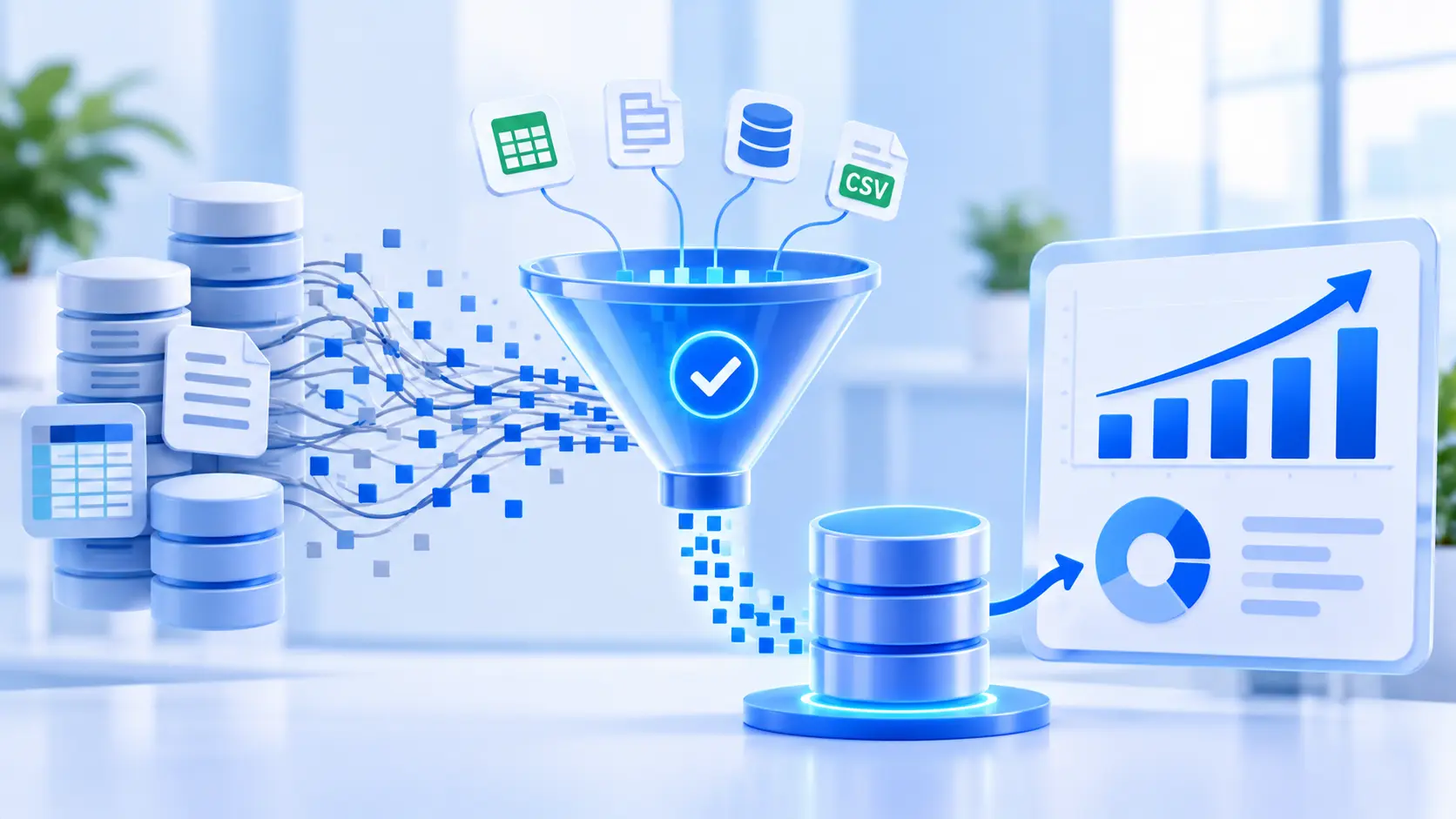
Many automation and reporting projects stall because of messy underlying data, not bad logic on top of it. Here is what data engineering for business actually covers, and why it has to come before the systems built on top of it.
Data engineering for business rarely gets attention on its own. It shows up as the reason a dashboard shows the wrong number, the reason two systems disagree about the same customer, or the reason an automation project stalls before it reaches production. The work itself is unglamorous: moving data from where it is created to where it needs to be read, in a form that is consistent enough to trust.
This is the discipline covered under data engineering and analytics, separate from the automation or reporting layer built on top of it. This covers what data engineering for business actually involves, the signs a business's data is not ready for the next project built on it, and why the order matters.
What Data Engineering for Business Actually Means
Data engineering is the work of getting data from wherever it is created, a point-of-sale system, a booking tool, a spreadsheet someone maintains by hand, into a structure that other systems can read reliably. It covers three jobs: pulling the data in from its source, cleaning and standardizing it so the same field means the same thing everywhere, and delivering it to whatever reads it next, a dashboard, a report, or an automated process.
This is different from data analysis, which asks what the data means, and different from building the dashboard or report itself, which presents it. Business data architecture is the layer underneath both of those, and it determines how reliable everything built on top of it will be.
Signs a Business's Data Is Not Ready
The same customer exists in three different forms
A customer who shows up as one record in the booking system, a different record in the email platform, and a third in a spreadsheet someone keeps for reporting is a sign that nothing is actually synchronized. Every report built on top of this disagrees slightly with every other report, and nobody can say which number is correct.
Reports require a person to manually reconcile numbers
If getting an accurate monthly number requires someone to open three exports and cross-reference them by hand, the business does not have a data pipeline yet. That manual step is doing the job a pipeline should be doing automatically, and it does not scale past the person currently doing it.
A new system or automation project keeps getting delayed
Automation and AI projects are frequently scoped around a clean version of the data that does not actually exist yet. The project then stalls while someone discovers, mid-build, that the fields do not mean what they were assumed to mean.
What a Data Pipeline Actually Does
Ingestion
A data pipeline for business turns that manual step into a scheduled one: data is pulled from its source on a schedule or as it is created, rather than exported by hand whenever someone needs a report. This removes a common point of human error: someone forgetting to export, or exporting the wrong date range.
Cleaning and standardizing
Fields get normalized so a phone number, a date, or a customer name is represented the same way regardless of which system it came from. This is where much of the engineering work happens, and it is a step that is often underestimated when a project is scoped.
Delivery
The cleaned data lands somewhere other systems can read it reliably, a warehouse, a structured database, or a feed built for the specific tool reading from it. What matters is that whatever reads it next gets a consistent structure every time, not a slightly different export format depending on when it ran.
Why Automation Projects Depend on This Layer
Business process automation and AI agent development both assume the data feeding the process is already structured and consistent. That assumption is usually the weakest part of a project scoped without first checking the data infrastructure underneath it.
An AI agent built to read customer records reliably depends on those records meaning the same thing across every system it touches. When they do not, the agent inherits the inconsistency rather than fixing it, which is why clean data for automation is a precondition for AI solutions and agents, not a feature of the automation itself.
Why Mapping Comes Before Scoping
Mapping where data actually lives and how consistent it is comes before scoping anything built on top of it. A dashboard, a report, or an automation project inherits whatever state the underlying data is in, so that state is worth understanding first rather than discovering it partway through a build.
Businesses unsure whether their current data is ready for the next reporting or automation project can talk to Enorness about the state of their data before that project is scoped.
Frequently Asked Questions
What is data engineering for a business?
Data engineering is the work of pulling data from wherever it is created, cleaning and standardizing it, and delivering it in a consistent structure to whatever reads it next, a dashboard, a report, or an automated process.
How is data engineering different from data analysis?
Data analysis asks what the data means. Data engineering is the layer underneath that: getting the data into a reliable, consistent structure in the first place, before anyone can analyze it accurately.
What are the signs a business needs data engineering work?
The same customer or record existing in different forms across systems, reports that require manual reconciliation, and automation projects that keep stalling once they hit the actual data are the most common signs.
Does a small business need a full data pipeline for business?
The scale matters less than the number of systems involved. A business pulling data from two or three disconnected tools benefits from the same standardization a larger business needs, just at a smaller scope.
Can an automation or AI project succeed without this data layer?
It can run, but it inherits whatever inconsistency already exists in the underlying data rather than fixing it. The automation is only as reliable as the data feeding it.
What affects how long it takes to review a business's data before a project starts?
A review of data from a small number of connected systems is a smaller scope than mapping data across many disconnected tools, which takes longer to assess and clean.

Written by
Mark Louis




Let's Build Something Extraordinary
Turn ideas into intelligent products that drive real business results.