AI-Powered Customer Retention: How AI Agents Reduce Churn Without Losing the Personal Touch

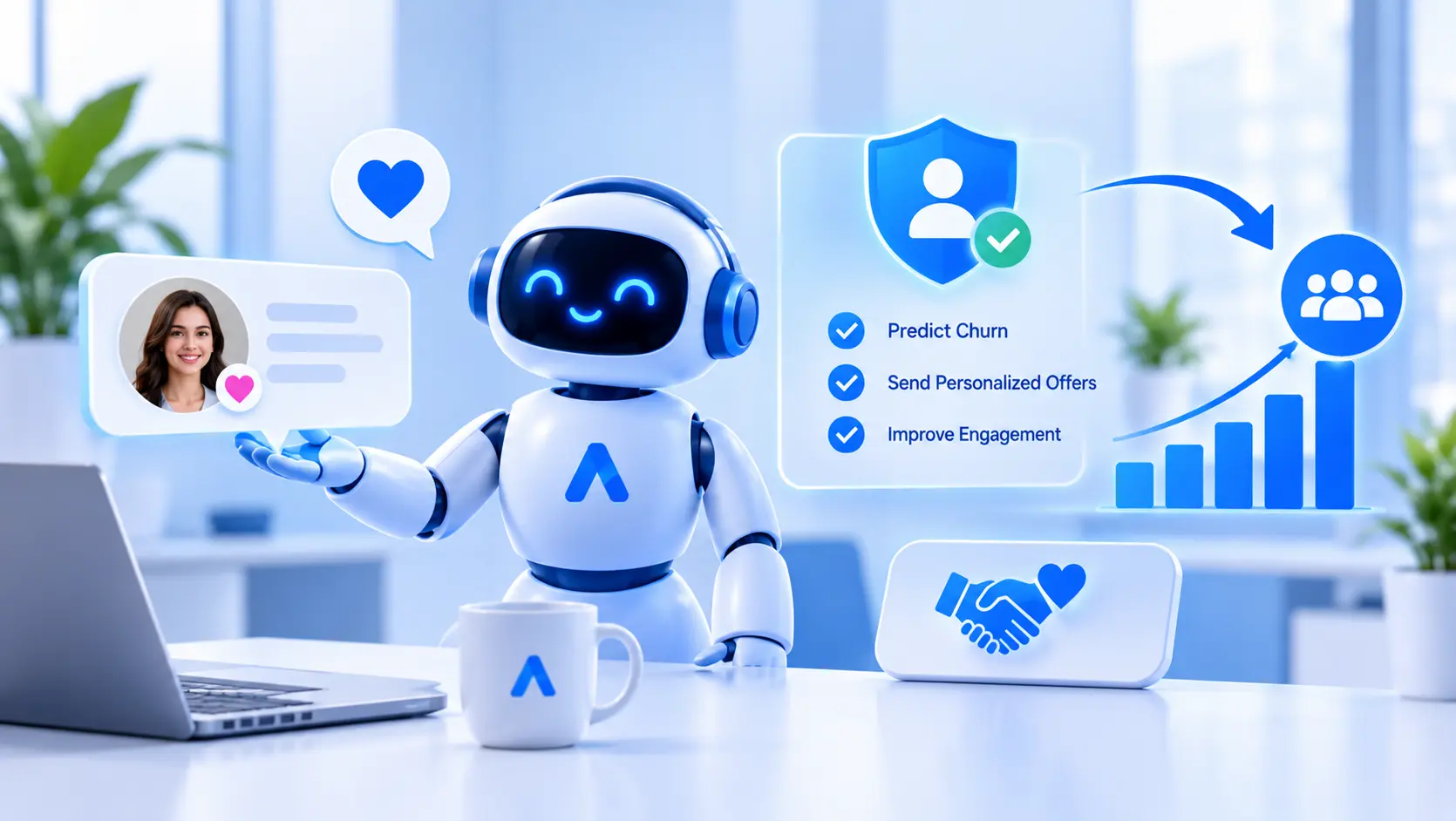
An AI retention agent watches for early signs that a customer is about to churn, then triggers the right response before it is too late. Here is how that works, and how GrabEasy's own Grab AI applies a similar idea for restaurants.
Most customer retention effort starts after the fact: a win-back email once a customer has gone quiet, a discount offered once someone stops ordering. By the time that message goes out, the decision to leave is often already made. AI-powered customer retention moves that work earlier, into the window where a customer's behavior is changing but the relationship is not yet over.
Enorness builds AI solutions and agents that watch for that window directly in a business's existing data, rather than relying on a fixed schedule of reminder emails. This covers what an AI retention agent actually does, how it differs from a standard loyalty program, and how a similar idea shows up in GrabEasy's own Grab AI.
What AI-Powered Customer Retention Actually Means
AI-powered customer retention uses an agent to monitor behavior signals, such as order frequency, login activity, or renewal timing, and compares each customer against their own baseline rather than a single fixed threshold. A customer segmentation AI layer then groups customers by the type of change in their behavior, and a triggered response goes out that matches the likely reason, not a single generic offer sent to everyone.
This is different from a loyalty program, which rewards behavior that already happened the same way for every member, and different from basic email reminders, which go out on a schedule regardless of whether a customer's behavior has actually changed.
Where Manual Retention Efforts Fall Short
Churn signals get noticed too late
A drop in order frequency or engagement is easy to miss when no one is tracking it against a customer's own history. By the time a staff member notices a customer has gone quiet, weeks have usually passed, and the same message that could have worked early no longer does.
One offer does not fit every reason for leaving
Customers drift for different reasons: price sensitivity, a bad recent experience, a competitor, or simply reduced need. A single win-back discount addresses one of those reasons and ignores the rest, so AI churn reduction depends on separating customers by likely cause before a response is sent.
Segmentation by hand does not scale with the customer base
Reviewing accounts individually works at a small scale and breaks down as the customer base grows. Without an automated layer, the business either stops segmenting, which weakens every campaign that follows, or spends disproportionate staff time on a task that an agent can do continuously.
How an AI Retention Agent Works
The architecture follows the same layered pattern used in AI agent development generally: a data layer that reads existing behavior records, a reasoning layer that classifies the type of change, and an action layer that triggers the response. What differs is the specific signals the agent is built to watch.
Reading behavior data
The agent reads from systems that already exist: order history, login records, booking frequency, whatever the business already tracks. No new data collection step is required before the agent can start working.
Detecting the signal
A drop is measured against the customer's own prior pattern, not a fixed rule applied to everyone. A customer who orders weekly and goes quiet for ten days is a different signal than one who orders twice a year and goes quiet for a month.
Triggering the response
Once a churn signal is classified, the agent triggers a response suited to the likely cause, a price-sensitive customer gets a different message than one who had a service issue. The response is the first step; a human still handles anything that needs a real conversation.
A Real Example: Grab AI Inside GrabEasy
GrabEasy, an online ordering platform for independent restaurants and cafes, addresses this same retention problem with Predict and Grab AI. Predict scores each customer nightly on churn likelihood and customer value. Grab AI gives the restaurant owner recommendations for campaigns, and the owner schedules and sends them by email and push notification.
The pattern is similar: use existing order data to flag churn risk early. In GrabEasy, the restaurant owner decides which campaign to send and when; the churn scoring and campaign recommendations sit inside the ordering platform itself.
AI Retention vs Traditional Loyalty Programs
A loyalty program rewards a transaction after it happens, with the same points or discount structure for every member regardless of why any individual customer keeps coming back or stops. It is a retention tool, but a passive one: it works only if the customer engages with it on their own.
An AI retention agent works earlier and more specifically. It does not wait for a customer to redeem a reward or respond to a newsletter; it watches behavior directly and initiates the response itself once a signal appears. The two are not mutually exclusive. A loyalty program can run alongside an AI retention agent, with the agent deciding when a loyalty offer is the right response and when something else is.
Retention also connects to the earlier stage of the same customer relationship covered in AI lead generation: one agent qualifies interest before it becomes a customer, and a separate agent, built on the same underlying architecture, works to keep that customer once the relationship exists.
How Enorness Approaches AI-Powered Retention
Enorness starts with the data a business already has rather than requiring a new tracking system. Order history, booking records, and CRM activity are usually enough to establish a baseline for each customer.
Getting that data into a usable, consistent form is data engineering work, and it is the step that determines whether the churn signals the agent detects are reliable or noisy.
Once a response is triggered, the handoff into the CRM, the booking system, or a support queue is handled through business process automation, so a flagged customer does not sit in a queue waiting for someone to notice.
Businesses looking to reduce churn with AI do not need to replace their existing systems first. The agent is built around the data already in place, and the first version can target one churn signal rather than every possible one at once.
Companies that want to know where their own customer base is losing people quietly can get in touch with Enorness to scope the first retention agent.
Frequently Asked Questions
What is AI-powered customer retention?
AI-powered customer retention uses an agent to monitor behavior signals such as declining order frequency or missed renewal dates, then segments customers and triggers a targeted response before they churn, rather than waiting for a win-back campaign after they have already left.
How does an AI retention agent detect churn risk?
The agent tracks patterns in existing behavior data, how often a customer orders, books, or logs in, and how that frequency changes over time. A drop against a customer's own baseline is treated as a churn signal, rather than a single missed interaction.
Is this different from a loyalty program?
A loyalty program rewards behavior that already happened, usually with the same offer for every member. AI-powered retention looks for signs that behavior is about to change and responds before it does, with a message suited to the specific reason a customer appears to be drifting.
Does AI-powered retention only work for larger businesses?
The approach scales down as well as up. A single-location business with a smaller customer base still benefits from catching early churn signals, since losing even a few regular customers has a larger relative impact than it would for a larger operation.
How long does it take to deploy an AI retention agent?
A focused agent handling one churn signal is a smaller scope than a deployment covering multiple signals and campaign types, which takes longer to design and test before it runs reliably.
Does AI retention replace a customer success or support team?
No. It replaces the manual work of spotting churn risk and triggering the first response, not the relationship itself. A customer success or support team still handles the conversation once a response is triggered.

Written by
Mark Louis



Let's Build Something Extraordinary
Turn ideas into intelligent products that drive real business results.