AI Agent Security: What Businesses Need to Know Before Deploying One

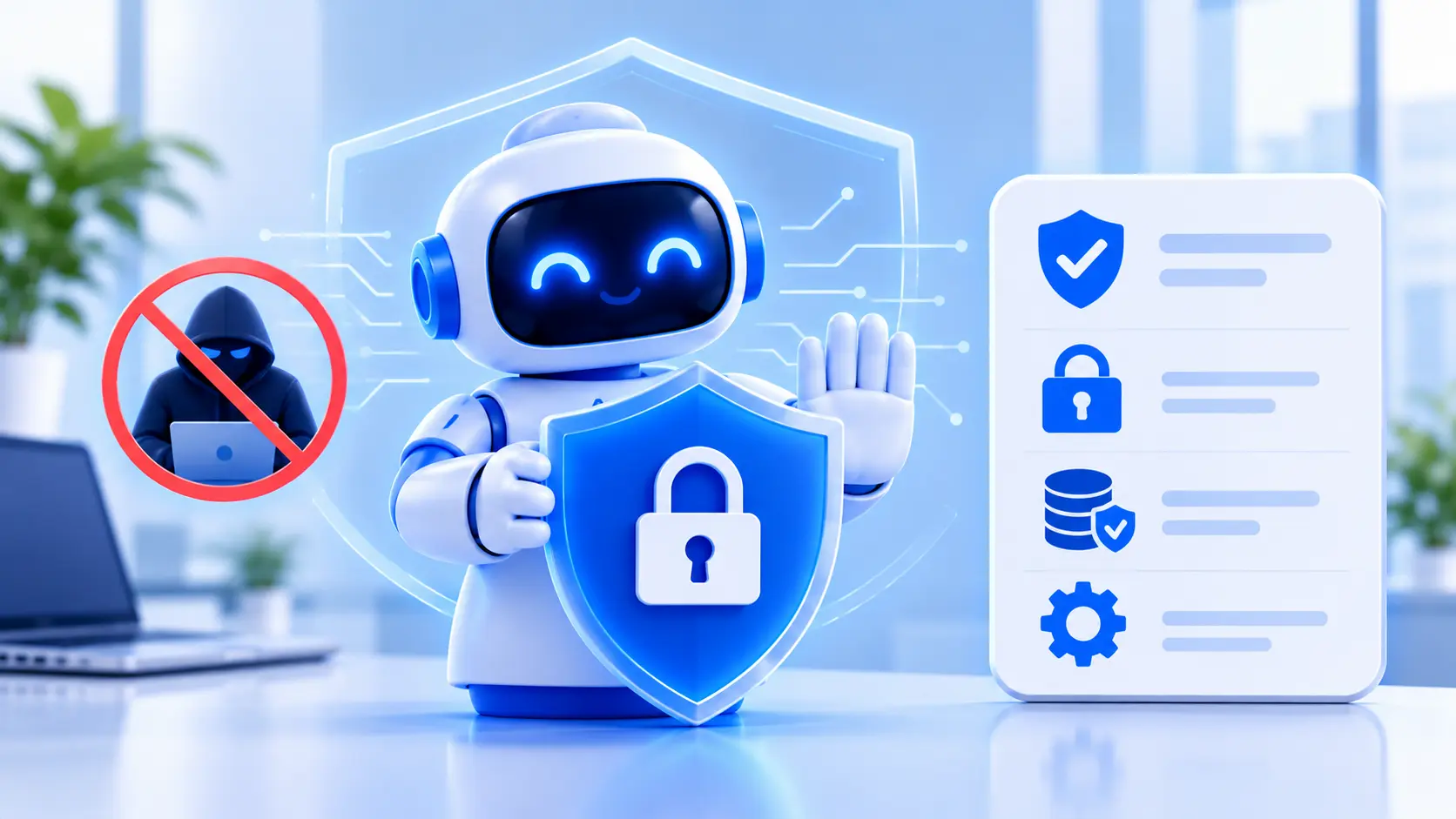
Many AI agent security problems trace back to one of three gaps: too much data access, unreviewed action permissions, or no audit trail. Here is what to check before an agent goes into production.
AI agent security is usually treated as an afterthought, addressed once a deployment is already running rather than designed in from the first architecture decision. That ordering contributes to much of the avoidable risk: an agent given broad access to data or systems before anyone worked out what it actually needs to do its job.
Scoping access before an agent gets a live connection to any system is the order that works. This matters directly for AI solutions and agents, and this covers what AI agent security actually means in practice, where risk tends to enter a deployment, and the core practices that keep an agent's access matched to what it is supposed to do.
What AI Agent Security Actually Covers
AI agent security covers three distinct areas: what data the agent can read, what actions it is permitted to take once it has read that data, and how reliably those actions can be reviewed after the fact. A deployment that addresses only one of these, usually data access, is not secure in a meaningful sense, because the other two carry just as much risk.
This is a narrower problem than general AI safety, and a different one than traditional application security. The agent itself may be well built and still create exposure if the surrounding access controls were never scoped to the task.
Where Security Risk Enters an AI Agent Deployment
Overbroad data access
An agent built to qualify inbound messages does not need read access to an entire CRM, an entire inbox, or every field in a customer record. Data privacy for AI agents starts here more often than anywhere else: access was granted at the system level because it was convenient to set up, not because the agent needed that much of it.
Unreviewed action permissions
Reading data safely is only half the problem. An agent that can also write to a system, send a message, or trigger a workflow needs those permissions scoped just as tightly as its read access. A permission granted during testing and never revisited is a common source of risk once the agent is handling real input.
No audit trail
Without a record of what the agent read, how it classified it, and what action it took, there is no way to investigate an incident after it happens or to confirm the agent is behaving as expected during normal operation. Logging is not optional once an agent has any access to real customer or business data.
Core Practices for Secure AI Deployment
Least privilege by default
An agent should be given access scoped to the specific process it handles, not blanket access to every connected system. AI agent access control applies to an agent the same way it applies to any other piece of software with access to real data, and the default should start narrow rather than being narrowed later.
Logging every decision, not just every action
A useful audit trail records what the agent classified an input as and why, not only the action it eventually took. Two inputs that produce the same action for different reasons look identical in an action-only log, which makes it harder to catch a misclassification before it becomes a pattern.
A review path for low-confidence cases
A well-designed agent (see our guide to AI agent development) can flag cases it is unsure about for a person to review instead of acting on every input automatically. Whether that review path exists, and how it is configured, is part of AI agent risk management and varies by deployment.
AI Agent Security vs Traditional Software Security
Traditional software security deals with a fixed set of inputs and outputs, which is why the difference between agentic AI and RPA matters here: an RPA bot's permissions can be scoped to a narrow, predictable action because its input is narrow and predictable. An AI agent's input is not fixed, which means its access and permissions have to be scoped around a range of possible interpretations rather than a single expected case.
This does not make agents inherently less secure than other software. It means the scoping work has to account for a wider range of what the agent might decide to do with a given input, rather than a single predictable path.
Why Scoping Comes First
The practice that works best is scoping access and permissions during the data engineering phase of a build, before an agent is given a live connection to any system, rather than tightening access after a deployment is already running.
The same logic applies to logging and review paths: building them in from the start costs less than adding them after an agent is already handling real input, and retrofitting either one after an incident is a harder, more expensive position to work from.
Businesses evaluating an AI agent deployment and wanting a second opinion on scope can get in touch with Enorness before access and permissions are finalized.
Frequently Asked Questions
What is AI agent security?
AI agent security covers what data an agent can access, what actions it is permitted to take, and how reliably those actions can be reviewed after the fact. A secure deployment addresses all three, not just one.
What is the biggest security risk with AI agents?
Overbroad data access is a common risk. An agent given access to an entire database or inbox, when it only needs a narrow slice of it, creates exposure that has nothing to do with how well the agent reasons.
Does an AI agent need full access to connected systems?
No. An agent should be given access scoped to the specific process it handles, not blanket access to every connected system. Least privilege applies to agents the same way it applies to any other piece of software with system access.
Does secure AI deployment slow down how fast an agent can go live?
Not when access and permissions are scoped from the start rather than added as an afterthought. Security slows down a deployment mainly when it is addressed after the architecture is already built.
Do AI agents built by Enorness include human review for uncertain cases?
Agent configurations vary by deployment. A well-designed agent includes a path for flagging low-confidence or sensitive cases for human review rather than acting on every input automatically.
What affects how long a security review takes?
A focused review of one agent's access and permissions is a smaller scope than auditing a deployment spanning multiple agents and systems, which takes longer to review and remediate.

Written by
Mark Louis


Let's Build Something Extraordinary
Turn ideas into intelligent products that drive real business results.