Sentiment Analysis for Manufacturers: How to Hear What Contractors and Dealers Really Say

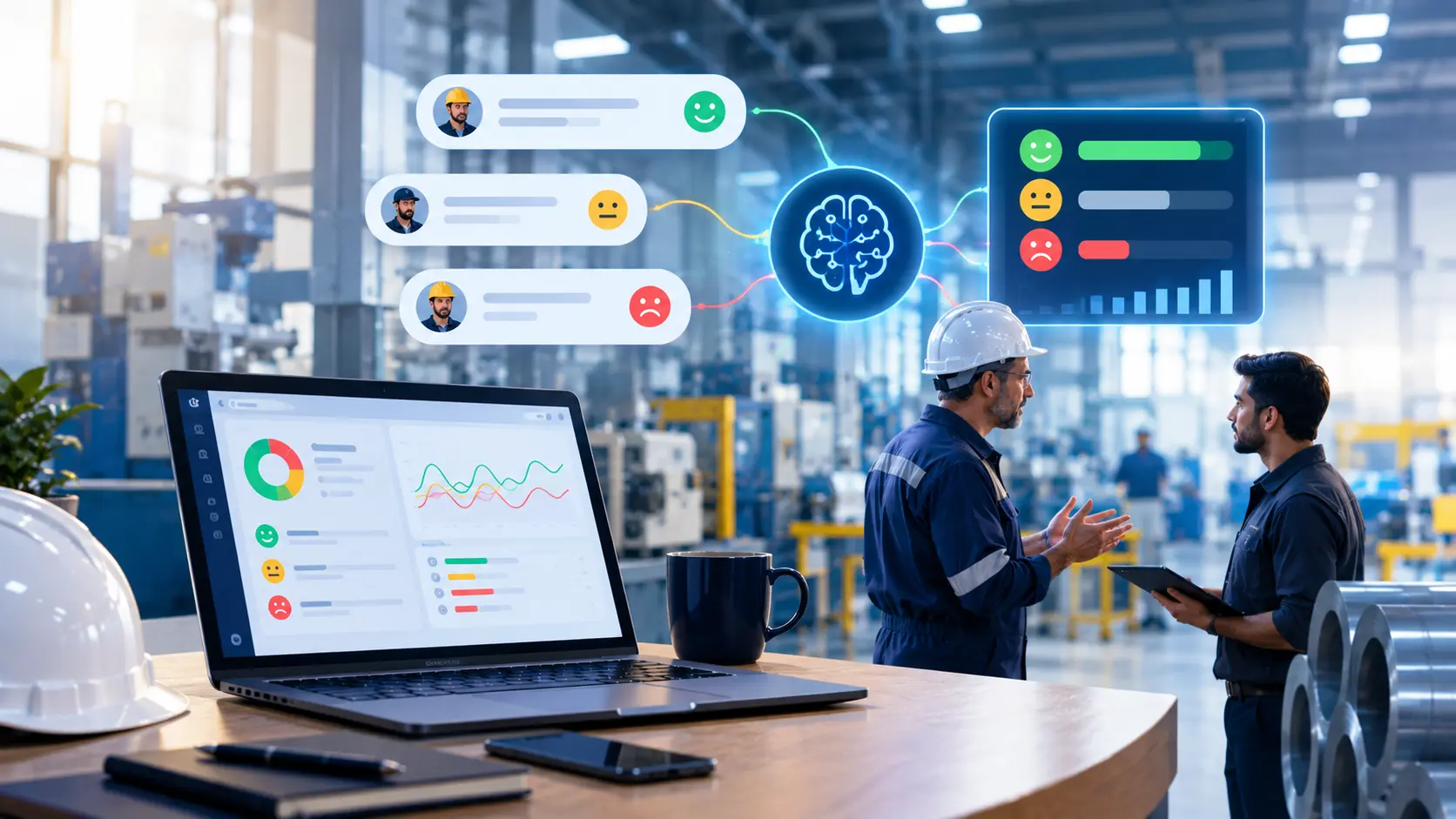
Learn how manufacturers can use sentiment analysis to understand contractor and dealer feedback, identify recurring issues, track customer sentiment, and improve products and relationships.
Here is a hypothetical example. A building products manufacturer launches an updated shingle line, and first-quarter sales look normal. Meanwhile, installers in three states trade complaints on a forum about a nailing strip that behaves differently in cold weather. Nobody inside the business connects the dots until a large distributor raises the issue in a quarterly review, months after the conversation started.
Sentiment analysis for manufacturers exists to close that gap. Manufacturers that sell through contractors and dealers face this blind spot for a simple reason: the people who install, recommend, and resell the product rarely talk to the manufacturer directly. They talk to each other, in reviews, forums, social posts, and dealer counter conversations. Sentiment analysis turns that scattered conversation into a clear, early signal.
Why Buyer Conversations Matter More Than Ever
Peer opinion now shapes which suppliers make the shortlist. G2's 2026 Buyer Behavior Report, based on a survey of more than 1,000 B2B software buyers and decision-makers conducted in June 2026, found that review sites were the top source shaping vendor shortlists at 38%, ahead of AI chatbots at 37%. G2's April 2026 Answer Economy research added that 51% of B2B software buyers now start their research in an AI chatbot more often than in Google, and that review site citations are the signal that makes buyers trust an AI answer most.
Both reports focus on software buyers rather than building trades, but the direction is clear. What people say about a product in public now shapes the next buyer's shortlist, both directly and through the AI tools that summarize it.
What Sentiment Analysis Actually Means
Sentiment analysis is the use of software to read written feedback and classify the opinion behind it as positive, negative, or neutral. Modern systems go further. They identify the specific topic of each comment, such as installation, warranty, pricing, or dealer availability, and track how opinion on each topic changes over time.
The technology behind it is natural language processing, or NLP, the branch of AI that lets software understand everyday human language. Instead of counting keywords, an NLP model reads a sentence the way a person would. It recognizes that "this underlayment saved me a callback" is praise, even though no positive keyword appears.
Social listening for manufacturers is the related practice of collecting those public conversations in the first place, from review sites, forums, and social platforms, so the feedback is ready for analysis.
Where Contractor and Dealer Sentiment Lives
For manufacturers with a contractor or dealer network, useful feedback sits in places a standard brand monitoring tool misses:
• Trade forums and online communities where installers compare products and troubleshoot problems
• Review sites and retailer listings where homeowners and contractors rate products after installation
• Social media groups and comment threads where tradespeople share job site photos and opinions
• Warranty claims and support tickets that reveal recurring product issues
• Dealer and distributor notes captured by field sales teams, the raw material for dealer feedback analysis
Why Generic Tools Fall Short in Manufacturing
Most off-the-shelf brand reputation monitoring tools are built for consumer brands. They fall short in three ways.
First, technical terms confuse them. A comment that a product "ran long" or "didn't seal" carries meaning that a generic model misreads or ignores.
Second, they treat every piece of contractor feedback the same. Routine trade grumbling about weather delays or supply prices has nothing to do with product quality, yet generic tools flag it as negative brand sentiment.
Third, they miss the channels that matter. Niche trade forums and private dealer feedback rarely appear in consumer-focused data feeds.
This is why NLP sentiment analysis for manufacturing works best when the model is tuned to the industry's own vocabulary, so it can separate everyday trade complaints from genuine reputation risk.
A Real Example From the Field
A national manufacturer that sells roofing products through a nationwide contractor and dealer network faced exactly this problem. Market sentiment shifted across review sites, forums, and social channels without anyone inside the business seeing it in real time. Brand perception risks became visible only after competitive damage was already done.
Enorness built a sentiment intelligence system with NLP clustering tuned specifically to roofing industry language. The system distinguishes routine trade complaints from real reputation risk and tracks signals across review sites, forums, and social channels. Every signal surfaces inside one executive dashboard, so a sentiment spike appears as a single alert instead of something a team member has to notice while checking five different platforms separately.
The case study reports operational changes rather than percentage gains, since adoption metrics were not part of that engagement's reporting.
How to Set Up Sentiment Analysis for a Manufacturing Brand
A practical rollout follows six steps.
1. Define the questions first. Common examples include early warning on product defects, contractor sentiment tracking by region, and dealer perception of support and availability.
2. Map the sources. List every channel where contractors, dealers, and end customers talk about the products, including the niche trade communities.
3. Collect data responsibly. Gather feedback from public sources and internal systems in line with each platform's terms of service and applicable privacy rules.
4. Tune the model to industry language. Train the NLP model on real examples of trade feedback so it understands product terms, job site slang, and the difference between a weather complaint and a product complaint.
5. Build one view. Bring every signal into a single manufacturing sentiment dashboard, a screen that shows overall opinion, trending topics, and changes by product line and region in one place.
6. Route alerts to the right people. Set thresholds so a sudden spike in negative sentiment about a product line notifies product, quality, or marketing teams immediately. Automated alert routing makes sure the warning reaches someone who can act on it.
What to Measure
Four metrics give a clear picture of brand health across the channel:
• Net sentiment score: The balance of positive and negative mentions over a set period
• Sentiment by topic: Opinion on installation, warranty, pricing, availability, and support
• Sentiment by region: Where satisfaction is rising or falling
• Volume spikes: Sudden increases in conversation about one product or issue
Turning Insight Into Action
Sentiment data creates value only when it changes decisions. Product teams can prioritize fixes based on recurring installation complaints. Marketing teams can adjust messaging around the features contractors praise most. Sales leaders can see which regions need dealer support.
Sentiment data also connects naturally to forecasting. Combined with sales and inventory figures, it adds an early signal to predictive analytics in the supply chain, where a wave of negative feedback about a product line becomes an early indicator to test against demand data.
Common Mistakes to Avoid
• Monitoring only the brand name. Contractors refer to products by nickname, model number, or category, so tracking must cover all of them.
• Treating every negative comment as a crisis. Without industry tuning, teams drown in false alarms and stop trusting the alerts.
• Sending alerts with no owner. Every alert needs a named person responsible for the response, or warnings sit unread.
• Ignoring internal sources. Warranty claims and support tickets hold some of the most specific product feedback available.
How Enorness Builds Sentiment Intelligence Systems
Enorness is an AI-native software and digital product partner based in Sheridan, Wyoming. Each sentiment project starts by mapping where the brand's contractors, dealers, and customers actually talk, and diagnosing which signals the business currently misses.
The team then builds the collection pipelines, the industry-tuned NLP model, and the dashboard, verifies the model's accuracy against real feedback samples, and refines it as new product lines and channels appear. For any manufacturer ready to see reputation risk before it spreads, the next step is simple: Book a strategy call.
Frequently Asked Questions
Q1: What is sentiment analysis for manufacturers?
A: Sentiment analysis for manufacturers uses AI to read feedback from contractors, dealers, and customers across reviews, forums, and social channels, then classifies the opinion and topic of each comment to reveal how the market views a product.
Q2: How is sentiment analysis different from social listening?
A: Social listening collects public conversations about a brand or product. Sentiment analysis reads those conversations and measures the opinion behind them, so the two work together.
Q3: Why do manufacturers need industry-tuned sentiment models?
A: Generic models misread trade terms and flag routine complaints as brand risk. A model trained on industry language separates everyday grumbling from genuine product or reputation problems.
Q4: Which data sources should a manufacturer monitor?
A: The most useful sources include trade forums, review sites, retailer listings, social media groups, warranty claims, support tickets, and notes from dealer and field sales teams.
Q5: Can sentiment analysis include private data like warranty claims?
A: Yes. Internal sources such as warranty claims and support tickets can feed the same system, as long as access controls limit who can see customer details and the data is handled in line with applicable privacy rules.
Q6: How long does it take to see results from sentiment analysis?
A: The first useful view comes once the main sources are connected and the model is tuned. Trend insights grow stronger as months of data build a reliable baseline.
Final Thoughts
Contractors and dealers already say what they think about every product they install and sell. The challenge for manufacturers is hearing it early enough to act. Sentiment analysis brings those scattered conversations into one view, separates real risk from routine noise, and puts the right warning in front of the right team. Starting with one product line and the channels where installers talk most is the most reliable way to prove the value.

Written by
Mark Louis



Let's Build Something Extraordinary
Turn ideas into intelligent products that drive real business results.