AI Voice Agents for Customer Support: How They Actually Handle a Phone Call

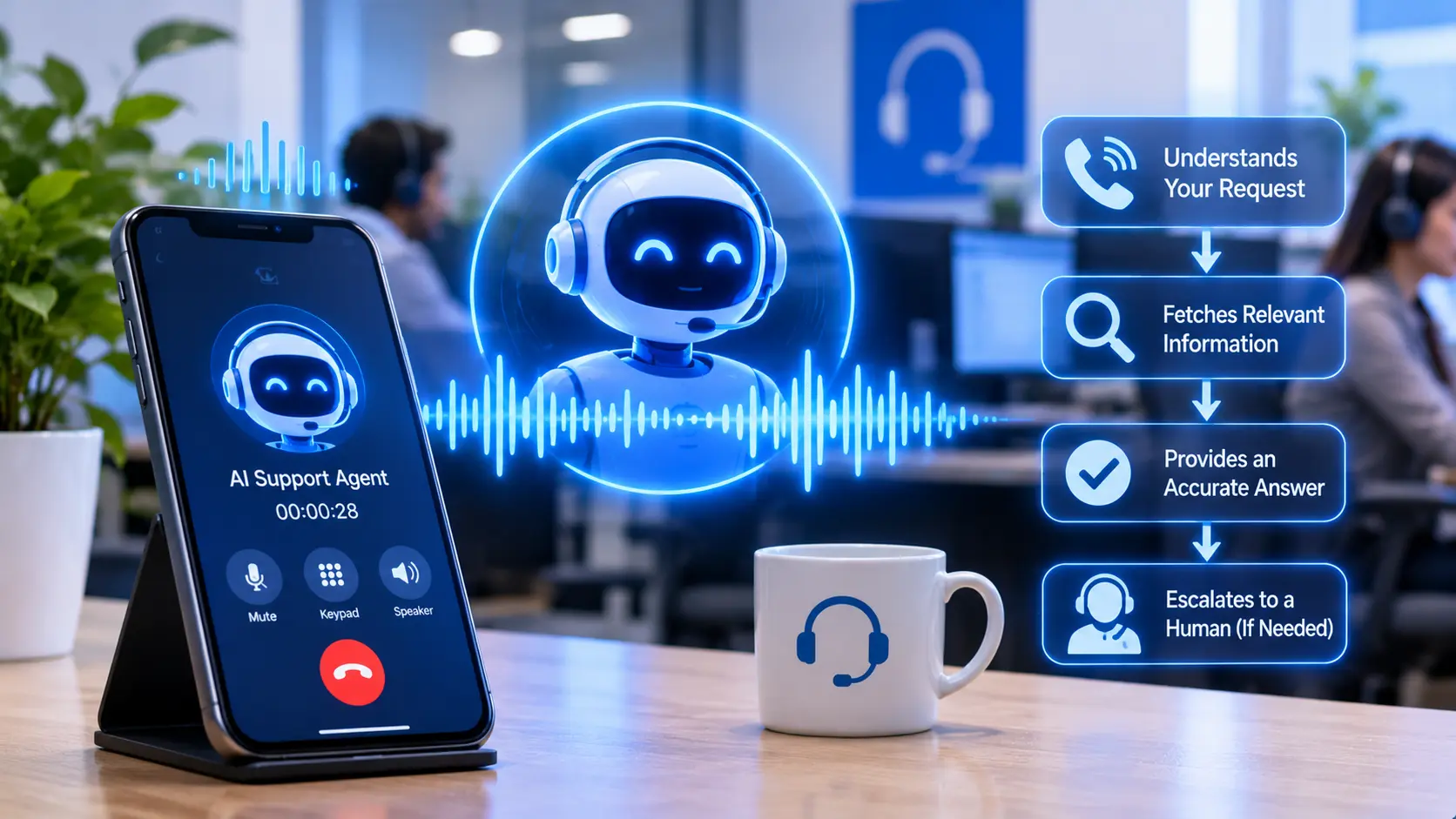
AI voice agents are changing how businesses handle phone support. Here's what they can actually do, where they still fall short, and how to tell whether a business's call volume is ready for one.
An AI voice agent, often called an AI phone agent, answers a call, works out what the caller actually wants, and either resolves it directly or hands it to a person with the context already gathered. It is not a recording and not a button-press menu; it is software that holds a real conversation and can act on what it hears.
The more useful question is not whether a voice on the phone sounds human enough. It is whether the call gets resolved without the caller repeating themselves, waiting on hold, or getting routed in circles. That is the gap between phone support that works and phone support that technically exists.
What an AI Voice Agent Actually Is
A voice agent listens to a caller's natural speech, works out the intent behind it, and responds in kind, without requiring a caller to say a specific keyword or press a number. Older phone systems relied on IVR trees: press 1 for billing, press 2 for support, each one mapped to a fixed destination. A voice agent instead handles open speech the way a person would, including a caller who explains their situation out of order or changes the subject mid-call.
What separates a voice agent from a glorified recording is that it can act. It can check an account, look up an order, confirm an appointment slot, or update a record, inside the call, rather than only logging the request for someone to action later.
Where Phone Support Breaks Down Today
Hold times cost patience before a human even answers
A caller who waits several minutes before reaching anyone has often already decided the company does not value their time, regardless of how the call goes afterward. Abandoned calls rarely get followed up on, which means the business loses the interaction entirely, not just the call.
Staffing phone lines around the clock is expensive
Live coverage for evenings, weekends, and overnight call volume means either paying for shifts that often sit idle or accepting that support simply is not available outside business hours, which pushes frustrated callers toward a competitor who does answer. Call center automation is usually aimed at this problem first, covering the hours a live team can't staff without paying for empty shifts.
Simple requests still consume live-agent time
Many inbound calls are repetitive: checking a status, confirming a time, resetting something routine. Each one takes a live agent off a call that actually needed judgment, and the backlog grows during any volume spike.
How an AI Voice Agent Handles a Call
Voice AI customer service works best when the agent moves through the call in three clear stages, understanding the request, pulling the right information, and either completing the action or handing it off cleanly.
Understanding what the caller wants
The agent processes the caller's speech in real time and identifies the underlying request, even when it is phrased conversationally rather than as a clean command.
Pulling up the right information
For requests that need a lookup, an order, an account, a schedule, the agent queries the connected system directly during the call instead of asking the caller to wait while someone else checks.
Completing the action or handing off cleanly
If the request is within scope, the agent completes it on the call: confirming a booking, updating a detail, answering the question fully. If it is not, it transfers to a person along with a summary of what was already established, so the caller does not start over.
A Practical Example: Appointment Rescheduling at Scale
A hypothetical example: consider a multi-location service business where many inbound calls are reschedule requests. Handled manually, each one needs a staff member to find the original booking, check the new slot against availability, and confirm the change, all while other calls wait. A voice agent can handle the same request end to end: confirm the caller's identity details, check the calendar, offer available slots, and update the booking, with no hold time and no need for a staff member unless the caller asks for something outside a standard reschedule. The time saved compounds with call volume, which is exactly where manual phone support struggles most.
AI Voice Agents vs Traditional IVR and Live Chatbots
Conversational AI for calls handles open speech where an IVR only handles what its fixed menu anticipated; anything else on an IVR routes to a person regardless. A text chatbot solves a similar problem in writing, but it does not help a caller who is driving, has their hands full, or simply prefers to talk. A voice agent covers the gap between the two: open conversation, like a chatbot, delivered through the channel customers still default to when something feels urgent, the phone.
Starting With the Call Types That Repeat
The clearest starting point for any phone line is separating calls that are genuinely repetitive from the ones that need a person's judgment. That is the same question that shapes any AI agent build, whether the task is answering a call, qualifying a lead, or handling a booking: does the request need an action completed, or only a question answered well, and what should happen the moment a call falls outside what the agent is scoped to resolve.
Frequently Asked Questions
Is an AI voice agent the same as an old phone menu (IVR)?
No. An IVR routes callers through fixed button presses or a narrow set of recognized phrases. An AI voice agent understands open, natural speech, can ask a follow-up question, and can complete the request itself rather than only routing the call.
Can an AI voice agent actually change something in another system, or does it just answer questions?
A well-built one can do both. It can answer common questions directly, and for the ones that need action, it can look up a record, check it against a policy, or book an appointment in a connected system rather than just promising a callback.
Will callers always know they are talking to AI?
Many businesses disclose it upfront, and requirements vary by location and use case. Caller satisfaction tends to depend more on speed and accuracy than on whether the voice is human.
What happens when a call is too complex for the agent to handle?
A properly scoped voice agent recognizes when a request falls outside what it is built to resolve and hands the call to a person with the context already gathered, rather than making the caller repeat everything from the start.
How long does it take to build an AI voice agent for a support line?
It depends on how many distinct call types it needs to handle and how many systems it needs to connect to. A single, well-defined task, like checking an order status, is a smaller scope than an agent covering several kinds of requests across multiple systems.
Is this worth it for a business with a small support team?
It depends on call volume and repetition. If the same handful of questions account for most calls, even a small team can free up meaningful time by letting an agent resolve those first and reserving live staff for calls that need judgment.
Working Out Whether a Voice Agent Fits a Support Line
The fastest way to tell is counting how many of a support line's calls are repetitive versus how many genuinely need judgment. Enorness can be reached to talk through whether a specific call volume and call mix is ready for a voice agent.

Written by
Mark Louis




Let's Build Something Extraordinary
Turn ideas into intelligent products that drive real business results.