AI Agent vs Chatbot: What Actually Sets Them Apart

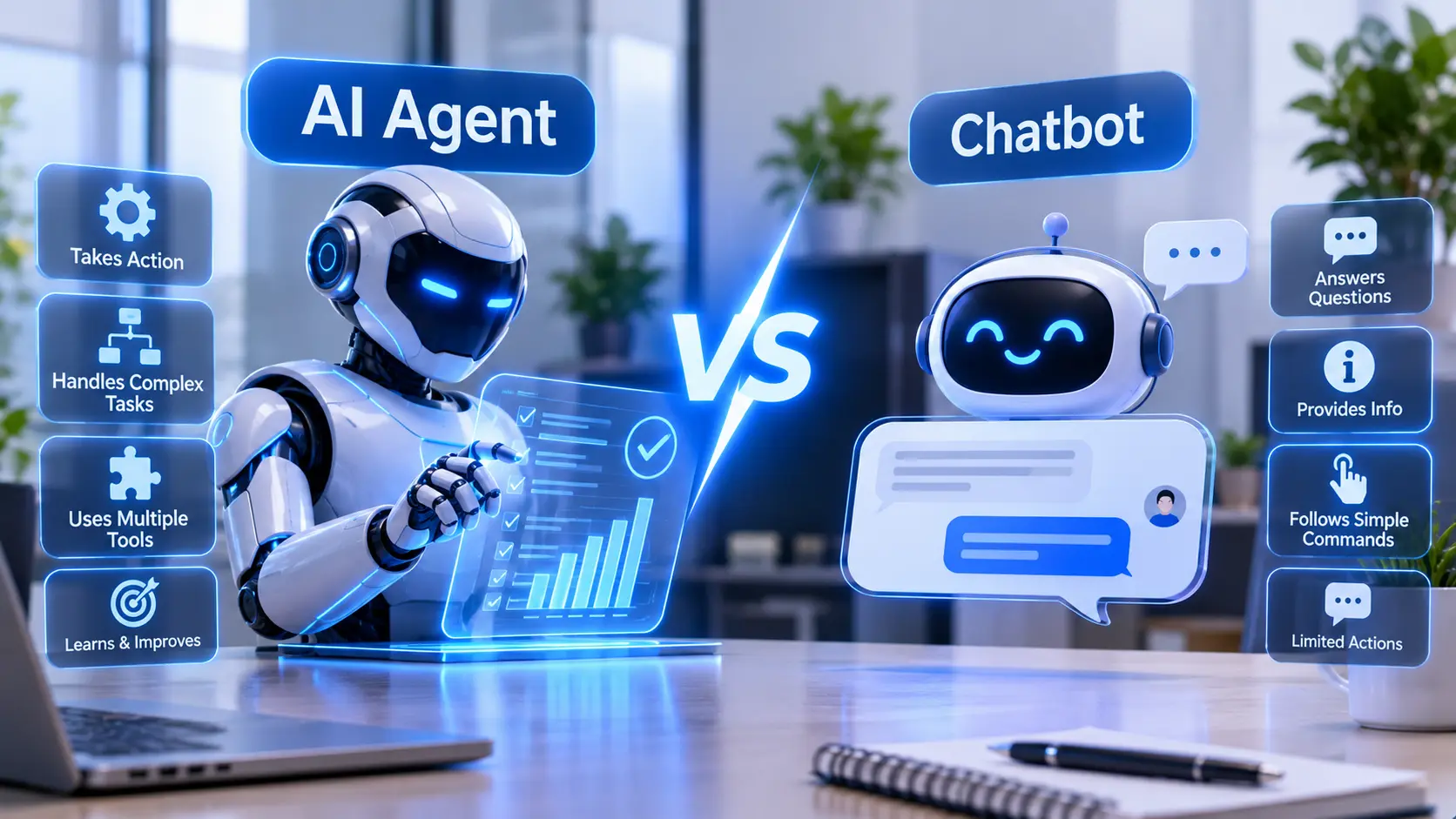
The two terms get used interchangeably in marketing, but they describe different capabilities. Here is what actually separates an AI agent from a chatbot, and when each one fits.
The AI agent vs chatbot question gets muddied by marketing, where both labels get applied to almost anything with a text box. Underneath the labels, though, the two describe genuinely different kinds of software, and picking the wrong one for a given job either overspends on capability nobody needed or underdelivers on what the business actually required.
The useful question is rarely which label sounds more advanced. It is what the tool needs to actually do once someone is talking to it. The difference between a chatbot and an AI agent in what each can do is a better starting point than either term on its own.
What a Chatbot Actually Is
A chatbot answers questions and follows a conversation within a fixed, defined scope. Older chatbots worked off scripted decision trees: a menu of buttons or a narrow set of recognized phrases, each one mapped to a pre-written response. Newer ones use natural language understanding to recognize a wider range of phrasing for the same underlying intents, which is what is usually meant by conversational AI.
What a chatbot shares across both generations is scope. It answers from what it was given, inside the conversation it is having, and it generally does not take action in another system on its own. Ask a well-built chatbot about store hours, a return policy, or how to reset a password, and it answers well. Ask it to actually check a specific order's status against a live database and update a shipping address, and many chatbots are not built to do that step themselves.
What an AI Agent Actually Is
A short answer to what is an AI agent: software built around a goal rather than a single reply. An AI agent is built to act, not just respond. Given a goal, it can reason through the steps needed to reach it, call other systems to get or change information, and carry context across a multi-step process rather than answering one message at a time in isolation. A chatbot answers a question about an order. An agent can look the order up, check it against a return policy, and process the return.
This is the capability gap that actually matters: not how natural the conversation sounds, but whether the software can take an action with a consequence outside the conversation itself, a booking made, a record updated, a lead routed to the right person, rather than only producing text.
Where the Line Gets Blurry
Plenty of products marketed as chatbots today have agent-like capabilities bolted on: a booking integration here, a CRM lookup there. The label on a product page is not a reliable way to know what it can actually do, and comparing conversational AI vs AI agents by marketing copy alone will not settle it either. The difference between chatbot and AI agent capability shows up in what the tool does, not in what it is called. The more reliable question to ask about any specific tool is what it is capable of doing on its own, not what word is used to describe it.
The Questions That Actually Decide It
Does it need to take action in another system, or only answer questions. A tool that only needs to answer from a knowledge base, hours, policies, product details, rarely needs the complexity of an agent. A tool that needs to check a calendar, pull a record, or trigger a workflow needs agent capability to do that without a person completing the action manually afterward.
Does the conversation need to carry context across multiple steps. A single-turn question and answer is chatbot territory. A process that spans several exchanges, gathering details, checking them against a system, confirming a result, fits an agent's ability to hold that context through the whole interaction.
What is the cost and complexity tradeoff worth. A chatbot is generally cheaper to build and simpler to maintain. An agent costs more to build correctly because it has to reason through steps and interact safely with other systems, and that additional cost is only worth it when the task genuinely requires taking action, not just answering well.
When to Use a Chatbot
A chatbot fits well for FAQ handling, simple triage before a conversation reaches a person, and any use case where the value is in answering quickly and consistently rather than in completing a task. A business with a high volume of repetitive, answerable questions and a limited budget often gets most of the value here without needing to build or pay for agent capability it will not use.
When an AI Agent Is Worth the Investment
An agent earns its cost when the task itself is the point, not the conversation around it. A gym booking agent that reads an inbound message, checks availability, and books the appointment is doing something a chatbot cannot do on its own. One of Enorness's own clients, Train Gym, used an agent across Instagram and Facebook messages from May 1 to July 15 and processed 260 messages into 69 qualified leads and 6 booked appointments, an 8.7 percent conversion rate from qualified lead to booking, without a staff member opening the thread first. That outcome depended on the agent qualifying and acting, not only replying.
Frequently Asked Questions
Is an AI agent just a more advanced chatbot?
Not exactly. The difference is not only sophistication, it is capability. A chatbot answers from a conversation. An agent can take action in other systems as part of completing a task, which a chatbot is generally not built to do.
Can a chatbot be upgraded into an AI agent later?
Often, yes, usually by adding the integrations and reasoning steps needed to take action, which avoids starting over from scratch.
Is an AI agent always more expensive to build than a chatbot?
Usually upfront, since it has to reason through steps and connect safely to other systems. Whether that cost is worth it depends on whether the task actually requires taking action, not just answering a question.
What affects how long it takes to build an AI agent?
A single, well-defined action, such as checking availability and booking it, is a smaller scope than an agent handling several different kinds of tasks across multiple systems, which takes longer to design and test.
Does a small business need an AI agent instead of a chatbot?
Not automatically. If the main need is answering common questions quickly, a chatbot often covers it. An agent becomes worth it once a specific, repeatable task, like booking or qualifying leads, is being done manually and could be handled by software instead.
How can a business know which one a specific use case needs?
The clearest signal is whether the tool needs to complete a task with a consequence outside the conversation. If it only needs to answer accurately, a chatbot usually fits. If it needs to check, update, or trigger something in another system, that points to an agent.
Working Out Which One a Specific Case Needs
The action-versus-answer question above is usually the fastest way to tell. Enorness can be reached to talk through whether a specific use case needs a chatbot, an agent, or a bit of both.

Written by
Mark Louis


Let's Build Something Extraordinary
Turn ideas into intelligent products that drive real business results.