AI Software for NDIS Compliance: Why Most "Compliance Tools" Are Solving the Wrong Problem

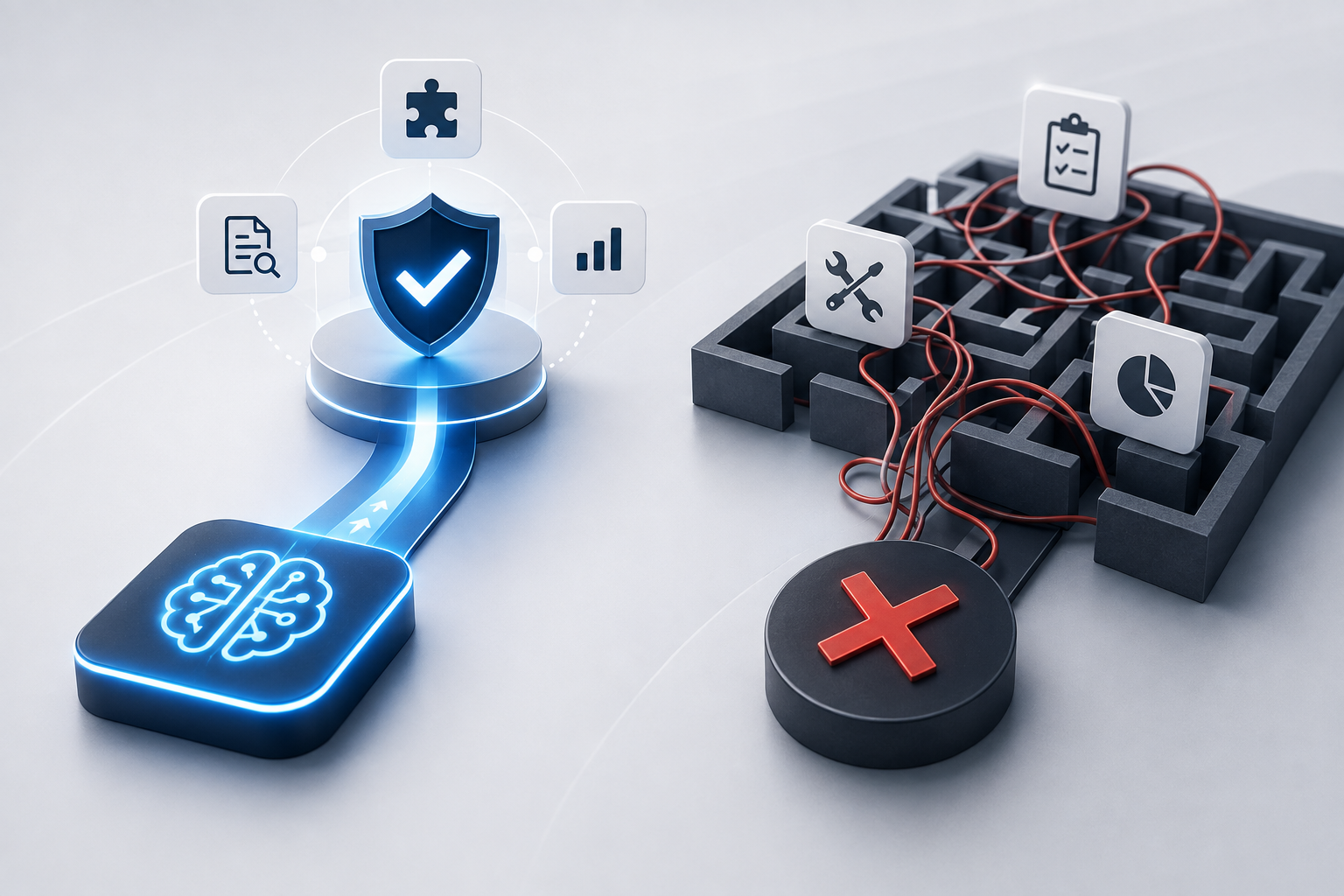
The providers managing this well aren't running more compliance checks.
Ask most NDIS providers what eats their week, and compliance rarely shows up as one task. It shows up as five: documentation that has to match rostering, billing and claims. All of it needing to be provable the moment an auditor asks. Recent sector research backs up what that feels like on the ground, a majority of providers say navigating NDIS requirements pulls time directly away from care, and most cite regulatory overhead as one of their heaviest administrative burdens.
The response most software vendors offer is a "compliance module", a checklist bolted onto whatever case management system a provider already uses. It looks like a solution on a sales page. In practice, it adds a sixth system to reconcile instead of removing the problem.
The Real Failure Point Isn't Compliance. It's Fragmentation.
Here's what most compliance content gets wrong: it treats compliance as a documentation problem. It's not. It's an integration problem. Compliance risk doesn't usually originate in the compliance module, it originates upstream, in a rostering error that becomes a billing error that becomes a claims discrepancy that eventually surfaces as a compliance finding. By the time it reaches the compliance tool, the actual mistake happened three systems ago.
That's why bolt-on compliance software has a ceiling. It can log what happened. It can't prevent the disconnect that caused it, because it was never connected to the systems where the disconnect occurs.
What Actually Closes the Gap
The providers managing this well aren't running more compliance checks. They're running fewer disconnected systems. Three shifts make the difference:
1. One data model, not five reconciled ones.
When rostering, billing, documentation, and claims all write to the same underlying record instead of syncing between separate tools, there's nothing to reconcile because there was never a second version of the truth to begin with.
2. Continuous AI review instead of periodic sampling.
Traditional compliance checks sample a handful of files before an audit. AI-assisted review can scan every record continuously, flagging inconsistencies in plain language as they appear not weeks later when a compliance officer finally gets to that folder.
3. Audit trails that build themselves.
If documentation, rostering, and billing already live in one system, the audit trail isn't a report someone generates under deadline pressure. It's a byproduct of the system working normally.
What This Looked Like in Practice
We built exactly this kind of system for a provider running two connected NDIS platforms in parallel. The brief wasn't "add a compliance dashboard." It was to unify care management, compliance, rostering, billing, claims, and AI-powered audits into one connected system, so an error in one place couldn't silently become a finding somewhere else. The result: compliance stopped being a parallel task competing with care delivery, and became a natural output of how the platform already worked.
The Cost of Waiting
Manual, fragmented compliance processes scale linearly with headcount double the participants, roughly double the administrative load. A connected system scales sublinearly, because the verification work doesn't grow at the same rate the caseload does. Providers who delay this investment aren't avoiding the cost. They're deferring it to a point where the gap is larger and harder to close under regulatory pressure.
Frequently Asked Questions
Q1. What makes software "NDIS compliant" versus just general care management software?
A: NDIS-compliant software is built around the specific practice standards the NDIS Commission requires participant rights documentation, incident management, risk reporting, and audit-ready record keeping rather than generic case notes retrofitted to meet those requirements after the fact.
Q2. Can AI actually reduce compliance risk, or does it just create more data to review?
A: Used correctly, AI reduces risk by continuously scanning records for inconsistencies as they're created, rather than waiting for a scheduled audit to catch them. The key is that it needs to be connected to the actual source systems (rostering, billing, documentation), AI reviewing an isolated compliance log has the same blind spots a human reviewing it would.
Q3. How long does it typically take to move from fragmented systems to a connected platform?
A: This varies by provider size and existing systems, but the bigger factor is usually data migration and staff retraining rather than the software build itself. Providers running multiple disconnected tools should expect a phased transition rather than a single cutover.
Q4. Does connecting rostering, billing, and compliance into one system increase the risk if that system goes down?
A: It shifts the risk rather than increasing it. A well-architected connected system typically includes redundancy and audit logging that fragmented tools often lack individually, since compliance requirements are built into the system's core rather than bolted on.
Q5. Is this approach only relevant for larger NDIS providers with multiple platforms?
A: No, smaller providers often feel the fragmentation problem more acutely, since they have fewer staff to manually reconcile discrepancies between systems. A connected approach tends to reduce the administrative burden per participant regardless of provider size.
Where to Start
If compliance documentation is consistently late, if audits feel like scrambles instead of routine checks, or if the same discrepancy keeps resurfacing in different forms, the fix usually isn't a better compliance module. It's asking whether rostering, billing, claims, and documentation are actually one system, or five that only look like one from the outside.

Written by
Admin

Let's Build Something Extraordinary
Turn ideas into intelligent products that drive real business results.