
Your website is having conversations with potential customers right now. While you sleep. While you’re in meetings. While you’re serving existing clients.
The question is: what is it saying about you?
If you’re using a template that looks like 10,000 other websites, it’s whispering, “We took the easy way out.” If your design feels generic, it’s suggesting your service might be too. And if your site doesn’t work smoothly on mobile, it’s shouting, “We don’t really care about your experience.”
That’s the brutal truth about websites in 2026. Your digital storefront isn’t just about looking pretty, it’s about being uniquely, strategically, unmistakably YOU.
Custom web design services isn’t about ego or vanity. It’s about giving your business the competitive edge it deserves in a market where first impressions happen in 0.05 seconds.
The Template Trap That’s Costing You Customers
Let me paint a picture you’ve probably lived.
You started with a template because it was fast, affordable, and “good enough.” Maybe you used Wix, Squarespace, or a WordPress theme that looked great in the demo. You spent hours trying to make it work for your business, fighting with drag-and-drop builders, compromising on what you really wanted.
Three months later, you stumble across a competitor’s website. It has the same header. The same layout. The same “About Us” section structure. You look basically identical online, despite being completely different companies.
Worse? A potential client just told you they chose your competitor because “their website seemed more professional.” They both used the same template, they just customized theirs slightly better.
What Custom Web Design Actually Means (And Why It Matters)
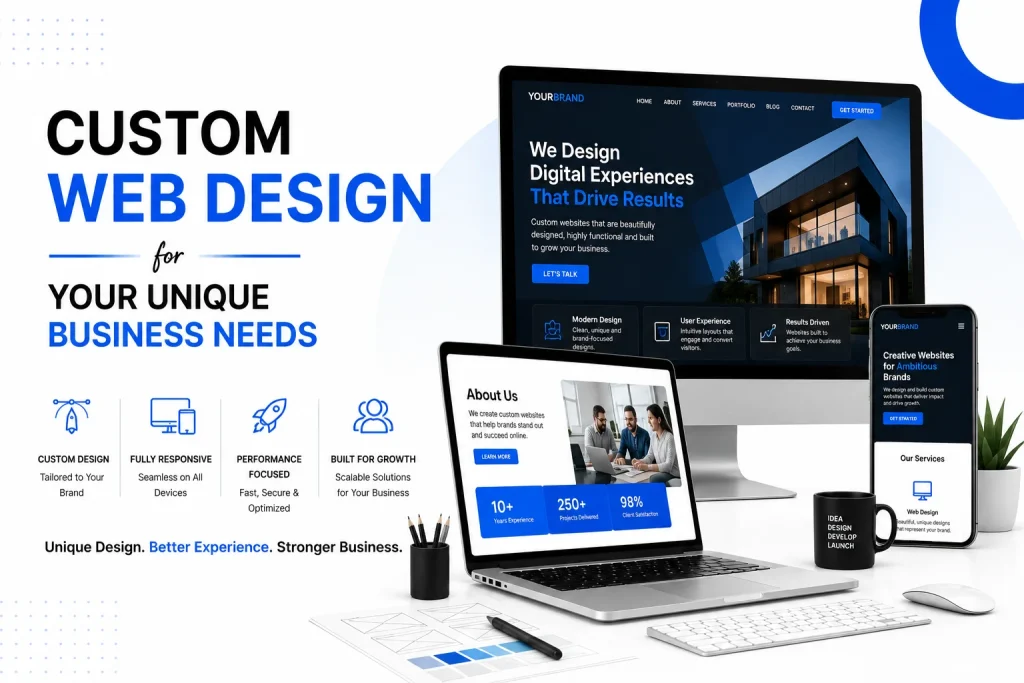
Let’s clear up the confusion. Custom website design services don’t just mean “making things look different.” They mean building a strategic digital experience specifically engineered for YOUR business goals, YOUR customers, and YOUR unique value proposition.
A custom website is:
1. Built around your specific customer journey: Not a generic funnel that sort-of-works for everyone, but a path designed for how YOUR customers actually make decisions.
2. Coded for your exact needs: Need custom functionality? Done. Want specific integrations? Built in. Planning to scale? The foundation supports it.
3. Optimized for your performance goals: Whether you need lead generation, e-commerce sales, or brand awareness, every element serves your objectives.
4. Designed to match your brand identity: Not adapted to fit within template constraints, but created to amplify what makes you different.
Think of it like the difference between a tailored suit and something off the rack. Sure, the off-the-rack version covers your body. But the custom suit? That makes a statement.
The Hidden Costs of “Cheap” Website Solutions
Template websites feel like smart financial decisions, until you calculate what they’re actually costing you.
1. Opportunity Cost: Every visitor who bounces because your site looks generic or works poorly is a lost customer. If your conversion rate is 1% instead of 3% because of design limitations, that’s 200 lost leads per 10,000 visitors.
2. Time Cost: You’ll spend dozens (maybe hundreds) of hours trying to force a template to do what you need. Hours you should spend running your business, not fighting with website builders.
3. Credibility Cost: When your website screams “budget operation,” prospects assume everything about your business is budget-quality. First impressions are lasting impressions.
4. Flexibility Cost – Templates break when you need to add custom features. As your business grows, you’ll hit walls constantly. Eventually, you’ll rebuild anyway, paying twice for what you should have done once.
5. SEO Cost – Templates often come bloated with unnecessary code, slow loading times, and structural issues that hurt search rankings. Professional responsive web design services build clean, fast, SEO-friendly sites from the ground up.
One client came to us after spending $3,000 on a template site and nine months trying to make it work. Their custom rebuild cost $12,000 but generated an additional $180,000 in revenue in the first year simply through better conversions. That’s not magic, it’s strategic design.
How Custom Web Design Transforms Business Results
Here’s what changes when you invest in bespoke web design that’s actually built for your business:
1. Your Brand Finally Feels Consistent
Your logo, your colors, your voice, your values, everything that makes your business special, gets translated into digital form perfectly. No compromises. No “close enough.”
Customers experience the same quality and professionalism online that they get when working with you in person. This consistency builds trust faster than any sales pitch ever could.
2. Your Website Actually Converts Visitors
Conversion-optimized websites aren’t accidental. They’re deliberately designed around psychology, user behavior, and proven best practices.
Strategic call-to-action placement. Intuitive navigation that guides visitors naturally. Trust signals positioned exactly where doubt creeps in. Forms that feel easy instead of intimidating.
A well-designed custom site doesn’t just look better, it performs better. We’re talking 200-400% increases in conversion rates compared to template alternatives.
3. Mobile Users Get the Experience They Deserve
Over 60% of web traffic comes from mobile devices. Yet most template sites treat mobile as an afterthought, everything gets crammed into a narrow screen, buttons become impossible to tap, and frustrated users leave.
Responsive web design built from scratch means your site isn’t just “mobile-friendly”, it’s mobile-optimized. Every interaction is designed for fingers, not mouse cursors. Every page loads fast on cellular connections. Every form is easy to complete on a small screen.
Your mobile experience becomes a competitive advantage instead of a liability.
4. You Stand Out in a Sea of Sameness
In most industries, 80% of businesses use the same handful of templates. They all start looking identical.
Custom design makes you memorable. When a potential client visits five websites in their research process, yours is the one they remember. Not because it’s flashy, but because it’s authentically different.
Unique website design signals that you’re a business that pays attention to details, invests in quality, and cares about the customer experience. These are powerful messages that templates can never send.
The Technology Stack That Powers Modern Custom Websites
Let’s talk about what’s happening behind the beautiful facade of a custom site.
1. Clean, Efficient Code: No template bloat. No unnecessary plugins. Just lean, fast, purposeful code that loads quickly and runs smoothly.
2. Scalable Architecture: Your website can grow as your business grows. Need to add new functionality in six months? The foundation supports it without requiring a complete rebuild.
3. Security Built In: Custom sites get security measures designed for your specific needs, not generic solutions that might not fit your situation.
4. SEO Foundation: Proper semantic HTML, optimized page speed, mobile-first indexing, schema markup, all the technical SEO elements that templates often butcher.
This is where custom software development expertise makes a massive difference. You’re not just getting designers who make things pretty, you’re getting developers who build bulletproof digital infrastructure.
Why User Experience Design Matters More Than Ever
Beautiful design that frustrates users is worse than ugly design that works smoothly. This is where UI/UX design services become crucial.
User experience design is about understanding how humans think, decide, and act online. It’s about:
1. Reducing cognitive load: Making decisions feel easy instead of overwhelming
2. Creating clear hierarchies: Helping visitors find what matters without searching
3. Eliminating friction: Removing every unnecessary step between visitor and conversion
4. Building trust progressively: Addressing concerns at exactly the right moments
Great UX is invisible. Users don’t notice it, they just feel like your website “gets them.” Bad UX is obvious. Users feel confused, frustrated, or lost.
Custom design lets you craft experiences based on actual user research and testing, not template limitations.
Custom E-Commerce: When Your Store Is Your Business
If you’re selling products online, template limitations become deal-breakers fast.
Custom e-commerce web design addresses challenges that generic solutions can’t:
- Product pages optimized for your specific category
- Checkout flows designed to reduce cart abandonment
- Custom filtering and search functionality
- Integration with your exact inventory and fulfillment systems
- Mobile shopping experiences that actually convert
- Upsell and cross-sell strategies built into the architecture
One e-commerce client switched from a template store to custom design. Same products, prices and Traffic. But their conversion rate jumped from 1.8% to 4.3% purely through better design and UX. That single change increased annual revenue by over $400,000.
Custom Web Design Process: What to Actually Expect
Let’s demystify how professional web design services actually work, because transparency builds trust.
Phase 1: Discovery (Weeks 1-2) We learn everything about your business, customers, competitors, and goals. This isn’t a questionnaire, it’s strategic conversations that uncover what will actually move the needle for your business.
Phase 2: Strategy & Planning (Week 3) We map out your customer journey, define conversion goals, plan site architecture, and create the strategic foundation that guides every design decision.
Phase 3: Design (Weeks 4-6) This is where your brand comes to life visually. We create custom mockups, refine based on your feedback, and perfect every detail before a single line of code is written.
Phase 4: Development (Weeks 7-10) Designers hand off to developers who build your site with clean, efficient code. Web development services that understand both aesthetics and functionality create sites that look great AND perform flawlessly.
Phase 5: Testing & Launch (Week 11-12) Rigorous testing across devices, browsers, and scenarios. We don’t launch until everything works perfectly.
Phase 6: Optimization (Ongoing) Launch is just the beginning. We monitor performance, gather user data, and continuously refine to improve results.
The Mobile-First Reality Nobody Can Ignore Anymore
Here’s a stat that should change how you think about web design: over 70% of users will leave a website if it takes more than 3 seconds to load on mobile.
Mobile app development and mobile-first web design aren’t futuristic concepts, they’re current necessities. Your mobile experience directly impacts:
- Google search rankings (mobile-first indexing is the standard)
- User satisfaction and bounce rates
- Conversion rates and sales
- Brand perception and credibility
Mobile app development services can take your mobile strategy even further, creating native experiences for customers who prefer apps over browsers. But at minimum, your custom website needs to be designed mobile-first, desktop-second.
Template builders claim to be “mobile-responsive,” but responsive doesn’t mean optimized. It means content stacks vertically instead of breaking completely. That’s not good enough anymore.
Building for Scale: When Your Website Grows with You
One of the biggest advantages of custom design is scalability.
Your business in six months will be different than today. In two years, you’ll offer new services, target new markets, or operate in new ways. Template sites make evolution painful. Custom sites make it natural.
Need to add a client portal? Built on a foundation that supports it. Want to integrate with new software? The architecture allows it. Planning to expand internationally? Multi-language support is feasible. Launching a new product line? Your site can grow that section without compromising existing content.
This is where staff augmentation services can be invaluable, having developers who understand your specific site architecture means adding features stays smooth and efficient.
The Investment Question: What Does Custom Web Design Actually Cost?
Let’s address the elephant in the room: custom web design costs more upfront than templates.
A professional custom website typically ranges from $8,000 to $50,000+ depending on complexity, functionality, and scale. That sounds like a lot compared to a $200 template.
But here’s the better way to think about it:
Templates cost less but perform worse: Lower conversion rates mean you’re losing money every month
Custom sites generate ROI: Better conversions, SEO, and user experience typically pay for themselves within 6-12 months
You pay once instead of repeatedly: Templates require constant paid plugins, workarounds, and eventual rebuilds
One medical practice calculated that their template site’s poor mobile experience was costing them 8-12 new patient inquiries monthly. At $2,000 average patient lifetime value, that’s $192,000-$288,000 in annual lost revenue. Their $25,000 custom redesign paid for itself in less than two months.
The real question isn’t “Can I afford custom design?” It’s “Can I afford NOT to invest in proper design?”
What Makes a Web Design Agency Worth Working With
Not all custom web design agencies are created equal. Here’s what separates great partners from mediocre vendors:
They ask more questions than they answer initially: Great agencies diagnose before prescribing. If someone gives you a quote in the first conversation without understanding your business deeply, run.
They show results, not just portfolios: Pretty designs mean nothing if they didn’t improve business metrics. Look for agencies that talk about conversion rates, traffic growth, and ROI.
They explain clearly without jargon: Technical expertise should make things simpler for you, not more confusing. If you’re constantly confused, they’re not communicating well.
They think strategically, not just aesthetically: Design should be driven by goals and data, not just what looks trendy. Strategy-first agencies create sites that perform.
They’re transparent about process and pricing: Hidden costs and scope creep destroy trust. Great agencies establish clear expectations upfront.
Difference Between Web Design and Web Development
Here’s a confusion point for many business owners: design and development are different skills that must work together seamlessly.
Web designers create the visual experience, layouts, colors, typography, imagery, user flows. They think about aesthetics, brand expression, and user psychology.
Web developers build the functionality, code, databases, integrations, performance optimization. They think about architecture, security, and scalability.
Tailored web design solutions require both talents working in harmony. The designer’s vision needs to be technically feasible. The developer’s code needs to express the design accurately.
The best results come from teams where designers and developers collaborate from day one, not from freelancers working in silos or template builders who do neither particularly well.
Custom Design for Different Business Models
Your business type impacts what “custom” actually means for you:
Service-Based Businesses: Focus on lead generation, trust-building, and clearly communicating value propositions. Need strong content strategy and conversion optimization.
E-Commerce: Product discovery, seamless checkout, mobile shopping experience, and inventory integration are priorities. Performance and speed are critical.
B2B Companies: Longer sales cycles mean nurturing visitors through extensive content, demonstrating authority, and multiple touchpoints before conversion.
Local Businesses: Local SEO optimization, mobile-first design, clear contact information, and reputation management integration matter most.
Startups: Flexibility and scalability are essential. Sites need to evolve rapidly without requiring complete rebuilds as the business model refines.
Professional designers tailor approaches to your specific business model rather than applying one-size-fits-all solutions.
Lead Generation Power of Strategic Design
If you’re investing in lead generation services, your website better be ready to convert that traffic.
All the marketing in the world won’t help if visitors hit your site and immediately bounce. Strategic custom design maximizes every lead generation dollar by:
- Creating landing pages optimized for specific campaigns
- Reducing friction in contact forms
- Building trust through strategic social proof placement
- Guiding visitors naturally toward conversion actions
- Providing clear value propositions immediately
- Addressing objections proactively in the design
Your website and your lead generation efforts should be designed together, not separately. When they’re strategically aligned, results multiply.
Future-Proofing Your Digital Presence
Technology changes. Design trends evolve. User expectations shift. But investing in quality custom design creates a foundation that adapts rather than becoming obsolete.
A well-built custom site can evolve for 5-7+ years with minor updates rather than requiring complete rebuilds every 18 months like many template sites.
This longevity comes from:
- Clean, modern code that follows best practices
- Flexible architecture that supports modifications
- Strong technical foundation that scales
- Design systems that can evolve incrementally
Think of custom design as building a house versus renting an apartment. You own it completely, control it fully, and can modify it as needed without asking permission or hitting arbitrary limitations.
Making the Decision: Is Custom Web Design Right for You?
Custom design isn’t for everyone. Here’s when templates might be acceptable:
- You’re testing a brand-new concept and need something fast
- Your website is purely informational with no conversion goals
- You have literally zero budget for proper design
- Your business is temporary or experimental
But if any of these are true, custom design is probably the right move:
- Your website is a primary customer acquisition channel
- You’re losing business to competitors with better online presence
- Your current site doesn’t reflect your brand quality
- You need specific functionality templates can’t provide
- You’re serious about digital growth
- Your business deserves better than “good enough”
The businesses that dominate their industries online didn’t get there with templates. They invested in custom solutions that give them competitive advantages.
Your Website Is Talking About You Right Now
While you’ve been reading this, dozens or hundreds of potential customers may have visited your website.
What did they experience? A generic template that looks like everyone else’s? Slow loading times that made them leave? A mobile experience that frustrated them? Or a professional, polished, uniquely-you digital presence that made them think, “These people have their act together”?
Your website is your 24/7 salesperson, brand ambassador, and first impression machine. The question is whether it’s helping you grow or holding you back.
Custom web design isn’t about vanity or prestige. It’s about giving your business the tools to compete effectively in an increasingly digital marketplace. It’s about converting more visitors, building stronger trust, and representing the quality you actually deliver.
Ready to Build Something Extraordinary?
You started your business because you saw an opportunity to do something better than everyone else. Your website should reflect that same commitment to excellence.
Whether you’re ready to rebuild a site that’s underperforming, launch a new digital presence that makes an impact, or finally get the professional website your business has always deserved, let’s create something custom-built for your success.
Your competitors are already investing in professional design. Your potential customers are comparing you to them right now. The only question is whether you’ll meet them with a website that matches the quality of your business.
Get your free custom web design consultation and let’s build a digital presence that’s as unique as your business.
Because template websites are for template businesses. And you’re anything but ordinary.
Frequently Ask Questions
Q1: What is custom web design and how is it different from using templates?
A: Custom web design is the process of creating a completely unique website built specifically for your business needs, brand identity, and goals. Unlike templates that offer pre-made layouts used by thousands of other sites, custom design provides original code, tailored functionality, and strategic user experiences designed exclusively for you. Custom sites offer unlimited flexibility, better performance, and unique branding that templates simply cannot match.
Q2: How much does custom web design typically cost?
A: Professional custom web design typically ranges from $8,000 to $50,000+ depending on complexity, functionality, and business requirements. While this seems expensive compared to templates, custom sites typically generate 200-400% better conversion rates and pay for themselves within 6-12 months through improved performance. The investment includes strategic planning, unique design, custom development, and ongoing optimization that templates cannot provide.
Q3: How long does it take to complete a custom website design project?
A: Most custom web design projects take 8-12 weeks from initial consultation to launch. This includes discovery, strategy, design mockups, development, testing, and refinement. Timeline varies based on project complexity, required functionality, and revision rounds. Rush projects can be completed faster, but quality custom work requires adequate time for proper strategy, design, and development.
Q4: Is custom web design better for SEO than template websites?
A: Yes, custom web design offers significant SEO advantages. Custom sites are built with clean code, optimized page speed, proper semantic structure, and mobile-first design, all critical ranking factors. Templates often contain bloated code, unnecessary plugins, and structural issues that hurt rankings. Custom sites also allow for technical SEO optimization that template builders restrict, giving you better visibility in search results.
Q5: Can my custom website be easily updated after launch?
A: Absolutely. Professional custom websites are built with content management systems (CMS) or custom admin panels that let you update content, images, and basic elements without coding knowledge. For more complex updates or new functionality, your development team can easily modify custom sites because they own the complete codebase, something impossible with restrictive template platforms. Custom design actually offers more long-term flexibility than templates.