
Every lead that sits unanswered for an hour is a lead your competitor already booked. See why speed-to-lead decides more deals than price or product ever will and how an AI lead conversion platform closes that gap for good.
Every business we talk to before they become a client has the same story, just with different numbers attached. Leads come in from ads, DMs, forms, and referrals. Someone gets to them eventually an hour later, a day later, sometimes never. By the time a human replies, the lead has already messaged three competitors and booked with whoever answered first. That gap, between when someone shows interest and when your business actually responds, is where most revenue quietly disappears. An AI lead conversion platform exists to close it.
What Is an AI Lead Conversion Platform
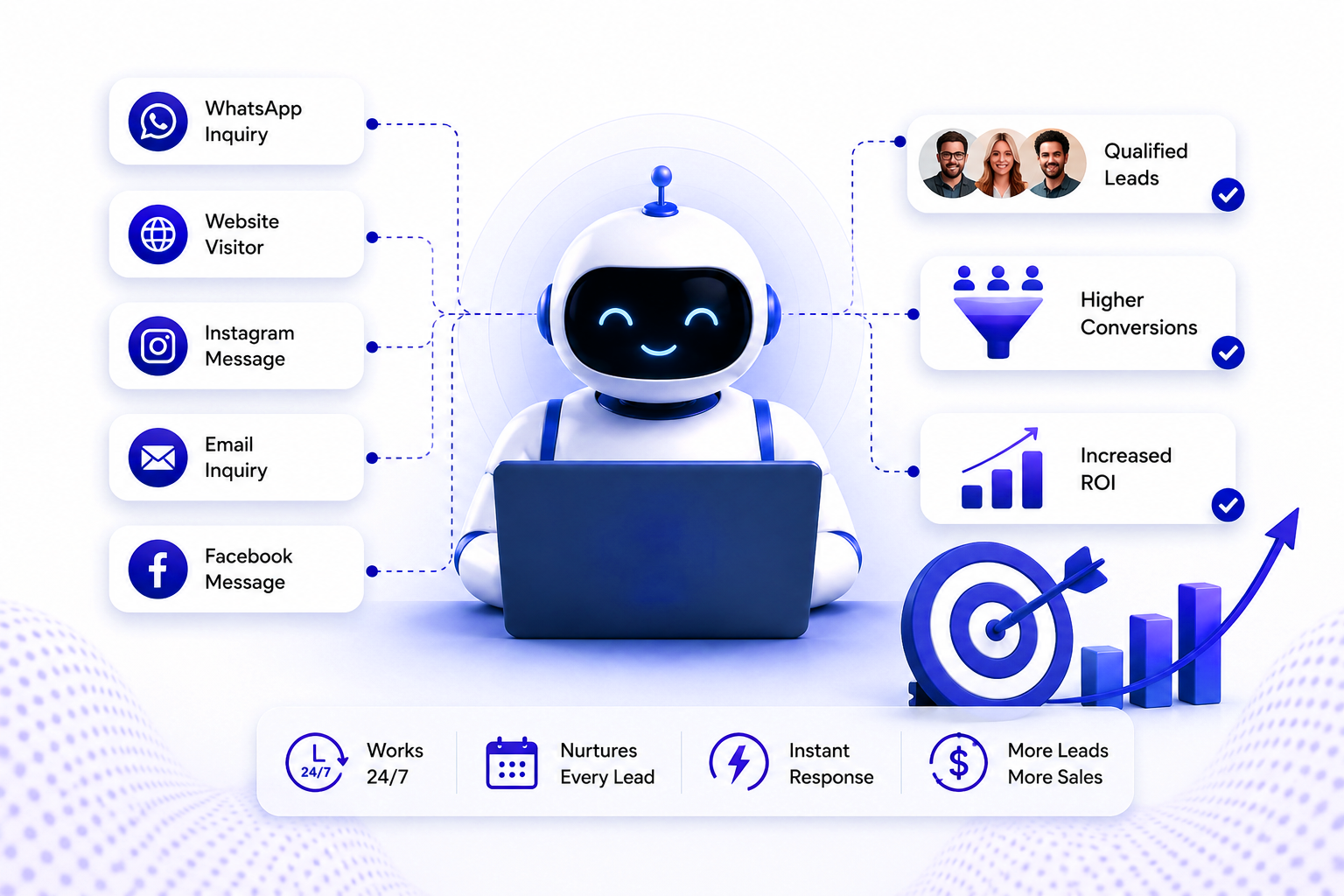
An AI lead conversion platform is a system that responds to every inbound lead instantly, qualifies them through real conversation, and books the appointment or handoff automatically, across every channel a lead might come from, at any hour, without a person doing it manually. It's not a chatbot bolted onto a website. It's connected directly to your ad accounts, your DMs, your CRM, and your calendar, so a lead goes from "interested" to "booked" without sitting in an inbox waiting for someone to notice.
The Real Cost of Slow Lead Response
Slow lead response costs businesses far more revenue than most owners realize, because conversion rates drop sharply within the first few minutes after someone reaches out, not the first few hours. Multiple studies on speed-to-lead point to the same pattern: a lead contacted within roughly five minutes converts at a rate many multiples higher than one contacted thirty minutes later, and the business that responds first tends to win the deal outright, regardless of price or product quality.
The uncomfortable part is how far most businesses are from that window. Independent research on average response times consistently finds businesses taking hours sometimes closer to a full day, to make first contact, and a meaningful share never respond at all. None of that is a staffing problem you fix by hiring one more person to watch the inbox. It's a structural problem, because leads now arrive faster and from more places than any team can realistically monitor around the clock.
There's a compounding effect that makes this worse over time. A lead that goes cold doesn't just represent one lost sale, it represents ad spend that already paid to generate the interest in the first place. Every dollar spent on a campaign that produces a lead who never gets a timely reply is a dollar spent buying a competitor's customer. Businesses running paid ads without a fast, consistent response system in place are, in effect, subsidizing whoever in their market responds first.
Why "We'll Get to It" Doesn't Work Anymore
The reason manual follow-up used to work is that leads came from one or two predictable places a phone line, maybe a contact form. That's no longer true for almost any business. Leads now arrive through Instagram DMs, Facebook comments, WhatsApp, website forms, Google ads, and referrals, often simultaneously, and each one expects a response at the speed of the platform it came from.
A team can watch one inbox closely. It cannot watch six inboxes closely, every hour, every day, without either burning out or missing leads usually both. This is the exact gap an AI lead conversion platform is built to sit in: one system watching every channel at once, responding the moment someone shows interest, instead of a person deciding which inbox to check next.
What an AI Lead Conversion Platform Actually Does
A properly built AI lead conversion platform replies to a new lead within seconds across whichever channel they used, asks the right qualifying questions in a real conversation rather than a rigid script, books the appointment directly onto your calendar if they qualify, updates your CRM automatically, and keeps following up with leads who go quiet, all without a staff member touching the conversation.
That last part matters more than most businesses expect. A large share of "lost" leads were never actually lost, they just never got a second or third message, because manual follow-up tends to stop after one attempt. A platform built to nurture doesn't get tired of following up.
How We Built This for Train Gym
We built exactly this system for Train Gym, a fitness brand that was losing leads across social media faster than its team could respond to them. The AI agent we built now qualifies every inbound lead across every offer and channel, holding a real conversation instead of a scripted one, and books the appointment directly, no staff member lifting a finger. Since launch, it's qualified dozens of leads and converted them into booked appointments that would previously have sat unanswered in a DM inbox until someone had time to reply, usually too late to matter.
Mica Dalton, Train Gym's CEO, has described the change simply: one agent now handles what used to require a person watching every inbox, every offer, every day.
Signs You Need One
You likely need an AI lead conversion platform if any of the following sound familiar:
Leads sit in your DMs or inbox for hours before anyone replies
Your team can name specific leads they know went cold from slow follow-up
You're running ads and can't say with confidence how fast those leads get a first response
Follow-up mostly happens once, if it happens at all
Booked appointments frequently no-show because the gap between interest and confirmation was too long
Your CRM is only as accurate as whoever remembered to update it that day
If two or more of these apply, the cost of not having one is almost certainly larger than the cost of building one.
How Enorness Builds an AI Lead Conversion Platform
We build these the same way we build every AI system: we diagnose the actual lead flow first where leads come from, how they're currently handled, and exactly where they're falling through before we design anything. From there, we connect the agent directly to your ad accounts, social channels, website forms, and CRM, so it's working inside your real lead flow rather than a separate tool your team has to check on top of everything else. We set clear rules for what it handles alone versus what gets flagged for a person, launch it, and measure it against what your response time and conversion rate looked like before.
This is also where a lot of off-the-shelf tools fall short, and why we build custom rather than pointing clients at a generic plug-in. Every business qualifies leads differently a gym asks different questions than a med spa, a B2B software company qualifies on budget and timeline rather than intent alone. A platform that treats every lead the same way ends up either over-qualifying and losing interested prospects to friction, or under-qualifying and flooding your calendar with bookings that were never going to close. We build the qualification logic around how your business actually sells, not a generic template.
What to Look for Before You Buy One
Not every "AI lead platform" on the market does what it claims. Before committing to one, it's worth checking three things: whether it connects directly to the specific channels your leads actually come from, rather than just a website widget; whether it can hold a real qualifying conversation instead of a rigid decision-tree script that breaks the moment a lead asks an unexpected question; and whether it updates your CRM automatically, so your sales data reflects what actually happened instead of what someone remembered to log.
A platform that fails any of those three ends up creating more manual work than it removes, which is the opposite of the point. It's also worth asking how the system handles a lead who asks something outside the script. Real leads don't follow a script they ask about pricing, mention a competitor, or bring up a concern nobody anticipated. A platform built on rigid decision trees breaks the moment that happens and either goes silent or gives an answer that damages trust. A properly built agent can hold that conversation naturally and still know exactly when to hand off to a person.
From AI Pilot to Production-Ready Business Solution
The businesses converting the most leads in 2026 aren't necessarily generating more of them. They're responding faster and following up more consistently than their competitors, because they've stopped relying on a person to do both of those things perfectly, every time, on every channel. An AI lead conversion platform is how that becomes structurally true instead of something you hope your team manages on a good day.
If leads are going cold before your team gets to them, that's exactly the problem we start with on a strategy call mapping your actual lead flow before recommending anything, the same way we did for Train Gym.
Frequently Asked Questions
What is an AI lead conversion platform?
An AI lead conversion platform is a system that automatically responds to, qualifies, and books inbound leads across every channel DMs, forms, ads, and messaging apps in real time, without a person manually handling each conversation. It connects directly to a business's CRM and calendar so qualified leads convert into booked appointments automatically.
How is an AI lead conversion platform different from a chatbot?
A chatbot typically answers scripted questions on a website and stops there. An AI lead conversion platform holds a real qualifying conversation across multiple channels, books the appointment directly, updates the CRM, and follows up with leads who don't respond right away completing the full conversion process, not just the first reply.
How much revenue do slow lead responses actually cost a business?
Research on speed-to-lead consistently shows conversion rates drop sharply within minutes of a lead going unanswered, and the business that responds first typically wins the deal regardless of price. For a business generating a meaningful volume of leads each month, even a modest improvement in response time and follow-up consistency can translate into a significant increase in booked appointments and closed deals.
Does an AI lead conversion platform work with my existing CRM and ad accounts?
Yes, when it's built correctly. Enorness connects each platform directly to a business's existing CRM, ad accounts, and social channels during the build, rather than creating a separate system the team has to check on top of everything else.
How fast can Enorness get an AI lead conversion platform live?
A: A focused platform built around one core lead channel can go from diagnosis to live deployment in a matter of weeks. Timelines extend when the scope includes multiple channels, complex qualification rules, or CRM systems that require custom integration work.


Let's Build Something Extraordinary
Turn ideas into intelligent products that drive real business results.