White-Label Ordering: Why Smart Restaurants Are Quietly Ditching Marketplace Commissions

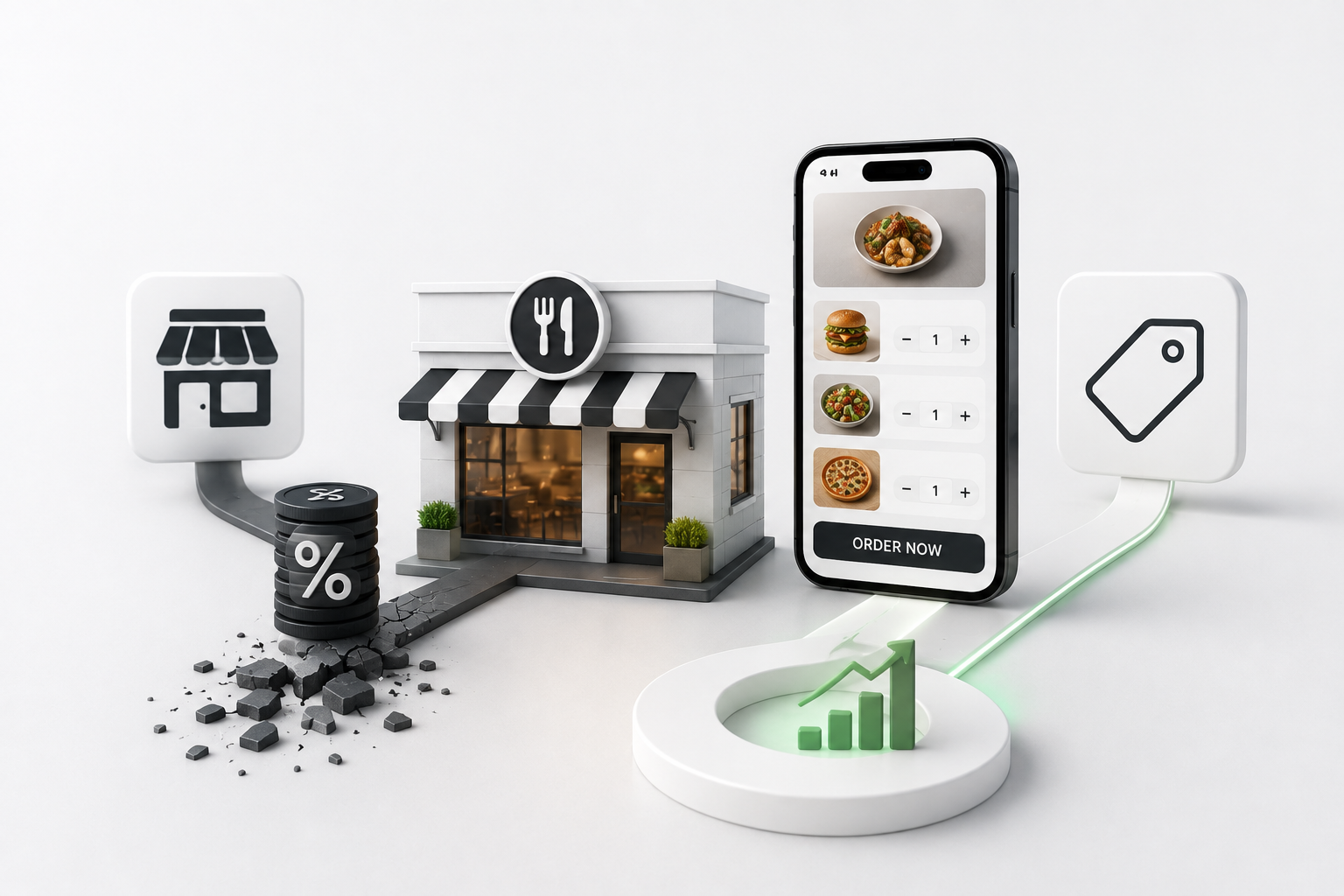
When a restaurant signs up for a delivery marketplace, the pitch is visibility get discovered by people already browsing the app.
Most articles about white-label ordering system open with the commission math, 15% to 30% per order and stop there, as if the fee were the whole story. It isn't. The fee is just the visible cost. The invisible one is bigger: every order that goes through a marketplace is a customer a restaurant will probably never be able to reach again.
That's the part most restaurant owners underestimate until they've been running on a marketplace for a year and realize they have thousands of orders behind them and almost no way to contact the people who placed them.
The Marketplace Trade-Off Nobody Explains Upfront
When a restaurant signs up for a delivery marketplace, the pitch is visibility get discovered by people already browsing the app. That part is real, especially early on. What's rarely mentioned is what the restaurant gives up in exchange:
The customer relationship becomes the marketplace's, not the restaurant's.
Order confirmations, delivery updates, and remarketing all happen through the platform's branding, not the restaurant's. The customer associates the experience with the app, not necessarily the kitchen that made the food.
Data access is limited or nonexistent.
Most marketplaces don't hand over customer emails or phone numbers. That means no win-back campaign for a customer who hasn't ordered in six weeks, because the restaurant has no way of knowing who that customer is.
The competitive set is built into the checkout screen.
A customer browsing a marketplace sees five other restaurants in the same radius before they see the menu. On a restaurant's own site, that competition doesn't exist there's nothing to compare against except the restaurant itself.
The online ordering market has grown past $46 billion globally and continues expanding at double-digit rates, which tells you restaurants aren't opting out of digital ordering. They're increasingly choosing where that ordering channel is hosted and a growing share are choosing to host it themselves.
What "White-Label" Actually Buys a Restaurant
A white-label ordering system isn't a stripped-down version of a marketplace app. It's the same underlying infrastructure payments, order routing, POS integration, real-time order tracking rebuilt so the restaurant owns the brand layer completely: its logo, its colors, its domain, and critically, its customer data.
The practical difference shows up in three places:
1. Cost structure that doesn't punish success.
Commission-based models charge more as a restaurant does better. Infrastructure-based pricing stays flat or predictable, so growth actually improves margins instead of eroding them.
2. A real customer list.
Every direct order captures contact information the restaurant actually owns, which is what makes loyalty programs, win-back campaigns, and repeat-order incentives possible in the first place.
3. An ordering experience that reinforces the brand instead of diluting it.
No competitor logos on the same screen, no marketplace-imposed design constraints just the restaurant's own storefront, digital.
Why This Matters More for Independent Restaurants, Not Less
There's a common assumption that white-label ordering is really a chain-restaurant play something for operators with the resources to build a direct channel. In practice, it's often independent restaurants and small groups who have the most to gain and the least margin to spare on commission. A single-location restaurant losing 25% of every delivery order to commission is losing a much larger share of its actual profit than a large chain with volume-based negotiating leverage.
What We Built
We developed a white-label ordering engine specifically for this shift giving a restaurant a fully branded, commission-free channel instead of a marketplace listing. It handles the complete order lifecycle end to end (menu management, checkout, payment processing, order routing) while keeping the restaurant in control of the one thing a marketplace never gives back: the customer relationship.
The Question Worth Asking
If a growing share of orders is arriving through a marketplace and there's no reliable way to reach those customers directly outside that app, that's usually the clearest signal that the infrastructure gap not the marketing gap is what needs fixing first.
See how we built a commission-free ordering system
Frequently Asked Questions
Is white-label ordering only worth it for restaurants with high order volume?
Not necessarily. Since commission scales with revenue on marketplace platforms, restaurants with steady but modest order volume often see a faster return by switching, because they stop losing a percentage of every order rather than paying a flat infrastructure cost.
Do restaurants using white-label ordering still need to be listed on delivery marketplaces?
Many restaurants run both in parallel using marketplaces for discovery and new customer acquisition, while directing repeat customers to their own branded ordering channel where there's no commission and the customer relationship stays with the restaurant.
How does a white-label ordering system handle delivery logistics?
This depends on the specific setup some systems integrate with existing delivery networks or third-party logistics providers, while others are built for pickup and dine-in-focused restaurants that don't need built-in delivery dispatch at all.
What's the realistic timeline to launch a white-label ordering system?
It varies based on menu complexity, POS integration needs, and payment setup, but the discovery and configuration phase is typically the longest part building on existing infrastructure is generally faster than building an ordering system from scratch.
Can a white-label system integrate with the POS a restaurant already uses?
Most modern white-label ordering platforms are built to integrate with common POS systems rather than requiring a restaurant to replace their existing point-of-sale setup, which significantly reduces the operational disruption of switching.

Written by
Admin

Let's Build Something Extraordinary
Turn ideas into intelligent products that drive real business results.