NFT Benefits for Businesses: Real Use Cases for US Companies

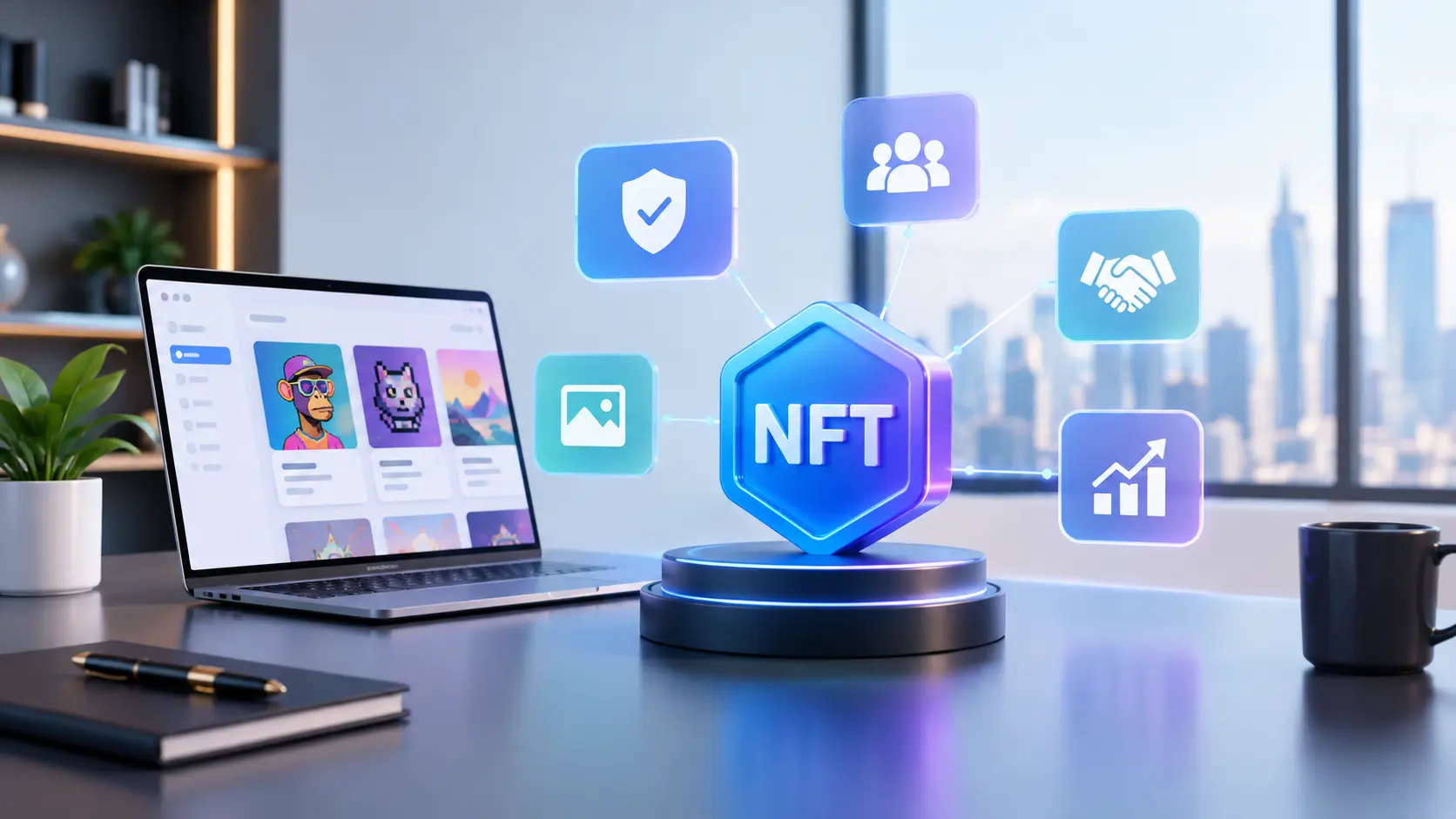
NFTs give businesses a way to prove ownership, authenticity, or access rights for a digital or physical asset.
NFTs give businesses a way to prove ownership, authenticity, or access rights for a digital or physical asset, recorded permanently on a blockchain and enforced automatically through smart contracts. Past the speculation cycle of profile-picture collectibles, the businesses actually getting value from NFTs in 2026 are using them for loyalty programs, product authentication, ticketing, supply chain tracking, and credential verification, applications where the underlying blockchain properties, immutability and verifiable ownership, solve a real operational problem.
This guide covers what NFTs actually do for a business beyond the hype, the use cases with real commercial traction, the difference between a collectible and a utility NFT, what a program costs to build, and the US tax and regulatory considerations that matter before you launch one.
What Are NFTs, and Why Do They Matter for Businesses Now?
An NFT, or non-fungible token, is a unique digital record on a blockchain representing ownership of a specific asset, digital or physical. Unlike a cryptocurrency, where one unit is interchangeable with another, each NFT is distinct, which is exactly the property that makes it useful for anything requiring proof of a specific, non-duplicable item: a ticket, a certificate, a loyalty tier, or a claim on a physical product.
The market has shifted meaningfully since the 2021 to 2022 speculative peak. Industry coverage now describes the sector moving past simple collectibles toward what gets called utility NFTs, tokens tied to an actual function, a discount, an access right, a governance vote, rather than pure resale value. That shift is exactly what makes NFTs relevant to a business audience that has no interest in speculative trading but does have a real problem NFTs happen to solve well.
Key Benefits of NFTs for Businesses
Verifiable authenticity: an NFT tied to a physical product creates a tamper-proof record of origin, which directly addresses counterfeiting in luxury goods, pharmaceuticals, and high-value equipment.
Programmable loyalty and membership: unlike a traditional points program locked to one platform, an NFT-based loyalty token can be traded, verified, and extended with new perks without rebuilding the whole program.
Automated royalties and revenue share: smart contracts can route a percentage of every resale back to the original creator or business automatically, something traditional licensing agreements require manual enforcement to achieve.
Supply chain traceability: NFTs minted at each stage of a product's journey create an immutable record of custody, which matters most for perishable goods, pharmaceuticals, and any product where provenance affects trust or compliance.
Frictionless ticketing and access control: an NFT ticket cannot be duplicated the way a PDF or barcode can, and it can unlock recurring access to a community or event series rather than a single one-time entry.
Verifiable credentials: educational and professional certifications minted as NFTs create a tamper-proof, instantly verifiable record, removing the manual verification step employers or partners currently have to chase down.
Real Business Use Cases by Industry
Industry | How NFTs Get Used |
Retail and e-commerce | Tiered loyalty tokens, early access drops, token-gated discounts |
Luxury goods and manufacturing | Product authentication tied to a physical item, anti-counterfeiting |
Logistics and supply chain | Custody and provenance tracking at each handoff point |
Events and entertainment | Non-duplicable ticketing, ongoing membership access post-event |
Education and professional services | Verifiable certificates and credentials, tamper-proof records |
Real estate and asset management | Fractional ownership records, title and transaction history |
The pattern across all of these is the same. NFTs work where a business needs to prove something is genuine, scarce, or owned by a specific party, and where that proof needs to be checkable by someone outside the business's own systems. Where that need does not exist, an NFT adds blockchain complexity to a problem a normal database already solves.
Utility NFTs vs Collectible NFTs: What Businesses Should Actually Build
This distinction matters more than almost anything else in this space. A collectible NFT derives its value primarily from scarcity and resale speculation, digital art, profile pictures, trading cards. A utility NFT derives its value from what it actually does: unlocking access, tracking an asset, or automating a royalty split.
For a business, a utility NFT is almost always the right model. It ties the token's value to a real function your business controls and can improve over time, rather than to a secondary market you do not control and that can collapse independent of anything your business does. Dynamic NFTs, tokens whose metadata updates based on usage or predefined rules, take this further, letting a loyalty tier or product warranty status update automatically as conditions change rather than staying static after mint.
How NFTs Work for Business: The Technical Basics
An NFT is minted, created and recorded, on a blockchain using a smart contract, self-executing code that defines the token's rules: what it represents, whether royalties apply on resale, and what actions it can trigger. Ethereum remains the most established network for business NFT projects, though the transaction fees, known as gas fees, can be significant during high network demand. Layer 2 networks like Polygon offer the same smart contract capability at a fraction of the cost, which is why most business-focused NFT programs in 2026 build there rather than directly on Ethereum mainnet.
Token-gated access, restricting a website, community, or discount to verified NFT holders, is the mechanism behind most loyalty and membership use cases. A wallet connects, the smart contract verifies ownership, and access unlocks automatically without a business needing to maintain a separate login system.
US Tax and Regulatory Considerations for Business NFTs
The IRS treats NFTs as property, the same general category as cryptocurrency, which means minting, selling, or trading one is a taxable event that must be reported. The IRS has also proposed treating certain NFTs as collectibles under a look-through analysis, meaning the tax treatment follows whatever underlying asset the NFT represents, a rule that carries a higher capital gains rate when it applies. This proposal remains under IRS review rather than finalized guidance, so businesses should treat it as a developing area rather than settled law.
Separately, IRS broker reporting rules under Form 1099-DA now apply to digital asset transactions, including NFTs, with reporting requirements phasing in through 2025 and 2026 and a de minimis threshold for aggregate reporting. On the securities side, the SEC has scrutinized NFT projects that function like fundraising mechanisms, tokens sold with an expectation of profit driven by the issuer's efforts can trigger securities law regardless of what the project calls itself. A utility-first NFT program tied to a real product or service carries meaningfully less of that exposure than one marketed primarily on resale value, which is one more reason the utility model is the safer starting point for a business.
None of this is a substitute for tax or legal counsel specific to your program. Digital asset regulation is moving quickly enough that guidance current at the time of writing may shift before a project launches, so confirm the current rules with a qualified advisor before finalizing a business NFT program's structure.
What Does It Cost to Launch a Business NFT Program?
Program Type | Typical Range | What Drives the Cost |
Single-use case pilot (loyalty or ticketing) | $15,000 to $50,000 | Smart contract development, minting infrastructure, basic wallet integration |
Full loyalty or membership platform | $50,000 to $150,000 | Dynamic NFT metadata, token-gated access, e-commerce integration |
Enterprise supply chain or authentication system | $150,000+ | Multi-party integration, custom smart contracts, ongoing infrastructure and compliance |
Ongoing costs matter as much as the build itself: smart contract audits, gas fee budgeting even on lower-cost networks, and metadata storage all add recurring expense that a one-time project quote can understate.
Common Mistakes Businesses Make with NFT Programs
Leading with the technology instead of the business problem, launching an NFT because it is trendy rather than because it solves something a database could not.
Building a collectible-style program when a utility model would carry less regulatory exposure and more durable value.
Skipping a smart contract audit to save cost, then facing an exploit that a basic audit would have caught.
Ignoring the tax and reporting obligations that apply the moment a business mints, sells, or distributes NFTs, not just when a customer resells one.
Choosing a blockchain network based on hype rather than gas fees and transaction speed relevant to the actual use case.
How Enorness Approaches Custom Software for Emerging Technology
Enorness evaluates blockchain and NFT-based systems through our Enterprise Software Engineering practice, starting with whether the business problem actually needs blockchain-backed proof of ownership or authenticity before recommending a build. A loyalty or authentication use case that does not need public, trustless verification is often better and cheaper solved with a conventional database, and we say so rather than defaulting to blockchain because it was requested.
Frequently Asked Questions
What is the actual benefit of an NFT over a normal database record?
An NFT provides verifiable ownership or authenticity that anyone can check independently, without trusting the business's own systems. A normal database works fine when only your business needs to trust the record. An NFT matters when a customer, partner, or auditor outside your systems needs to verify it too.
Are utility NFTs regulated differently than collectible NFTs?
Utility NFTs tied to a real product or service function generally carry less securities law exposure than NFTs marketed primarily on resale value and profit expectation, since the SEC has focused enforcement attention on projects that function like unregistered securities offerings. This distinction does not eliminate tax reporting obligations either way.
Do businesses have to pay taxes when they mint or sell NFTs?
Yes. The IRS treats NFTs as property, and minting, selling, or trading one is a taxable event that must be reported, separate from whether an NFT might also be classified as a collectible under proposed IRS guidance.
Which blockchain should a business use for an NFT program?
Ethereum remains the most established network, but its gas fees can be significant. Most business-focused programs in 2026 use Layer 2 networks like Polygon, which offer the same smart contract functionality at a fraction of the transaction cost, making them more practical for loyalty and ticketing use cases with high transaction volume.
How long does it take to launch a business NFT program?
A single-use case pilot, a loyalty program or ticketing system, typically takes 6 to 10 weeks. A full platform with dynamic metadata and e-commerce integration usually runs 3 to 5 months, with smart contract auditing adding time that should not be skipped to hit a launch date.
Does every business need an NFT strategy in 2026?
No. NFTs solve a specific problem: proving ownership, authenticity, or access in a way outside parties can verify independently. If your business does not have that problem, a conventional system is usually simpler, cheaper, and just as effective.
Ready to Evaluate Whether NFTs Fit Your Business?
Before building an NFT program, it is worth confirming the problem actually needs one. Book a Strategy Call with Enorness and we will assess whether your use case genuinely needs blockchain-backed verification or whether a simpler system gets you the same result faster and cheaper.


Let's Build Something Extraordinary
Turn ideas into intelligent products that drive real business results.