Native vs Cross-Platform Mobile App Development: How to Choose

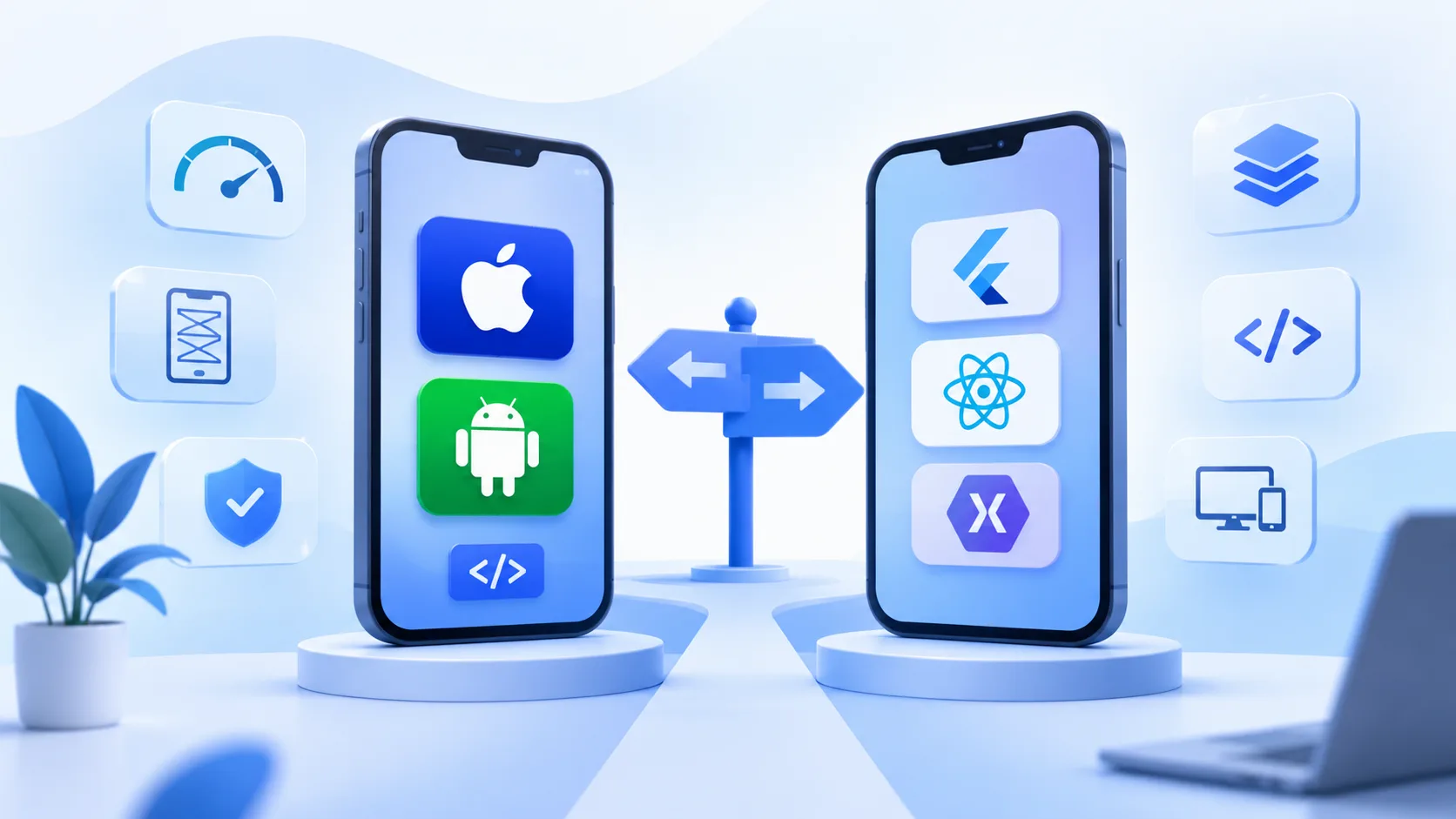
Neither approach is universally better. Here is what native and cross-platform mobile app development actually trade off, and the questions that decide which one fits.
The native vs cross-platform mobile app development question gets argued as if one side is always right. It isn't. Native app development means building separately for iOS and Android, each in its own language and SDK. Cross-platform app development means writing one codebase that runs on both. Each approach is the correct choice for a specific kind of app, and the wrong choice for a different kind of app.
The decision comes down to what the app actually needs to do, not which approach sounds more modern or more established.
What Native Actually Means
Native mobile app development uses each platform's own language and toolkit: Swift for iOS, Kotlin for Android. The app is built twice, once for each platform, which gives it full and immediate access to whatever that platform's SDK exposes: camera controls, background processing limits, augmented reality frameworks, the newest OS features on release day rather than whenever a cross-platform framework catches up.
The cost of that access is maintaining two separate codebases. A feature gets built twice, a bug gets fixed twice, and the two versions can drift apart if the two builds are not kept in sync deliberately.
What Cross-Platform Actually Means
Cross-platform app development, through frameworks like React Native or Flutter, uses one codebase that compiles down to both iOS and Android. A feature gets built once and ships to both platforms at close to the same time, which is why cross-platform is usually faster and cheaper to build and maintain for a team that does not want to run two parallel codebases. This decision is a core part of mobile app development planning, not an afterthought once a build is already underway.
The trade is a layer of abstraction between the app and each platform's native capabilities. Much of the everyday functionality, forms, navigation, standard UI, works through that layer without friction. A feature that depends on something very specific to one platform, a new OS capability on release day or heavy background camera processing, is where that abstraction layer can add delay or require dropping into native code anyway for just that piece.
The Questions That Actually Decide It
How performance-sensitive is the app. A game, a video editing tool, or anything doing heavy camera or sensor processing in real time benefits from native's direct access to the hardware. A booking app, a content app, or many business tools built around forms and data display run fine on either approach, since the bottleneck is rarely raw performance. Choosing a mobile app framework usually starts with an honest answer to this one question.
What is the budget and timeline. Cross-platform generally reaches both app stores faster and for less, since one codebase replaces two. A business trying to validate an idea quickly, or with a limited budget to prove demand before investing further, has less to lose starting there.
How will the app be maintained going forward. A team with one engineer wearing multiple hats has an easier time keeping one codebase current than keeping two platform-specific codebases from drifting apart. A team planning to invest heavily in platform-specific features down the line may prefer starting native rather than migrating later.
The Misconception Worth Clearing Up
Cross-platform is not automatically the compromise option, and native is not automatically the premium one. Large, well-known apps run successfully on both approaches. The honest framing is that cross-platform removes some of the lowest-level control a development team has over each platform in exchange for building and maintaining one codebase instead of two, and for many apps that trade rarely becomes a problem worth noticing.
Mobile app development cost comparisons that treat native as simply more expensive miss this nuance. The real cost difference shows up in long-term maintenance and in how much platform-specific functionality the app actually uses, not in which approach is chosen on day one. The backend and infrastructure behind either kind of app is where cloud and DevOps work tends to matter more than the frontend framework decision.
Starting Cross-Platform and Moving Pieces to Native Later
A common path for a business unsure which way to go is starting cross-platform to validate the app and reach both platforms quickly, then rebuilding a specific feature in native code later if that feature turns out to need capabilities the cross-platform framework cannot reach cleanly. This avoids committing to two full codebases before anyone knows whether the app will have enough users to justify that cost.
This staged approach pairs well with a backend built to handle either direction without a rewrite: a backend workflow layer that is not tied tightly to one specific app framework, the kind of work covered under business process automation, keeps the business logic reusable no matter which frontend decision changes later.
Frequently Asked Questions
Is cross-platform app development always cheaper than native?
Usually upfront, since one codebase replaces two. Over the long run, the comparison depends on how much platform-specific functionality the app needs, which can narrow or reverse the initial cost advantage.
Which approach is better for performance?
Native has a direct performance edge for heavy real-time processing like games or intensive camera and sensor use. For many business apps built around forms, content, and standard navigation, the performance difference is rarely noticeable to a user.
Can an app switch from cross-platform to native later?
Yes, usually feature by feature rather than all at once. A specific feature that needs deeper platform access can be rebuilt natively while the rest of the app stays on the shared codebase.
What affects how long mobile app development takes?
A straightforward app built on one shared codebase is a smaller scope than building two separate native versions in parallel, or an app with heavy platform-specific features, either of which takes longer to design, build, and test.
Does React Native or Flutter limit what an app can do?
Not for typical, everyday functionality. They can reach a large share of each platform's native features directly. The limits show up mainly with brand-new OS capabilities or specialized hardware access, where dropping into native code for that one piece is sometimes still necessary.
How can a business know which approach fits a specific app idea?
The clearest signal is how much of the app depends on deep, platform-specific functionality versus standard forms, content, and navigation. An app closer to the second category is generally a safer fit for cross-platform.
Working Out Which Approach Fits
The performance-sensitivity question above is usually the fastest way to narrow this down. For a closer look at a specific app idea, Enorness can be reached to talk through whether it fits cross-platform, native, or a staged path between the two.

Written by
Mark Louis




Let's Build Something Extraordinary
Turn ideas into intelligent products that drive real business results.