Food Delivery App Development: How Restaurants Keep Margin and Keep Customers

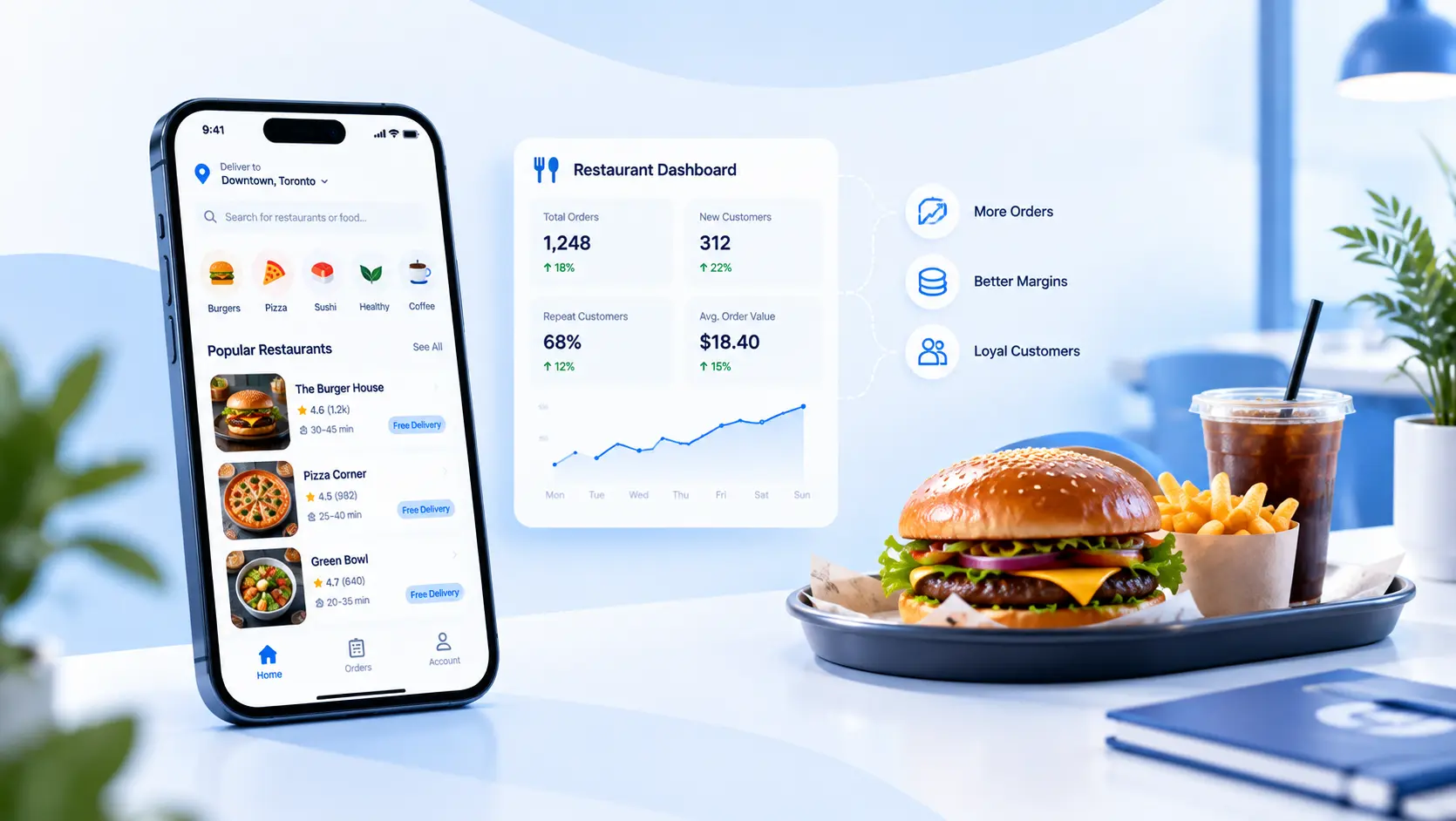
How food delivery app development works: POS integration, loyalty, flat-rate ordering, and real repeat-purchase data from GrabEasy.
Food delivery app development is the process of building a branded ordering system that handles the full transaction cycle for a restaurant or food brand: menu display, payment, order routing to the kitchen, and the repeat-use mechanics that bring a customer back. The difference between an app that a customer uses once and one that becomes a habit lives in the infrastructure underneath, not the design on top.
Third-party aggregators solve the discovery problem and introduce a different one. A restaurant listed on a major delivery marketplace pays a commission on every order. The brand, the customer data, and the relationship belong to the platform, not the business. Food delivery app development addresses this by giving a restaurant its own channel: branded, free of aggregator-level commissions, and connected to the kitchen workflow it already runs.
This guide covers what makes a food ordering app work at the infrastructure level, what distinguishes platforms that retain customers from those that do not, and how the GrabEasy white-label ordering engine performs against those criteria with real order data.
What Food Delivery App Development Actually Involves
Building a food ordering app involves more than a menu and a checkout screen. The components that determine whether the system performs are mostly invisible to the end customer.
A production-ready system covers five areas:
· Menu and inventory management: categories, availability toggles, item-level pricing, and modifiers that match how the business actually sells.
· Order routing: the path an order takes from confirmed payment to kitchen printer and point-of-sale system, without a manual step in between.
· Payment processing: secure checkout that handles card, digital wallet, and in-app payment methods with low friction at confirmation.
· Loyalty and repeat-purchase mechanics: a mechanism built into the ordering flow itself, not a separate app or bolt-on program.
· Analytics: order data by customer, channel, and time period so the business can read what is working and where orders drop off.
Each of these connects to the others. A loyalty profile that does not travel with the ordering flow becomes something a customer has to remember to use. An analytics layer that sits outside the order data produces reports the business cannot act on.
The Commission Problem and What Replaces It
Aggregator platforms charge a percentage of every order. For an independent restaurant or food retailer, this means the most engaged customers, the ones ordering frequently, generate the highest absolute commission spend. The business builds a customer relationship on infrastructure it does not own.
A white-label food ordering platform replaces that arrangement with a system the business controls. GrabEasy, built and operated by Enorness, charges a flat five percent commission per order. Once a location reaches $10,000 in monthly sales, the commission is capped at $500 for that month. The business owns the customer data, the loyalty profile, and the ordering history. Flat-rate ordering at scale means the margin stays with the operator, not the platform.
The case for flat-rate ordering is not theoretical. The operational bottleneck for most independent operators is not building a loyal customer base. It is keeping the margin from orders those customers place.
How GrabEasy Approaches Restaurant App Features
GrabEasy is Enorness's own white-label ordering platform. Each business on the platform gets a proprietary application configured for its specific menu structure, availability schedule, and pricing. Four infrastructure decisions separate it from a generic checkout flow.
Live POS integration without manual re-entry
POS integration for restaurants is the layer that removes manual re-entry from the kitchen workflow. An order placed in the app reaches the kitchen printer and the point-of-sale system directly. No staff member re-keys an order from the app into a separate terminal. The kitchen sees what the customer confirmed, and the POS system records the transaction in the same step.
Loyalty built into the ordering flow itself
A digital loyalty profile and biometric login travel with the ordering session. A returning customer's rewards status and history are present at checkout, not in a separate program. This fits with the 97 percent loyalty enrollment rate across registered GrabEasy users.
Dine-in and delivery in the same system
Table selection and order type sit alongside delivery details within a single flow. The same app covers a customer ordering from their table and one ordering for pickup or delivery. The business manages one system rather than two parallel ones.
Per-business menu configuration, not a shared generic storefront
Categories, availability toggles, and modifiers are configured for each business individually. A multi-location retailer can set item availability by location without a shared menu structure constraining what it can offer.
What Real Order Data Shows About Retention
SalTea Sloth, a multi-location specialty tea retailer, is GrabEasy's longest-running deployment. Its order history is the platform's clearest evidence of how the engine performs once a customer base starts using it.
The numbers from that deployment:
|
|
Metric | Result |
Repeat purchase rate | 59.8% of customers who ordered once placed a second order |
Median time to second order | 5.1 days |
Top customer depth | One customer placed 223 orders across two years |
Loyalty enrollment | 97% of registered users carry an active loyalty profile |
Order concentration | 35% of all orders came from the top 10 customers |
Peak-to-trough order ratio | 2.6x more orders on the busiest day than the slowest |
A 59.8 percent repeat purchase rate means roughly six in ten customers who order once order again. The median return window of 5.1 days indicates that repeat orders are not occasional. The loyalty and ordering mechanics run together rather than separately, which is the infrastructure condition that produces this pattern.
The same dataset also shows new customer growth slowing alongside minimal push activity, only 63 notifications sent across the full engagement period. The platform mechanics perform once a customer is in the system. Driving new customers into that system is a marketing responsibility that sits with the business, not the platform.
What Separates a Food Ordering App That Works From One That Does Not
Most food ordering apps that underperform share the same structural problem: the loyalty and retention mechanics are separate from the ordering flow. A customer who has to open a separate loyalty app or remember a points balance from a different program encounters friction that generic checkout flows do not remove.
Three conditions produce a food ordering app that retains customers:
· The loyalty profile is present at checkout, not in a parallel system the customer must consult separately.
· The order reaches the kitchen directly through POS integration, removing the lag and error rate that manual re-entry introduces.
· The app is configured for the specific business, not a shared storefront where the menu structure reflects the platform's constraints rather than the business's actual offerings.
A restaurant app built on a generic white-label template solves the first problem (having an app) while creating the second (a checkout flow that does not fit how the business operates). Custom food delivery app development addresses configuration at the infrastructure level.
Mobile App Development for Food Businesses: The Build vs. Platform Decision
Restaurant owners evaluating mobile app development for food businesses face a decision before the first line of code is written: build custom from scratch, license a generic white-label platform, or work with a team that builds and configures a platform as a managed system.
Each path has a different cost structure and a different ceiling.
· Full custom build: highest upfront cost, longest timeline, full ownership. Appropriate for businesses with complex operational requirements that no existing platform can accommodate.
· Generic white-label: lower upfront cost, faster deployment, shared constraints. Menu structure, loyalty mechanics, and POS integration work within the platform's parameters, not the business's.
· Configured platform as a managed system: the platform is built and operated by the development team, configured specifically for the business. GrabEasy operates this way.
The decision turns on how much the business's ordering workflow deviates from what a generic platform can handle, and whether the development team that builds the system also operates it long-term.
How Enorness Approaches Food Delivery App Development
Enorness builds food ordering systems as part of its broader mobile application development practice. GrabEasy is Enorness's own product, built on the same infrastructure discipline as every client engagement: systems architects and engineers building infrastructure that owns the full order lifecycle, not just a storefront on top of someone else's platform.
The platform handles menu configuration, live POS integration, loyalty enrollment, and order analytics within a single system. Restaurants and food retailers that want an online and in-house ordering channel without paying aggregator-level commissions, and that are prepared to actively market the app to their customer base, are the operators GrabEasy is built for.
For businesses with requirements that go beyond what GrabEasy covers, Enorness builds custom mobile applications through its enterprise software engineering and mobile app development services.
Restaurants that need additional capabilities alongside ordering, such as business process automation, AI solutions, or data engineering, can reach those practices through the same team.
For operators ready to move forward, the next step is simple: Book a strategy call.
Frequently Asked Questions
Q1: What is food delivery app development?
A: It is the process of building a branded ordering system for a restaurant or food brand that handles menu display, payment, order routing to the kitchen, and the repeat-purchase mechanics that bring customers back.
Q2: How does a restaurant food ordering app connect to the kitchen?
A: Through live POS integration, an order placed in the app reaches the kitchen printer and the point-of-sale system directly, without a manual re-entry step between the customer's confirmation and the kitchen's view of the order.
Q3: What is a white-label food ordering platform?
A: A white-label food ordering platform is a system a business deploys under its own brand, configured for its specific menu structure and ordering flow, without paying aggregator-style commissions on every transaction.
Q4: How does restaurant app loyalty enrollment work?
A: When a loyalty profile and login are built into the ordering flow itself rather than sitting in a separate app or program, a returning customer's rewards status is present at checkout on every visit.
Q5: What repeat purchase rate does GrabEasy show?
A: SalTea Sloth's order data from the GrabEasy platform shows a 59.8 percent repeat purchase rate, with a median time to second order of 5.1 days and 97 percent loyalty enrollment among registered users.
Q6: What does food delivery app development cost?
A: Cost depends on whether the business uses a configured white-label platform, a generic white-label with limited customization, or a full custom build. A configured platform like GrabEasy charges a flat commission per order with a monthly cap, while a full custom build carries a higher upfront development cost.

Written by
Mark Louis




Let's Build Something Extraordinary
Turn ideas into intelligent products that drive real business results.