FHIR API Integration Guide: Architecture, Compliance, and Cost for US Healthcare

FHIR API integration, sometimes searched as “fihr API,” connects your application to a health system's electronic records using HL7's FHIR R4 standard, structured resources like Pa…
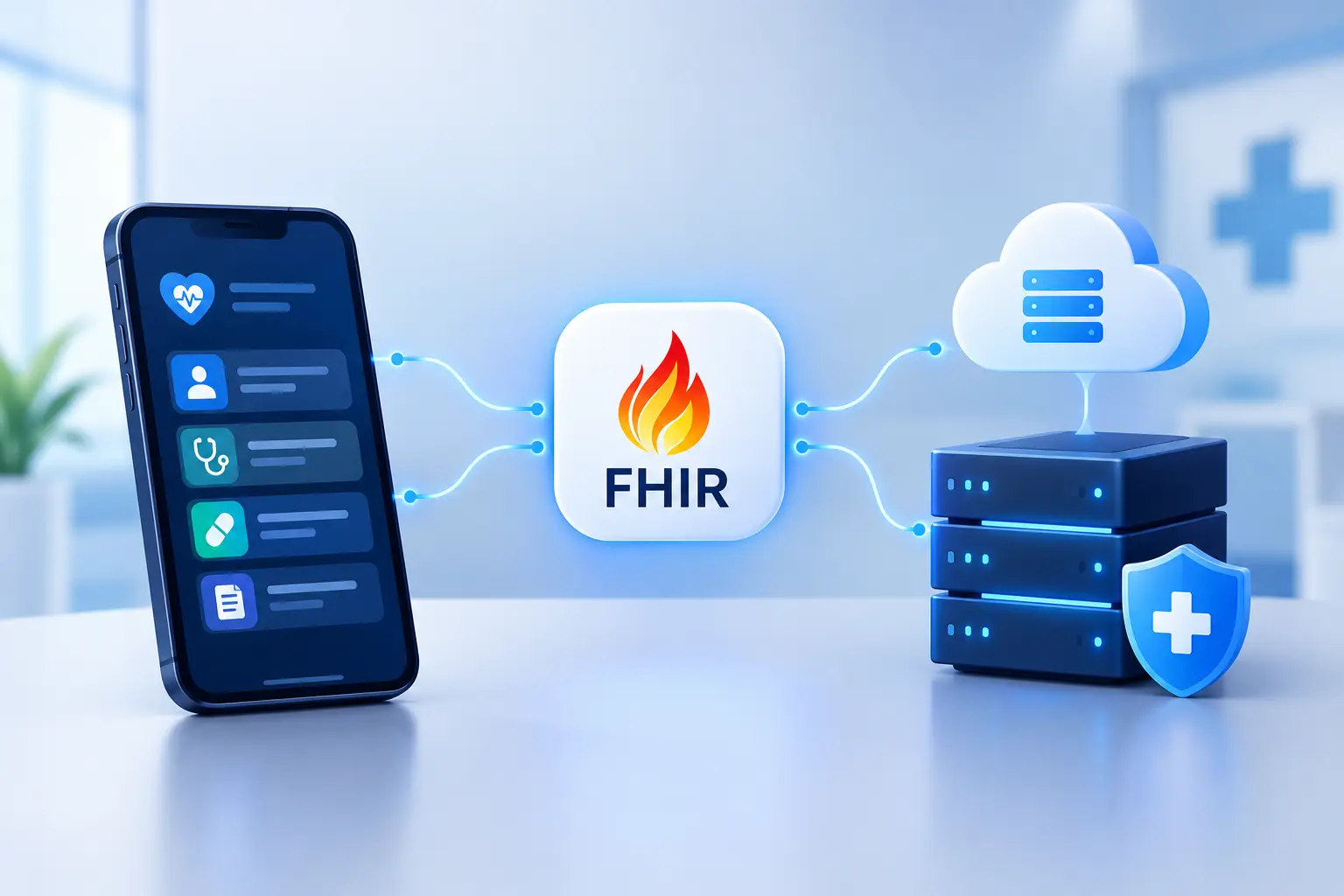
FHIR API integration, sometimes searched as “fihr API,” connects your application to a health system's electronic records using HL7's FHIR R4 standard, structured resources like Patient and Observation, SMART on FHIR authorization, and a Capability Statement that tells you exactly what the target server supports. Done right, it replaces slow, point-to-point HL7 v2 message pipes with a REST-based, standards-compliant data exchange that scales across EHR vendors. Done wrong, it becomes a compliance liability and a maintenance burden that grows with every ONC rule change.
This guide covers what FHIR API integration actually involves, how to implement it step by step, what US regulations require, which integration pattern fits your use case, realistic cost ranges, and the mistakes that turn a straightforward integration into a six-month fire drill.
What Is FHIR API Integration?
FHIR, short for Fast Healthcare Interoperability Resources, is HL7's standard for exchanging health data over REST APIs using structured, machine-readable resources instead of proprietary message formats. FHIR R4 is the current baseline for US patient-access APIs and the version most EHR vendors, including Epic, Oracle Health (formerly Cerner), Athena-health, Veradigm, and NextGen, expose through their developer programs. A newer version, FHIR R5, exists but has limited production adoption in US healthcare as of 2026, so R4 remains the safe default for new integrations.
Instead of parsing HL7 v2 pipe-delimited messages over a point-to-point connection, a FHIR API integration queries a server using standard HTTP verbs and receives back a structured resource in JSON or XML. Any authorized application, from a patient portal to an analytics pipeline, can query the same structured record using the same protocol.
The FHIR Resources You Will Actually Work With
Most integrations touch a consistent set of resource types. US Core profiles, which are built on USCDI, define the minimum required fields for each of these when the integration targets a US patient-access API.
Resource | Typical Use |
Patient | Demographics, identifiers, contact information |
Observation | Lab results, vitals, social determinants of health |
Encounter | Visit history, care setting, encounter status |
Condition | Diagnoses, problem list entries |
MedicationRequest | Prescriptions, dosing, prescriber details |
AllergyIntolerance | Allergy and intolerance records |
DiagnosticReport | Imaging and lab report summaries |
Appointment | Scheduling and slot management |
Before mapping any of these, query [base]/metadata to pull the server's Capability Statement. It lists exactly which resources, interactions (read, search, create, update, patch, delete, batch/transaction), and search parameters the server supports. No FHIR server is required to support everything, and vendor Capability Statements vary widely, so this step decides what is actually possible before a single line of client code gets written.
How FHIR API Integration Works: A Step-by-Step Implementation Path
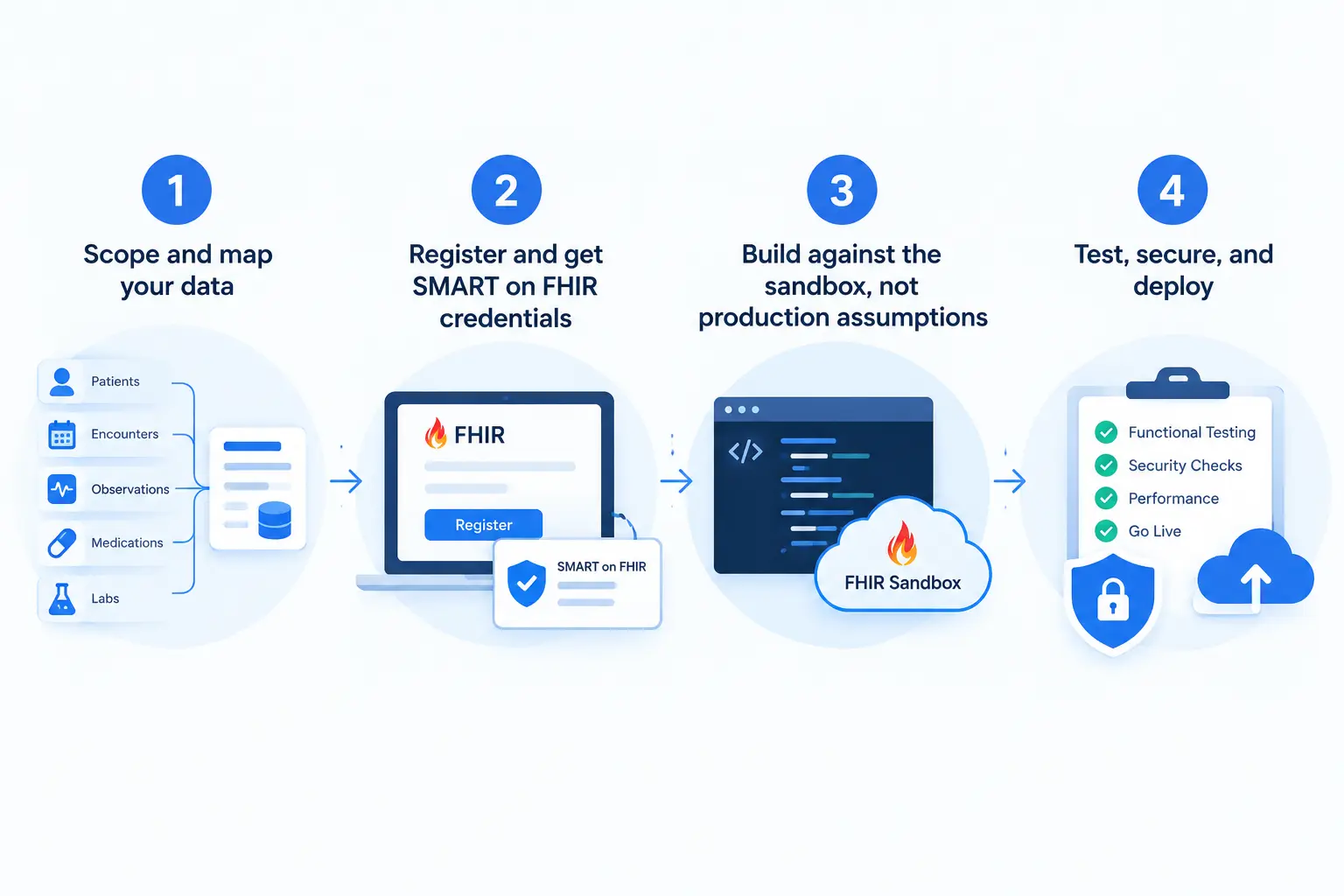
1. Scope and map your data
List every data element the integration must read or write and map each one to a FHIR resource and US Core profile. Document where your source system's data model diverges from the profile, since these gaps become either transformation logic or a documented limitation.
2. Register and get SMART on FHIR credentials
Collect a client ID, allowed scopes, and redirect URIs from the vendor's developer portal, such as Open@Epic or Oracle Health's Code Console. Request narrow scopes; broad scope requests slow down vendor security review. Approval timelines vary by vendor and can take several weeks for production credentials, so build this into the project timeline rather than treating it as a buffer.
3. Build against the sandbox, not production assumptions
Implement resource clients with typed models rather than raw JSON parsing. Handle paging on every search query using Bundle.link relations. Implement exponential backoff for 429 and 503 responses. Validate every resource against its US Core profile before sending it, and treat sandbox behavior as a hypothesis rather than a guarantee, since scope handling and rate limits frequently differ in production.
4. Test, secure, and deploy
Run end-to-end flows with real SMART on FHIR authentication, including token refresh and PKCE validation. Segregate environments strictly: dev, sandbox, staging, production, and never test with production credentials in a lower environment. Production security review typically expects HTTPS-only transport, secure secrets management, audit logging, and in some cases a penetration test report.
SMART on FHIR: Authentication and Security Explained
SMART on FHIR layers OAuth 2.0 with healthcare-specific scopes, so an application can request narrow access, such as medication history only, instead of the full record. For patient-facing native apps and single-page applications, the required pattern is the Authorization Code flow with PKCE. Confidential, server-side clients use the standard Authorization Code flow with a client secret.
Treat the token lifecycle as an operational priority, not an afterthought. Implement refresh token rotation, store tokens securely and never in localStorage for anything PHI-adjacent, and design a graceful session expiry experience, especially for patient-facing flows where an abrupt logout damages trust.
HIPAA, ONC, and CMS Compliance Requirements
HIPAA applies to any protected health information (PHI) transmitted or stored through your integration. At minimum, that means TLS 1.2 or higher for data in transit, encryption at rest for any PHI you persist, and audit logs capturing who accessed what resource, when, and from which client, retained according to your organization's HIPAA policy.
On the regulatory side, ONC's information-blocking rules require certified EHR vendors to expose standardized APIs for patient data access, and the CMS Interoperability and Prior Authorization Final Rule sets operational deadlines for payers, with FHIR API implementation requirements phasing in through 2026 and 2027. These are not optional technical checkpoints. Non-compliance is a legal exposure, not just a bug to fix later, and the requirements shape your architecture from day one rather than something you retrofit before launch.
Where state law or organizational policy requires patient consent handling, model it as a FHIR Consent resource and link it to the relevant access decisions in your audit trail. Scope minimization is also a compliance signal auditors look for: request only what the use case needs, document why, and revisit the list at every production review.
Which FHIR Integration Pattern Fits Your Use Case?
Pattern | Best For | Auth Model |
SMART patient-facing app | Patient portals, consumer health apps | Authorization Code + PKCE |
Backend server-to-server | Analytics, care management platforms | Client credentials / system scopes |
CDS Hooks | Clinical decision support at point of care | Service-level trust + JWT |
Subscriptions / webhooks | Near-real-time event notifications | Server-managed |
Bulk FHIR ($export) | Population analytics, prior-auth workflows | Backend auth, async job |
CDS Hooks integrates directly into the clinician's workflow. The EHR calls your service at defined hook points, such as patient-view or order-sign, and expects a response with actionable cards inside a tight latency window, generally under one second. Subscriptions work well for near-real-time notifications like a new lab result, but delivery reliability depends on the server's retry semantics, so design your subscriber to handle duplicate deliveries idempotently. Bulk FHIR is asynchronous and built for population-level exports; it is not a substitute for a synchronous patient-facing query, and job completion can range from minutes to hours depending on population size.
Build vs Managed FHIR Server vs Integration Engine: Comparing Your Options
This is the decision teams get wrong most often, and it happens before any code gets written. Choosing the right FHIR integration solution starts with an honest read of your team's compliance capacity, not a vendor pitch deck. There are three real paths, not two.
Approach | What It Means | Best Fit |
Build in-house | Stand up and maintain your own FHIR server and compliance stack | Teams with dedicated compliance, security, and SRE functions already in place |
Managed cloud FHIR service | Google Cloud Healthcare API, Azure Health Data Services, or AWS HealthLake handle storage, scale, and evolving regulatory baseline | Most product teams that want control without owning compliance overhead |
Integration engine / aggregator | Platforms like Redox, Health Gorilla, 1upHealth, or Particle Health provide pre-built multi-EHR connectivity | Teams needing fast, multi-vendor connectivity without building each EHR connector individually |
Building a FHIR server from scratch feels like control, but it hands your team a permanent compliance maintenance burden. Every new ONC rule, every FHIR version increment, every security patch becomes your problem to track and patch. For most teams without a dedicated compliance engineering function, a managed service is the right default, not a shortcut. An integration engine adds another layer of leverage on top of that when the project needs to connect to several EHR vendors at once instead of just one, since it trades a monthly platform fee for months of connector-building time.
Using Budibase for Internal FHIR and HL7 REST API Tooling
Not every FHIR integration needs a full patient-facing app. Many healthcare teams pair a managed FHIR back-end with a low-code front-end like Budibase to give internal staff, care coordinators, or operations teams a working interface fast, without custom-building UI for every internal workflow. This is a Budibase healthcare integration pattern: connect Budibase to your FHIR REST API endpoint the same way you would connect any other REST data source, authenticate using your SMART on FHIR client credentials, pull Patient, Observation, or Encounter resources into a Budibase data source, and build read or write screens for internal use cases like eligibility checks, care coordination queues, or exception handling.
The same pattern extends to HL7 data feeding through a translation layer, since Budibase does not speak HL7 v2 directly. It only needs a REST or database interface exposed by your integration layer, which means your FHIR mapping layer effectively becomes the bridge between HL7 REST API traffic and the low-code front-end. This shortens the distance between a working FHIR API integration and a usable internal tool considerably, but it does not lower the compliance bar. Any Budibase-built internal tool touching PHI still needs the same TLS, role-based access control, and audit logging discipline as a patient-facing application.
How Much Does FHIR API Integration Cost?
Cost depends heavily on scope, but three rough bands hold across most US healthcare projects.
Project Scope | Typical Range | What Drives the Cost |
Single-EHR, read-only integration | $15,000 to $40,000 | One vendor, limited resource set, sandbox-to-production for one connector |
Multi-EHR or read/write integration | $50,000 to $150,000 | Multiple vendor onboarding cycles, write-back review, mapping layer complexity |
Enterprise-scale, Bulk FHIR, or CDS Hooks program | $150,000+ | Population-level exports, real-time clinical workflow integration, ongoing SRE and compliance monitoring |
These ranges assume a US-based delivery team working with SMART on FHIR and US Core alignment from the start. The single largest cost variable most teams underestimate is not development time, it is vendor onboarding: Epic's Open@Epic program alone can take several weeks from application to production credentials, and that clock runs in parallel with, not instead of, your engineering timeline.
A Sample FHIR API Request
Here is what a basic authenticated Patient read looks like in practice, which is often the first call a new integration makes against a sandbox.
GET [base]/Patient/12345
Authorization: Bearer <access_token>
Accept: application/fhir+json

Response (200 OK):
{
  "resourceType": "Patient",
  "id": "12345",
  "name": [{ "family": "Doe", "given": ["Jane"] }],
  "birthDate": "1988-04-12",
  "gender": "female"
}
A search query for a patient's lab results follows the same pattern but returns a Bundle of type searchset, paginated through Bundle.link relations rather than a single flat array. Always follow the next link until it is absent. Never assume the first page contains the full result set; this is one of the most common causes of silently incomplete data in production FHIR integrations.
Common Mistakes That Turn a FHIR Project Into a Compliance Risk
Treating sandbox success as a production guarantee. Scope handling, rate limits, and undocumented extensions routinely differ once real credentials are involved.
Skipping the mapping layer. A canonical model that normalizes vendor-specific extensions protects every downstream consumer from EHR-specific quirks, and it is the step most teams cut to ship faster.
Under-scoping the vendor onboarding timeline. Security review and production credentialing run on the vendor's clock, not yours.
Retrying validation failures instead of fixing the data. A 422 with an OperationOutcome means the resource is malformed; only retry transient errors like network timeouts or 503s.
Building a custom FHIR server without a compliance function to support it. Every regulatory update becomes an unplanned engineering task.
How Enorness Approaches FHIR API Integration
Enorness builds HIPAA-aligned, SMART on FHIR-authenticated integrations through our Enterprise Software Engineering practice, paired with our Data Engineering and Analytics team for Bulk FHIR pipelines and downstream reporting. We map every project to US Core profiles from day one instead of retrofitting compliance after the build, and we default to managed infrastructure over a custom-built FHIR server unless a team already has a dedicated compliance and SRE function in place.
Our CareConnect case study walks through how we approached structured health data exchange for a care coordination platform, including the resource mapping decisions and the production onboarding timeline the client actually experienced, not just the best-case scenario vendors quote upfront.
Ready to Scope Your FHIR Integration?
Vendor on-boarding timelines, US Core alignment, and HIPAA-grade audit logging are easier to get right with a team that has done it before. Book a Strategy Call with Enorness and we will map your target EHR vendors, required resources, and compliance deadlines into an actual implementation timeline before you commit budget.
Frequently Asked Questions
What is the difference between FHIR and HL7 v2?
HL7 v2 uses proprietary, pipe-delimited messages sent point-to-point between systems. FHIR uses structured, standards-based REST resources that any authorized application can query over HTTP, which is why FHIR is the standard for modern EHR and patient-access APIs while HL7 v2 remains common for internal hospital messaging.
Do I need to support every FHIR resource type?
No. Query the server's CapabilityStatement at [base]/metadata to see exactly which resources and interactions it supports, then scope your integration to the resources your use case actually needs. Supporting unused resources adds mapping and testing overhead with no benefit.
How long does Epic or Oracle Health production approval take?
Timelines vary by vendor and use case, but production credentialing for programs like Open@Epic commonly takes several weeks from application submission through security review and end-to-end testing. Build this into your project plan as a parallel track, not a buffer at the end.
Should we build our own FHIR server or use a managed service?
For most teams without a dedicated compliance, security, and SRE function already in place, a managed service like Google Cloud Healthcare API or Azure Health Data Services is the safer default. Building in-house makes sense mainly when you already carry that operational overhead for other systems.
What is Bulk FHIR and when should we use it?
Bulk FHIR, accessed through the $export operation, handles population-level data exports asynchronously and is built for analytics pipelines, quality measure reporting, and prior-authorization workflows. It is not designed for synchronous, single-patient queries in a live user-facing flow.
Is a FHIR API integration itself HIPAA compliant by default?
No. FHIR defines the data exchange format and API structure, not your compliance posture. HIPAA compliance depends on how you handle the PHI flowing through that integration: encryption in transit and at rest, audit logging, access controls, and a documented breach response process all have to be built and maintained separately.


Let's Build Something Extraordinary
Turn ideas into intelligent products that drive real business results.