Optimizing AI Integration Costs for Financial IT Departments

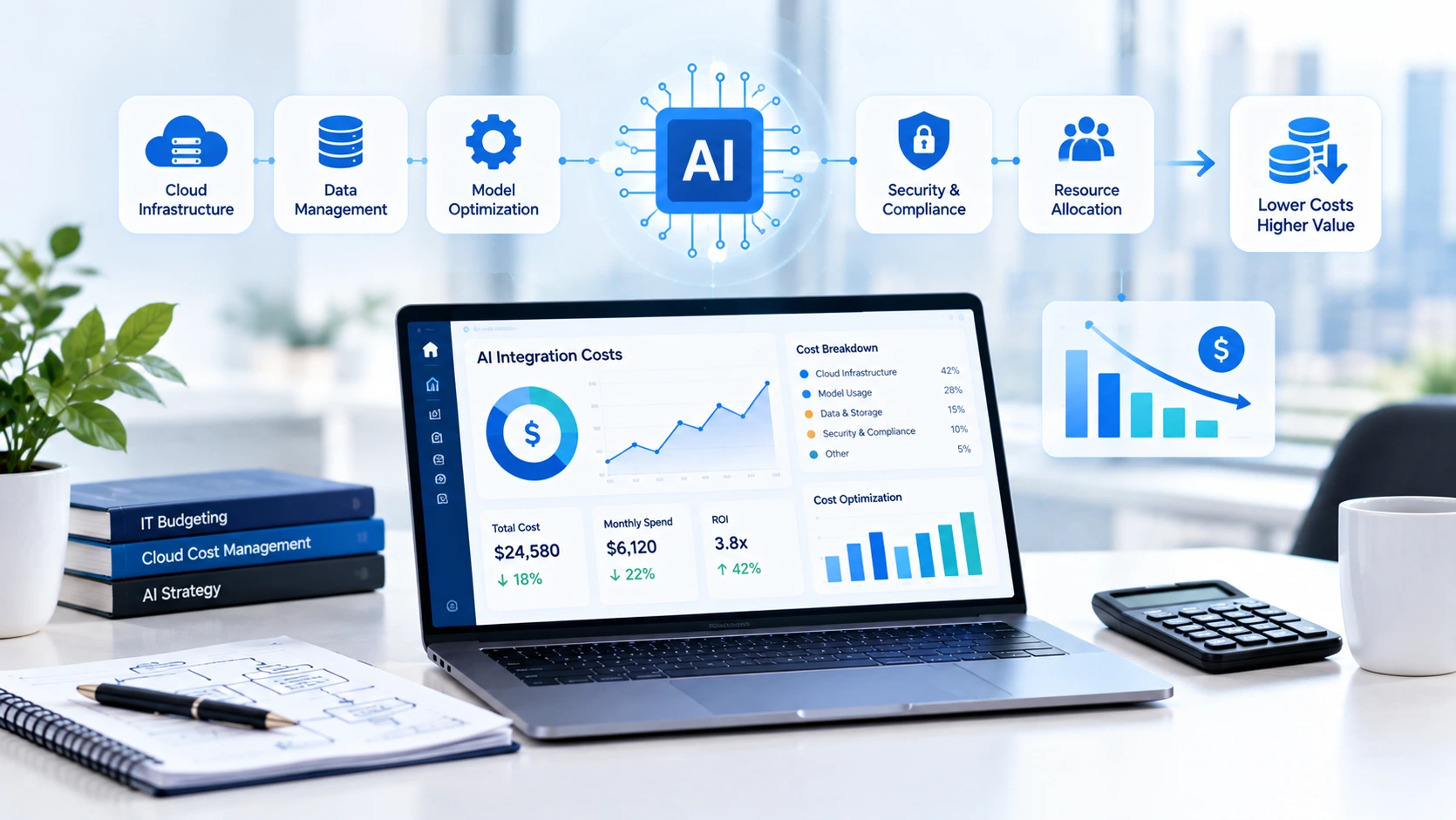
The pilot cost $4,000 a month. Six months later, the same AI assistant, now rolled out to three departments, is running $38,000, and the CFO wants to know why nobody saw it coming.
Quick Answer: Financial IT teams cut AI integration costs by measuring cost per business outcome, routing each task to the cheapest model that passes quality checks, using prompt caching and batch processing, trimming tokens, building one reusable integration layer to core systems, matching the pricing model to workload volume, scaling compliance effort to risk, and making every dollar visible through FinOps for AI.
The pilot cost $4,000 a month. Six months later, the same AI assistant, now rolled out to three departments, is running $38,000, and the CFO wants to know why nobody saw it coming. Sound familiar? It's one of the most common conversations happening in bank and credit union IT right now.
The problem is rarely the model's price tag. It's everything around it: oversized prompts, flagship models doing simple work, one-off integrations for every use case, and compliance processes built for a different era. The good news is that most of these costs are controllable. This guide breaks down where AI integration costs actually come from in financial services and gives you specific levers, with real math, to bring them down without weakening security or oversight.
Why AI Integration Costs Run Higher in Financial Services
The cost of AI implementation in banking starts higher than almost anywhere else. Financial institutions pay a premium for AI that retailers and software firms don't. Industry analyses estimate AI deployments in financial services cost 20 to 40% more than in less regulated sectors, and a Capgemini benchmark put the average European bank at about EUR 2.3 million per production AI use case. Four forces drive that premium:
Legacy core systems. Core banking platforms from FIS, Fiserv, Jack Henry, and Temenos weren't built for real-time AI calls. Integration work often costs more than the AI itself.
Regulation. Model risk management expectations like the Fed's SR 11-7 guidance, plus GLBA, PCI DSS, SOC 2, and state rules such as NYDFS Part 500, add validation, documentation, and audit work.
Recordkeeping. AI-generated customer communications can fall under SEC and FINRA retention rules, which means storing prompts and outputs for years.
Talent. Engineers who understand both LLMs and banking compliance are scarce and expensive.
None of these go away. But each can be managed far more efficiently than most teams manage them today.
Where the Money Actually Goes: The Real AI TCO
Before optimizing anything, map the full total cost of ownership. Token bills are the line item everyone watches, yet they're often a minority of spend.
Cost bucket | What's in it | Often missed? |
Model usage | Tokens, API calls, provisioned capacity | No |
Integration | APIs, middleware, core banking connectors | Sometimes |
Data preparation | Cleaning, tagging, retrieval pipelines, vector databases | Yes |
Compliance and validation | Model validation, bias testing, documentation | Yes |
Security | PII redaction, access control, vendor reviews | Sometimes |
Observability and storage | Logs, evaluation runs, retention archives | Yes |
People | Engineering, MLOps, human review of outputs | Yes |
Once these buckets are on one sheet, the priorities usually become obvious. A team fixated on model prices might find that human review of low-confidence outputs costs three times their API bill.
Start with Unit Economics, Not the Monthly Invoice
A monthly AI invoice tells you almost nothing. Rising spend could mean waste, or it could mean the tool is doing twice as much useful work. The metric that matters is cost per business outcome:
Cost per resolved customer inquiry
Cost per KYC or loan file reviewed
Cost per fraud alert triaged
Cost per reconciled exception
Compare each against the current manual cost. If a human analyst spends 12 minutes on a KYC file at a loaded cost of $60 an hour, that's $12 per file. An AI-assisted review at $1.40 per file, plus two minutes of human sign-off, still wins comfortably, even if the monthly AI bill looks large. Tracking unit costs also exposes the use cases that will never pay off, so you can stop funding them early.
Lever 1: Route Each Task to the Cheapest Model That Passes
The fastest way to overspend is sending every request to a flagship model. Price gaps between tiers are wide. On Anthropic's published rates, for example, Claude Opus costs $5 per million input tokens and $25 per million output tokens, while Claude Haiku costs $1 and $5. That's a 5x difference for work that often doesn't need the bigger model.
Model routing fixes this. Classify requests by complexity, send simple tasks like extraction, categorization, and summarization to small models, and escalate only ambiguous or high-stakes cases to the flagship. An LLM gateway such as LiteLLM, Kong AI Gateway, or a cloud option in Amazon Bedrock handles routing, retries, and fallbacks in one place.
The key rule: routing decisions must be backed by evaluation data. Build a test set of real cases for each use case and confirm the smaller model meets your accuracy threshold before switching.
Lever 2: Prompt Caching and Batch Processing
These two features are the closest thing to free money in LLM cost optimization, and many financial IT teams still don't use them.
Prompt caching. Most banking prompts repeat the same large block every time: policy text, compliance instructions, product rules, few-shot examples. With caching, that repeated content is stored and billed at a fraction of the normal rate. Both Anthropic and OpenAI now bill cached input reads at roughly 10% of the standard input price on current models. Put stable content at the start of the prompt and variable content at the end to maximize cache hits.
Batch processing. Plenty of financial workloads don't need an answer in two seconds: overnight transaction categorization, month-end report drafting, bulk document classification, and backlog reviews. Batch APIs from the major providers charge 50% of standard rates in exchange for results within 24 hours. On Anthropic, caching and batch discounts stack, which can push effective input costs down by about 95% from list price.
Lever 3: Trim the Tokens You Send and Receive
Token volume is a design choice. A few habits make a large difference:
Retrieve, don't stuff. Instead of pasting a 60-page policy manual into every prompt, retrieve only the relevant sections. A well-built enterprise knowledge base typically cuts prompt size dramatically while improving accuracy.
Cap output length. Output tokens usually cost four to five times more than input. Ask for structured JSON or short answers where possible.
Compress conversation history. Summarize older turns in long chats instead of resending the full thread.
Remove boilerplate. Audit prompts quarterly. Instructions added during testing often linger long after they stop helping.
What These Levers Look Like Together
Here's an illustrative example for a mid-size bank running AI document review: 200,000 requests a month, each with 4,000 tokens of shared policy instructions, 2,000 tokens of document text, and 500 tokens of output.
Scenario | Estimated monthly cost | Savings vs baseline |
Baseline: flagship model for everything ($5/$25) | $8,500 | Baseline |
Route 70% of requests to a small model ($1/$5) | $3,740 | 56% |
Add prompt caching on shared instructions | $2,156 | 75% |
Move 60% of volume to batch processing | About $1,510 | 82% |
The math excludes cache write premiums and assumes the smaller model passes your evaluation set. Still, the pattern holds across most banking workloads: architecture choices move costs far more than vendor negotiations.
Lever 4: Build One Reusable Integration Layer
The most expensive pattern in AI integration in financial services is treating every AI use case as a separate project, with its own connector to the core system, its own security review, and its own logging. The fifth use case costs as much as the first.
The fix is a shared integration layer: an API gateway or middleware platform such as MuleSoft sitting between your core banking systems and AI services, plus a central LLM gateway for model access, logging, and cost tracking. Build it once, secure it once, validate it once, then reuse it. Getting this right is really a web application architecture decision, and it pays off with every new use case. Legacy cores don't need replacing to support AI. They need a well-governed layer in front of them.
Lever 5: Match the Pricing Model to Your Workload
Pricing model | Best for | Watch out for |
On-demand API | Pilots, variable traffic | No spend cap by default |
Provisioned throughput (Azure OpenAI PTUs, Bedrock) | Steady, high-volume, latency-sensitive work | Paying for idle capacity |
Self-hosted open-weight models (Llama, Mistral) | Very high volume, strict data residency | GPU, MLOps, and staffing costs |
Committed-use cloud agreements | Predictable annual AI spend | Lock-in if usage shifts |
Most institutions do best with a mix: on-demand for new use cases, provisioned capacity once a workload proves steady, and self-hosting only where volume or data rules clearly justify running NVIDIA GPUs, vLLM, and Kubernetes in-house. Revisit the mix every quarter, because model prices have fallen repeatedly and yesterday's break-even point may no longer hold.
Lever 6: Scale Compliance Effort to Risk
Compliance is non-negotiable, but applying the same heavy validation to every use case wastes money. Tier your AI inventory:
Low risk: internal summarization and drafting with human review. Lightweight documentation and periodic sampling.
Medium risk: customer-facing answers and operational decisions. Formal testing, monitoring, and escalation rules.
High risk: credit decisions, fraud actions, and regulatory filings. Full model validation, bias testing, and mandatory human sign-off.
Two more savings hide here. Redact PII before data reaches any model, which shrinks the scope of vendor security reviews. And standardize validation templates and evidence collection in your shared integration layer, so each new use case inherits most of its compliance documentation.
FinOps for AI: Make Every Dollar Visible
You can't optimize costs nobody owns. The FinOps Foundation has extended its practices to AI spend, and the core ideas apply directly:
Tag every request by department, use case, and environment at the gateway.
Show costs back to business owners monthly, then move to chargeback once numbers are trusted.
Set budgets and alerts per use case, with automatic throttling if spend spikes unexpectedly.
Review unit economics in a monthly meeting between IT, finance, and business owners.
Visibility alone changes behavior. Teams that see their own AI bill start asking for smaller models and shorter prompts without being told.
Negotiate Smarter AI Vendor Contracts
Once spend is predictable, use it. Ask for volume or committed-use discounts, price protection for 12 to 24 months, clear terms that your data won't be used for training, regional data residency commitments, and exit provisions that let you export prompts, logs, and fine-tuned assets. Keeping your application code behind a model-agnostic gateway is your strongest negotiating position, because switching providers becomes a realistic option instead of an empty threat.
Common AI Cost Traps to Avoid
Pilots with no exit criteria. Set a target cost per outcome before launch, and stop pilots that miss it after 90 days.
Agent loops without limits. Autonomous agents can call models dozens of times per task. Cap steps, tokens, and spend per run.
Retries hiding bad prompts. High retry rates quietly double costs. Track them at the gateway and fix the root cause.
Testing in production. Evaluation runs against live, full-price endpoints add up. Use batch pricing for large test suites.
Forgotten environments. Dev and staging keys left running with real traffic are a surprisingly common leak.
How to Measure AI ROI in Financial Services
Use a simple formula: (annual savings + added revenue - total AI costs) / total AI costs. Count savings only when they're real, such as reduced overtime, avoided hires, fewer outsourced reviews, or lower fraud losses. McKinsey projects 15 to 20% net cost reductions for banks from AI adoption, but net is the key word. Rising infrastructure and compliance costs eat into gross savings, which is why the levers above matter.
Your 90-Day AI Cost Optimization Plan
Days 1 to 30: inventory every AI use case, tag spend at the gateway, and calculate cost per outcome for each one.
Days 31 to 60: build evaluation sets, test smaller models, turn on prompt caching, and move eligible workloads to batch.
Days 61 to 90: consolidate integrations into a shared layer, tier compliance by risk, and renegotiate vendor terms with real usage data.
Frequently Asked Questions
Q1: How much does AI integration cost for a bank or credit union?
A: It varies widely by scope. A focused pilot on one workflow can run in the tens of thousands of dollars, while enterprise programs cost far more. Integration, data preparation, and compliance usually outweigh model fees.
Q2: What is the fastest way to reduce AI costs in financial services?
A: Model routing and prompt caching usually deliver the quickest savings. Sending simple tasks to smaller models and caching repeated policy instructions can cut token spend by more than half within weeks.
Q3: Is self-hosting open-source models cheaper than using an API?
A: Only at very high, steady volumes or when data residency rules require it. GPU, MLOps, security, and staffing costs often make managed APIs cheaper for most mid-size institutions.
Q4: What is FinOps for AI?
A: It's the practice of tracking, allocating, and optimizing AI spend the same way FinOps manages cloud costs, using tagging, showback, budgets, and shared accountability between IT, finance, and business teams.
Q5: How do compliance requirements affect AI costs?
A: They add validation, documentation, logging, and retention work. Tiering use cases by risk and reusing a shared, pre-validated integration layer keeps those costs proportional.
Q6: How do you calculate AI ROI in banking?
A: Divide annual savings plus added revenue, minus total AI costs, by total AI costs. Track cost per outcome, such as cost per file reviewed, against the manual baseline.
Cut AI Costs Without Cutting Corners with Enorness
Enorness helps US financial IT teams design and deliver AI integration services that stay affordable at scale. We build model routing, caching, and gateway layers, connect AI safely to legacy core systems, and set up cost dashboards that finance teams actually trust. Whether you need end-to-end custom software development, practical AI automation for back-office workflows, or a dedicated development team to extend your engineers, our focus stays on measurable software development for business growth. Book a free AI cost review and we'll show you where your spend is leaking.

Written by
Mark Louis

Let's Build Something Extraordinary
Turn ideas into intelligent products that drive real business results.